Choosing a dental instruments supplier is one of the longest-lasting purchasing decisions a practice, school or distributor makes. A good extraction forceps or curette can stay in service for years, which means the supplier you pick today shapes the quality of your trays, your reprocessing workload and your costs for a long time. Yet most “best supplier” articles online are short lists written by the suppliers themselves, with little practical guidance. This guide is different: it explains how to judge any supplier against objective criteria, which standards and regulations matter in 2026, and how to turn all of that into a confident decision.
If you want a shortlist of established names first, see our top 10 dental instrument suppliers in the USA. Then come back here to evaluate them properly.
Key takeaways
- Judge suppliers on quality evidence, consistency, range, total cost, lead time and service — not unit price alone.
- In the US, dental hand instruments are FDA Class I devices; ask suppliers about registration, listing and quality systems.
- Always test samples through your own reprocessing before a large order.
- A weighted scorecard turns opinions into a defensible decision.
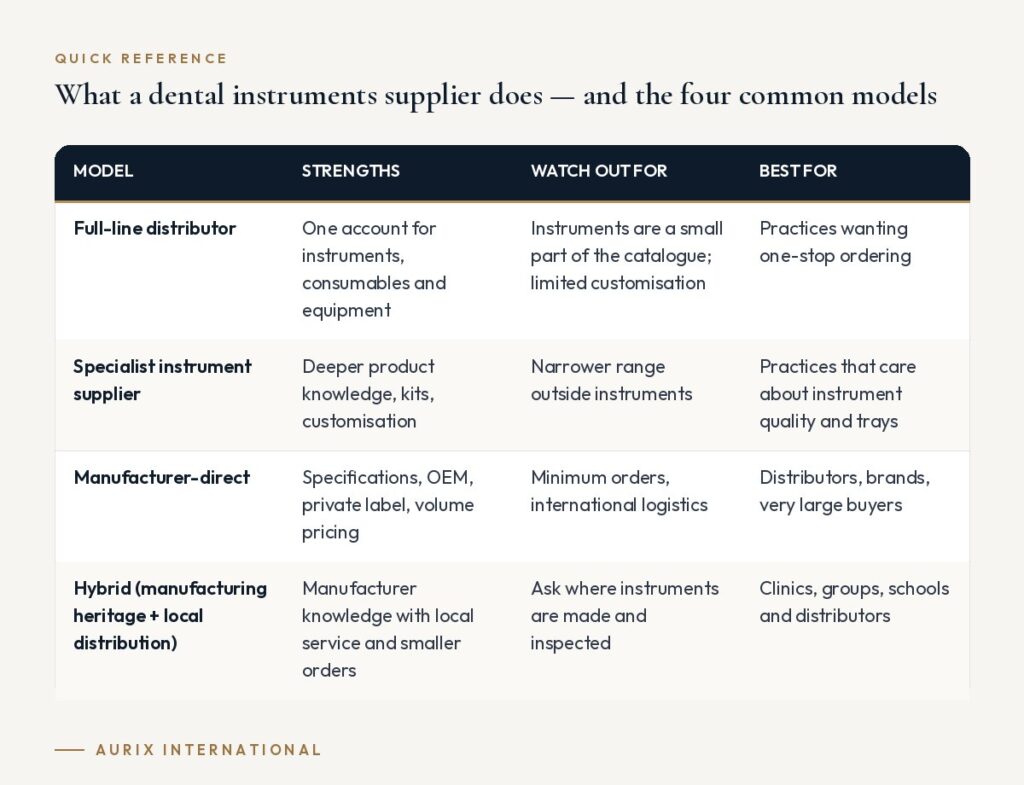
What a dental instruments supplier does — and the four common models
“Supplier” simply means the business you buy from. Behind that word sit very different business models, and each one suits different buyers:
| Model | Strengths | Watch out for | Best for |
|---|---|---|---|
| Full-line distributor | One account for instruments, consumables and equipment | Instruments are a small part of the catalogue; limited customisation | Practices wanting one-stop ordering |
| Specialist instrument supplier | Deeper product knowledge, kits, customisation | Narrower range outside instruments | Practices that care about instrument quality and trays |
| Manufacturer-direct | Specifications, OEM, private label, volume pricing | Minimum orders, international logistics | Distributors, brands, very large buyers |
| Hybrid (manufacturing heritage + local distribution) | Manufacturer knowledge with local service and smaller orders | Ask where instruments are made and inspected | Clinics, groups, schools and distributors |
For a deeper comparison read supplier vs manufacturer vs distributor.
The quality questions that actually matter
Material: the right stainless steel for each instrument
Dental hand instruments usually use martensitic stainless steels that can be hardened while resisting corrosion. The international standard ISO 7153-1:2016 specifies metals commonly used for surgical instruments, including those used in dentistry. A good supplier can tell you which grade helps with which instrument — typically tougher grades for forceps and retractors and harder grades for curettes, scalers and other cutting instruments. Our guide to 410, 420 and 440A stainless steel explains the trade-offs.
Heat treatment and passivation
The same steel can make an excellent or a poor instrument depending on how it is hardened, tempered and finished. Passivation — a chemical treatment that removes free iron and strengthens the protective chromium oxide layer — is particularly important for corrosion resistance. ASTM A967 is a widely referenced standard describing nitric acid, citric acid and electrochemical passivation methods for stainless steel parts. Ask whether instruments are passivated after finishing.
Inspection
Ask how instruments are checked before they ship: joint movement and tip alignment on hinged instruments, sharpness on cutting instruments, finish under magnification. Suppliers who inspect every instrument rather than sampling a batch generally deliver more consistent results.
Consistency over time
One excellent sample means little if the next order differs. Ask how patterns and finishes are kept consistent between batches and whether the supplier can match the same pattern when you reorder in two years’ time.
Regulations and documentation in 2026 (US focus)
Regulation is where many supplier articles stay vague. Here are the essentials for the US market (this is general information, not legal advice):
- Device class: under 21 CFR 872.4565, dental hand instruments are Class I devices. Many product codes — for example periodontic probes and operative explorers — are listed as 510(k) exempt, subject to the limitations in 21 CFR 872.9.
- Registration and listing: establishments involved in producing and importing devices for the US market generally must register with the FDA and list their devices. Foreign establishments must register before exporting to the US and designate a US agent; initial importers must also register.
- Quality systems: the FDA’s Quality Management System Regulation (QMSR) took effect on February 2, 2026, incorporating ISO 13485:2016 by reference into 21 CFR Part 820. ISO 13485 certification is not mandatory under the QMSR, but alignment with it is now the baseline expectation for manufacturers.
Practically, ask your supplier which registrations apply to their products and how you can verify them in the FDA’s public databases. Read more in supplier documentation and compliance.
Range, kits and customisation
A supplier that covers extraction, surgical, periodontal, restorative, endodontic and orthodontic instruments lets you standardise patterns across your practice. Increasingly, the most useful suppliers also offer:
- Pre-assembled procedure kits in sterilisation cassettes.
- Custom kits built to your preferred patterns, ideally through an online kit builder.
- OEM, private label and laser marking for distributors, groups and schools.
Pricing: think in cost per use
Unit price is the most visible number and the least useful on its own. A better measure is cost per use:
Cost per use = (purchase price + sharpening and repair costs) ÷ number of uses + reprocessing cost per cycle.
Example: a curette costing $28 that lasts 600 uses costs about 4.7 cents per use before reprocessing; a $16 curette that lasts 250 uses costs 6.4 cents — and needs replacing more than twice as often. Add the hidden costs of the cheaper instrument (more strokes per appointment, more sharpening, more reorders) and the gap widens. See what affects supplier pricing.
Lead times, stock and service
Ask separately about in-stock items, pre-assembled kits, custom kits and branded products, and get dates in writing for anything time-critical such as a new practice opening or the start of an academic year. Service matters just as much: how quickly does the supplier answer a technical question, resolve a damaged delivery or correct an invoice? Pre-sales responsiveness is the best predictor you have.
A weighted scorecard you can use today
| Criterion | Weight | Score 1–5 | What a 5 looks like |
|---|---|---|---|
| Quality evidence | 25% | Specific grades, passivation, inspection, samples pass your tests | |
| Consistency | 15% | Repeat orders match samples; pattern matching guaranteed | |
| Range and kits | 15% | Covers all procedures; pre-assembled and custom kits | |
| Total cost | 20% | Transparent pricing, fair terms, low cost per use | |
| Compliance and documents | 10% | Clear answers on registration, IFUs and traceability | |
| Lead time and stock | 7.5% | Core items in stock; realistic custom timelines | |
| Service | 7.5% | Named contact, fast and specific replies |
Multiply each score by its weight and add them up. Adjust weights to your situation: schools may weight consistency and lead time higher; distributors may weight OEM capability and documentation.
A 30-day supplier selection plan
- Days 1–7: list procedures, current instruments, annual volumes and must-have requirements.
- Days 8–14: shortlist three suppliers and send the same request for quote — see our quote comparison method and RFQ template.
- Days 15–21: normalise quotes and order samples from the top two.
- Days 22–30: test samples through normal use and reprocessing using our sample testing protocol, score, decide and place a first order.
Red flags
- Only vague claims (“premium”, “surgical grade”, “German steel”) with no specifics.
- No physical address, phone number or named team.
- Prices far below the market with no explanation.
- No samples, no warranty and unclear returns.
More in 12 red flags when choosing a supplier.
How buying needs differ by type of customer
The “best” dental instruments supplier depends on who is buying. A solo practitioner replacing a handful of instruments has very different priorities from a dental school ordering 120 identical kits or a distributor launching a branded range.
- Single practices usually value convenience, small order sizes, quick delivery and help choosing patterns.
- Multi-site groups and DSOs care most about standardisation, consolidated invoicing and volume pricing. See supplier guidance for DSOs.
- Dental schools need identical kits, firm delivery dates and a replacement process. See supplier guidance for schools.
- Specialists — oral surgeons, periodontists, orthodontists — need depth in their specialty and pattern consistency.
- Distributors need wholesale terms, OEM and private label, and documentation.
The real cost of a poor supplier choice
A low quote can hide costs that only appear months later. Instruments that stain after a few autoclave cycles need replacing sooner. Dull curettes add minutes to every hygiene appointment. Misaligned forceps slip and make extractions harder. Late deliveries leave rooms without complete kits. None of these costs appear on the invoice, but together they often outweigh any saving on unit price.
That is why experienced buyers think in terms of cost per use: what an instrument costs each time it is used, including purchase price, reprocessing, maintenance and replacement. Our article on total cost of ownership shows how to calculate it.
Frequently asked questions
Should I use one dental instruments supplier or several?
Most practices do best with one main instrument supplier for consistency and pricing, plus a back-up for emergencies. Distributors often combine one manufacturing partner for private label with others for specialist lines.
Do dental hand instruments need FDA clearance?
Many dental hand instruments are Class I and 510(k) exempt under 21 CFR 872.4565, subject to limitations. Registration, listing and quality system requirements still apply to the businesses involved. Confirm the status of specific products with your supplier.
Is ISO 13485 certification required?
Not under the FDA’s QMSR, which incorporates ISO 13485:2016 by reference. Certification is still a useful signal of a mature quality system at the manufacturer.
How often should I review my supplier?
Annually: compare quality, delivery performance, defect rates and pricing, and ask about new kits and services.
Next steps
Aurix International is a USA-based supplier and distributor of surgical and dental instruments, built on four generations of manufacturing heritage. We supply clinics, schools and distributors with individual instruments, pre-assembled kits, custom kits and OEM and private label programmes. Request samples or a quote, or read why customers choose Aurix.