
Most dental hand instruments are made from martensitic stainless steels — alloys that can be hardened by heat treatment while still resisting corrosion. Three grades are commonly mentioned: 410, 420 and 440A. Also, each balances hardness, toughness and corrosion resistance differently.
Why martensitic steel?
Generally, instruments need to hold an edge or keep their shape under load, which requires hardness. In addition, martensitic stainless steels contain enough carbon to be hardened, plus chromium for corrosion resistance.
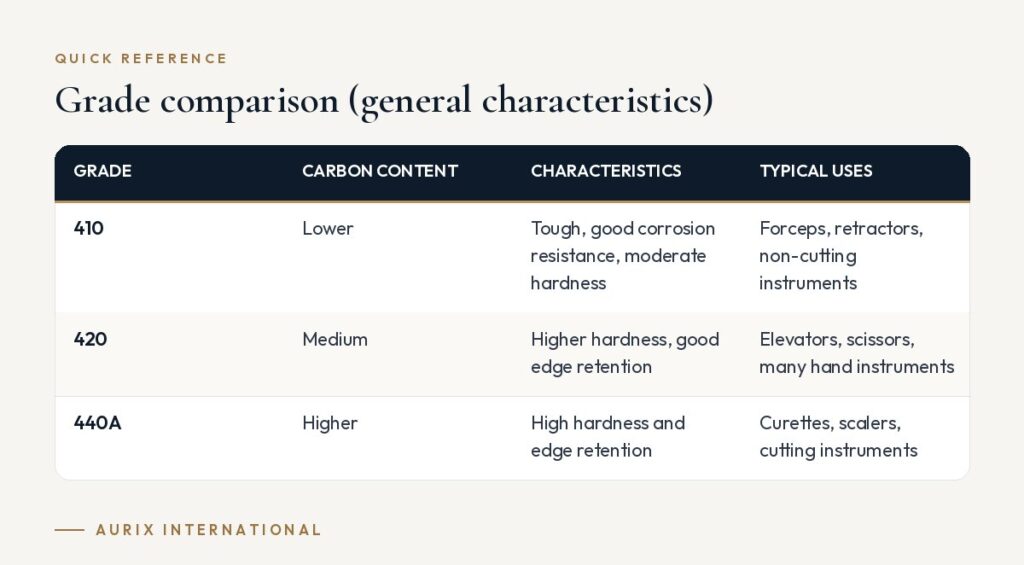
Grade comparison (general characteristics)
| Grade | Carbon content | Characteristics | Typical uses |
|---|---|---|---|
| 410 | Lower | Generally, tough, good corrosion resistance, moderate hardness | In general, forceps, retractors, non-cutting instruments |
| 420 | Medium | Higher hardness, good edge retention | Elevators, scissors, many hand instruments |
| 440A | Higher | High hardness and edge retention | Curettes, scalers, cutting instruments |
These are general characteristics; exact properties depend on composition and heat treatment.
Heat treatment matters as much as grade
In general, the same grade can perform very differently depending on how it is hardened and tempered. Correct heat treatment gives the right balance: hard enough to hold an edge, tough enough not to snap.
Passivation
After finishing, instruments are passivated — treated to remove free iron and strengthen the chromium oxide layer that protects the surface from corrosion.
Why different instruments use different grades
A curette needs a sharp, durable edge, so a harder grade is used. A forceps needs toughness to resist cracking at the joint, so a tougher grade may be preferred.
What to ask your supplier
- Which steel grades are used for which instruments?
- Are instruments hardened, tempered and passivated?
- Is there a warranty against manufacturing defects?
Aurix instruments are manufactured from surgical-grade stainless steel. Ask our team for specifications on any instrument.