Comparing quotes from different dental instrument suppliers is harder than it looks. One quote includes cassettes and another does not; one lists exact patterns, another “equivalents”; shipping, warranty and payment terms all differ. Without a method, the lowest headline number wins — and often turns out to be the most expensive. This guide gives you a copy-ready request-for-quote (RFQ) template, a comparison layout and a way to weigh quality and service properly.
Key takeaways
- Send every supplier exactly the same RFQ.
- Normalise quotes line by line, including cassettes, shipping and duties.
- Adjust for quality using samples and cost per use.
- Decide your weights before opening the quotes.
Step 1: Send the same request to every supplier
Use one RFQ so quotes are directly comparable. Here is a template you can copy:
Request for quote — dental instruments
Organisation, delivery address, contact.
Required delivery date: [date].
Items (pattern name, quantity, features — e.g. tungsten carbide inserts, satin finish).
Kits (contents list, quantity, cassette required Y/N).
Please confirm: steel grade per instrument type; passivation; inspection process; country of manufacture; FDA registration/listing status where applicable; reprocessing instructions; lead time per item; shipping cost; payment terms; warranty; price validity; any substitutions.
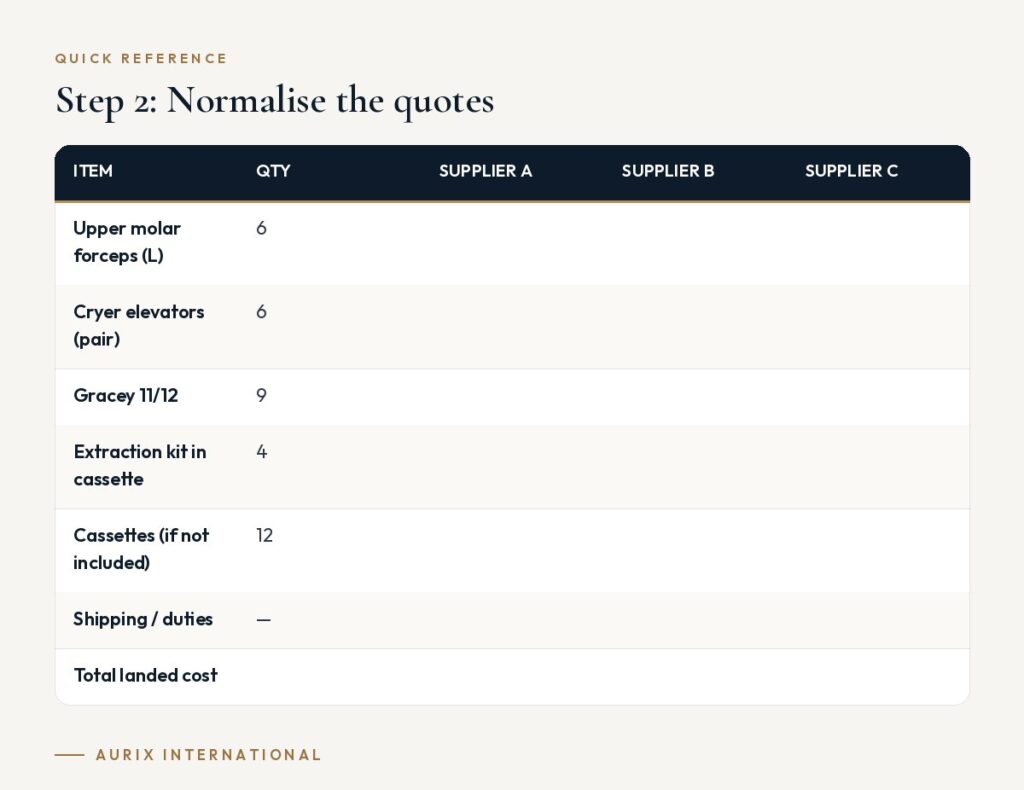
Step 2: Normalise the quotes
Enter every quote into one spreadsheet, one row per item, one column per supplier:
| Item | Qty | Supplier A | Supplier B | Supplier C |
|---|---|---|---|---|
| Upper molar forceps (L) | 6 | |||
| Cryer elevators (pair) | 6 | |||
| Gracey 11/12 | 9 | |||
| Extraction kit in cassette | 4 | |||
| Cassettes (if not included) | 12 | |||
| Shipping / duties | — | |||
| Total landed cost |
Step 3: Read the small print
- Substitutions: “equivalent” patterns may not match your request.
- Exclusions: cassettes, marking, shipping or duties listed separately.
- Validity: when the price expires.
- Payment: deposits or full advance payment.
- Delivery: “from” dates versus firm dates.
- Warranty: what is covered and for how long.
Step 4: Adjust for quality
A cheaper instrument that lasts half as long is not cheaper. Use samples and specifications to estimate lifespan, then compare cost per use. See our sample testing protocol and total cost of ownership.
Step 5: Score the whole offer
| Criterion | Example weight | A | B | C |
|---|---|---|---|---|
| Total landed cost | 30% | |||
| Quality evidence and samples | 30% | |||
| Exact patterns (no substitutions) | 10% | |||
| Lead time and delivery certainty | 10% | |||
| Terms and warranty | 10% | |||
| Service and responsiveness | 10% |
Set weights before opening quotes so the decision reflects your real priorities — schools may weight delivery certainty higher; surgical practices may weight quality higher.
Step 6: Negotiate
Tell your preferred supplier honestly that you have competitive quotes, and ask whether terms can improve for a larger commitment, a kit-based order, advance payment or a flexible delivery date. Avoid sharing competitors’ confidential documents.
Common pitfalls
- Comparing a kit price with loose instruments without adding cassettes.
- Missing substituted patterns.
- Ignoring shipping, duties and brokerage.
- Choosing on price alone.
- Forgetting price validity dates.
Making the final decision
If the top two are close after scoring, use samples, references and the quality of pre-sales communication to decide. If still undecided, place a moderate first order with your preferred supplier as a trial before committing fully.
Frequently asked questions
How many quotes should I get?
Two or three detailed quotes are usually enough.
Should I always choose the lowest total?
Only when quality, patterns, lead time and service are equivalent — which is rare.
How long should a quote be valid?
Ask for at least 30 days so you have time to test samples.
Next steps
Request a like-for-like quote from Aurix through our kit builder or contact form. Compare established names in our US supplier guide.