Two suppliers can list what looks like the same instrument at very different prices — sometimes double. Understanding what drives the price helps you judge whether a quote is fair, where savings are possible without compromising quality, and why the cheapest option so often turns out to be the most expensive. This guide breaks down the cost of an instrument from steel to tray.
Key takeaways
- Material, heat treatment, finishing and inspection drive quality — and cost.
- Each distribution layer adds margin; direct and hybrid suppliers can remove some.
- Compare cost per use, not unit price.
- Kits, standardisation and wholesale accounts lower cost without lowering quality.
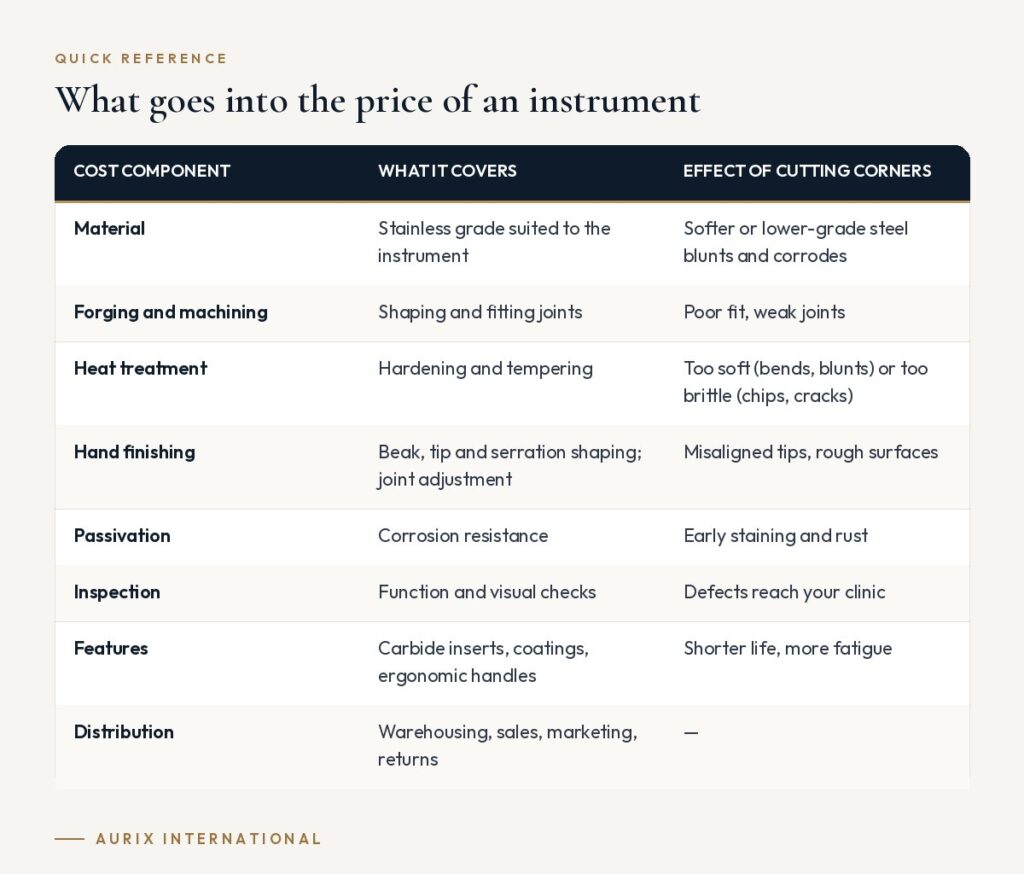
What goes into the price of an instrument
| Cost component | What it covers | Effect of cutting corners |
|---|---|---|
| Material | Stainless grade suited to the instrument | Softer or lower-grade steel blunts and corrodes |
| Forging and machining | Shaping and fitting joints | Poor fit, weak joints |
| Heat treatment | Hardening and tempering | Too soft (bends, blunts) or too brittle (chips, cracks) |
| Hand finishing | Beak, tip and serration shaping; joint adjustment | Misaligned tips, rough surfaces |
| Passivation | Corrosion resistance | Early staining and rust |
| Inspection | Function and visual checks | Defects reach your clinic |
| Features | Carbide inserts, coatings, ergonomic handles | Shorter life, more fatigue |
| Distribution | Warehousing, sales, marketing, returns | — |
Why distribution layers matter
Each business between manufacturer and clinic adds margin to cover its costs. A full-line distributor with large warehouses, field sales and broad catalogues provides real convenience — and its prices reflect that infrastructure. Specialist and hybrid suppliers with fewer layers can sometimes offer comparable quality at lower prices. Comparing different supplier types, as in our top 10 US supplier guide, shows the range.
Cost per use: the number that matters
Cost per use = (purchase price + maintenance) ÷ number of uses + reprocessing cost per cycle.
| Curette A | Curette B | |
|---|---|---|
| Price | $16 | $28 |
| Uses before replacement | 250 | 600 |
| Instrument cost per use | 6.4¢ | 4.7¢ |
| Sharpening frequency | Higher | Lower |
| Strokes per appointment | More | Fewer |
The “cheap” curette is more expensive per use before even counting extra sharpening time and clinician fatigue. These figures are illustrative; apply your own prices and experience. See total cost of ownership.
Hidden costs to include in comparisons
- Shipping and handling, especially on small, frequent orders.
- Duties, taxes and brokerage on international purchases.
- Cassettes, pouches and labels not included in loose prices.
- Staff time ordering, receiving and assembling trays.
- Early replacement and downtime from failed instruments.
Judging whether a price is fair
- Compare like with like: same pattern, features, finish and quantity.
- Ask what is included: inspection, warranty, documentation, support.
- Check total landed cost including shipping and duties.
- Test samples to estimate lifespan.
Where to save without cutting quality
- Buy kits instead of loose instruments — see kit vs single pricing.
- Standardise patterns to buy fewer SKUs in larger quantities.
- Open a wholesale account — see how wholesale works.
- Look after instruments so they last longer.
- Plan orders to avoid rush shipping.
Negotiating fairly
Suppliers are most flexible with predictable customers. Committing to annual volumes, ordering kits, paying promptly and standardising patterns all give a supplier room to improve terms. Be clear about what matters most — unit price, payment terms or delivery speed — so the offer can be tailored.
Frequently asked questions
Why do kit prices look lower than the sum of the instruments?
Kits are cheaper to produce, pick and pack, and suppliers often pass savings on.
Is it worth negotiating instrument prices?
For larger or repeat orders, yes — especially with a volume commitment.
Are more expensive instruments always better?
No. Price reflects many factors, including distribution costs. Judge quality by evidence and testing.
Next steps
See current kits in the Oral collection, compare quotes with our quote comparison method, or request a quote from Aurix.