
Most problems with dental instruments trace back to the supplier: steel that stains, tips that bend, kits with missing items, warranty claims that go nowhere. Spotting warning signs early protects patients, saves money and avoids awkward conversations with your team. Here are twelve red flags to watch for when choosing a dental instruments supplier, grouped by when they appear, followed by the green flags that signal a supplier worth trusting.
Key takeaways
- Vague claims, no contact details and no samples are the biggest pre-order warnings.
- Inspect every delivery — rough finishing and misaligned tips show up immediately.
- Staining after normal reprocessing is a material or finishing problem.
- How a supplier handles a complaint tells you everything.
Before you order
1. Vague material claims
“Premium”, “surgical grade” or “German steel” with no grades, heat treatment or passivation details. Good suppliers can name grades for each instrument type and reference recognised standards such as ISO 7153-1.
2. No real contact details
No physical address, phone number or named team — only a contact form or marketplace chat.
3. Prices far below the market
Unusually cheap instruments often reflect shortcuts in forging, heat treatment, finishing or inspection.
4. Copied or generic product images
The same photographs appear on many unrelated websites, suggesting the seller has never handled the product.
5. Missing policies
No clear shipping, returns or warranty terms.
6. Reluctance to provide samples or documentation
No samples, no reprocessing instructions, no straight answer about who manufactures the instruments or how they are registered for the US market.
When your order arrives
7. Rough finishing
Burrs, pits, uneven polishing or sharp edges where there should be none.
8. Misaligned tips and loose joints
Forceps beaks that do not meet, scissors that do not close evenly, needle holders with lateral play.
9. Wrong or missing items
Substituted patterns, missing kit components or quantities that do not match the order.
After a few weeks
10. Rust or staining after normal reprocessing
If instruments stain while others processed the same way do not, suspect material or passivation problems. See preventing rust and staining to rule out process causes first.
11. Tips that bend or blunt quickly
Explorers that bend, elevators that round, curettes that need constant sharpening.
12. Slow or no response to problems
The ultimate test of a supplier is what happens when something goes wrong.
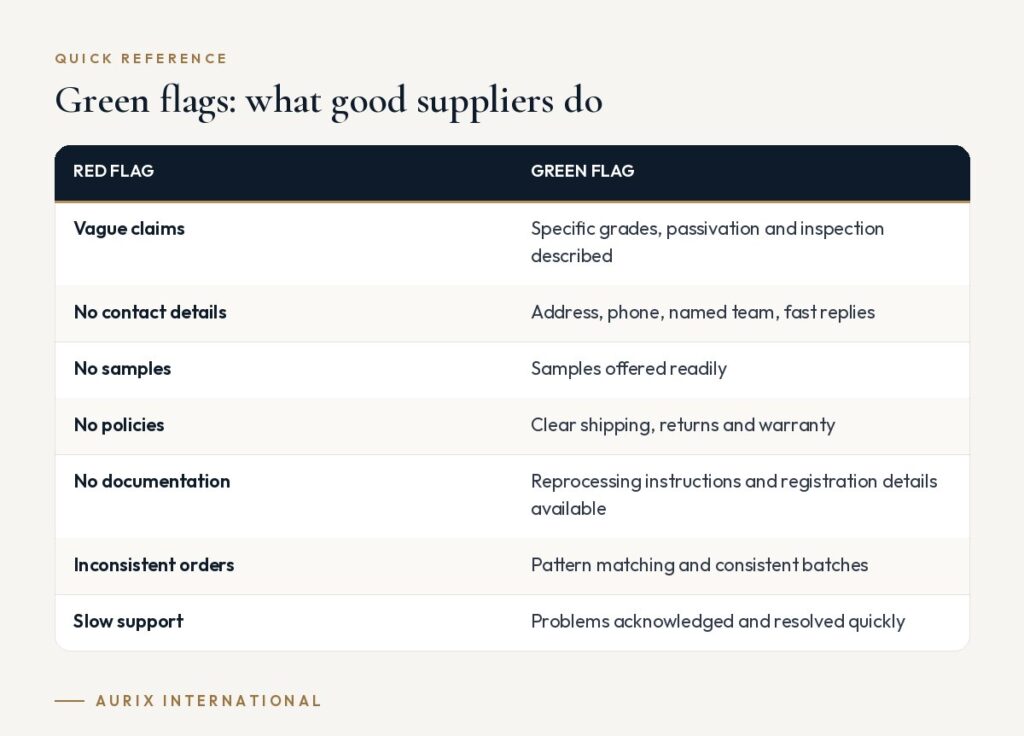
Green flags: what good suppliers do
| Red flag | Green flag |
|---|---|
| Vague claims | Specific grades, passivation and inspection described |
| No contact details | Address, phone, named team, fast replies |
| No samples | Samples offered readily |
| No policies | Clear shipping, returns and warranty |
| No documentation | Reprocessing instructions and registration details available |
| Inconsistent orders | Pattern matching and consistent batches |
| Slow support | Problems acknowledged and resolved quickly |
How to report a problem effectively
A clear report helps any supplier fix issues faster. Include the order number, instrument and pattern, photos, how the instrument was used and reprocessed, and the outcome you want — replacement, refund or credit. How a supplier responds to a well-documented report is one of the best indicators of whether to keep working with them.
Balancing price and risk
Low prices are not automatically a red flag, and high prices are no guarantee. Efficient suppliers with fewer intermediaries can offer good instruments at fair prices. What matters is evidence: specifications, samples, documentation, policies and service. See pricing explained.
Protect your practice
- Inspect every delivery with our receiving checklist.
- Test new suppliers with small orders and samples first.
- Keep records of suppliers and batches.
- Remove failing instruments from service immediately.
Frequently asked questions
Are marketplace instruments always poor quality?
No, but quality varies widely and accountability is often limited. Buy from sellers who provide specifications, policies and support.
What should I do with instruments that fail early?
Remove them from service, photograph the problem and contact the supplier under the warranty.
Can staining be caused by my reprocessing rather than the instrument?
Yes — water quality, detergent residues and chlorides are common causes. Rule them out before blaming the supplier.
Next steps
For established names, see our top 10 US dental instrument suppliers. To evaluate Aurix, request samples and use our 15 vetting questions.