Search for a dental instruments supplier and you will find manufacturers, national distributors, specialist online stores and marketplace sellers all using the same words. The differences matter: they affect price, customisation, minimum orders, how problems are solved and even who carries regulatory responsibility. This guide explains each model in plain language and helps you decide which one fits your needs.
Key takeaways
- A manufacturer makes instruments; a distributor resells them; “supplier” can mean either.
- Manufacturers offer customisation and OEM; distributors offer convenience and small orders.
- Hybrid suppliers combine manufacturing knowledge with local service.
- In the US, manufacturers and initial importers have distinct FDA registration roles.
How an instrument travels from steel to tray
A typical dental hand instrument passes through several stages: steel production, forging and finishing at an instrument manufacturer, optional branding for another company, then one or more layers of distribution before it reaches a clinic. Each layer adds cost — but can also add value through inspection, local stock, advice or faster delivery. Knowing where a supplier sits in this chain tells you what to expect from them.
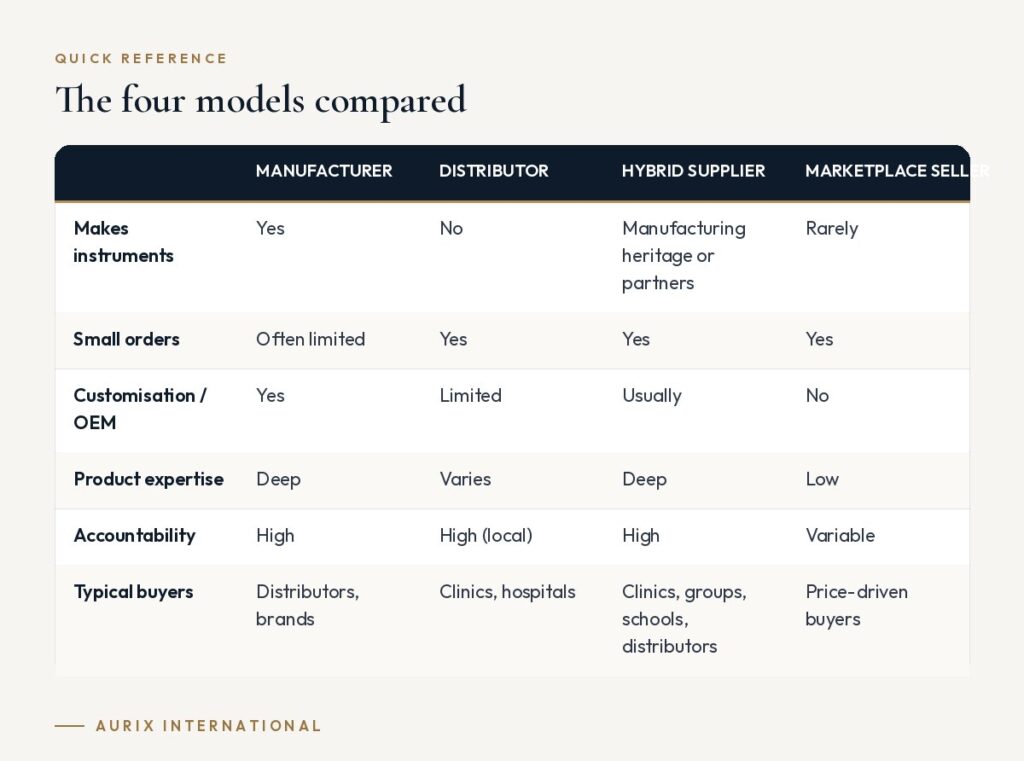
The four models compared
| Manufacturer | Distributor | Hybrid supplier | Marketplace seller | |
|---|---|---|---|---|
| Makes instruments | Yes | No | Manufacturing heritage or partners | Rarely |
| Small orders | Often limited | Yes | Yes | Yes |
| Customisation / OEM | Yes | Limited | Usually | No |
| Product expertise | Deep | Varies | Deep | Low |
| Accountability | High | High (local) | High | Variable |
| Typical buyers | Distributors, brands | Clinics, hospitals | Clinics, groups, schools, distributors | Price-driven buyers |
Buying from a manufacturer
Advantages
- Direct access to specifications, materials and production knowledge.
- OEM, private label and laser marking are possible.
- Lower unit prices on large volumes because fewer intermediaries take a margin.
Considerations
- Minimum order quantities can be high, particularly for custom or branded items.
- International manufacturers mean longer transit, customs paperwork and import obligations.
- Small clinics may not receive priority service.
Buying from a distributor
Advantages
- Small and mixed orders welcome; one invoice for many product types.
- Domestic stock and faster delivery.
- Local returns and account management.
Considerations
- Instrument expertise varies — some distributors sell tens of thousands of unrelated products.
- Little control over manufacturing or patterns; ranges may change when manufacturer contracts change.
The hybrid model
Some suppliers combine manufacturing heritage — their own or through long-standing partners — with local distribution. They can explain why an instrument performs the way it does, build custom kits and offer private label, while still welcoming small orders and providing domestic service. Aurix International follows this model: four generations of instrument manufacturing experience paired with USA-based distribution.
Marketplaces: convenient, but check accountability
Online marketplaces make it easy to buy from sellers worldwide. Prices can be attractive, but product photos are often generic, specifications thin and warranty claims difficult. They may be acceptable for non-critical items; for instruments used in surgery and daily patient care, most clinics prefer an identifiable supplier with clear specifications and policies. Our red flags guide is especially relevant here.
Who is responsible for what (US regulatory roles)
Under FDA rules, different businesses in the chain have different obligations. Foreign manufacturing establishments must register before exporting devices to the US and designate a US agent. Initial importers — firms that bring a foreign manufacturer’s device into the US without repackaging or relabelling it — must also register. Distributors that do not manufacture, repackage or relabel have more limited obligations. This is general information; check current FDA guidance for your situation. Practically, ask any supplier: who is the manufacturer, and how are your products registered and listed?
Price: why the same instrument costs different amounts
Each layer between manufacturer and clinic adds margin to cover warehousing, sales teams, marketing and returns. That is not necessarily bad — a distributor that holds stock and handles returns adds real value — but it explains why manufacturer-direct and hybrid suppliers can sometimes offer better prices for the same quality. See pricing explained.
Which model should you choose?
| You are… | Usually best served by | Why |
|---|---|---|
| A single practice replacing instruments | Specialist or hybrid supplier, or distributor | Small orders, advice, quick delivery |
| A group standardising trays | Hybrid or specialist supplier | Kits, wholesale tiers, consistency |
| A dental school | Hybrid or manufacturer-backed supplier | Identical kits at volume, marking, firm dates |
| A distributor building a brand | Manufacturer or hybrid | OEM, private label, documentation |
Questions that reveal a supplier’s model
- Do you manufacture these instruments, or who does?
- Where are instruments inspected before they ship?
- Can you produce to our specifications or add our branding?
- What are your minimum order quantities?
- How are your products registered and listed with the FDA?
What matters more than the label
Whether a business calls itself a manufacturer, distributor or supplier, the practical questions are the same: Are the instruments consistently good? Can I get what I need, when I need it? Will someone help me if something goes wrong? A business that answers those questions well is the right supplier, whatever its model. For a shortlist of established names, see our top 10 US dental instrument suppliers.
Frequently asked questions
Is buying direct from a manufacturer always cheaper?
Not for small orders. Once minimum quantities, shipping, duties and your own import responsibilities are included, a distributor or hybrid supplier is often better value for clinics.
Can a distributor offer private label?
Only if it has a manufacturing partner willing to brand instruments for it.
Does the model affect quality?
Not directly. Quality depends on the manufacturer and on how carefully the supplier selects and inspects products. Ask for evidence, whatever the model.
Next steps
Compare established names in our top 10 US dental instrument suppliers, read the complete buyer’s guide, or talk to Aurix about your requirements.