Wholesale pricing is not only for distributors. Dental groups, hospitals, schools, community health centres and busy multi-chair practices can often open a wholesale account with a dental instruments supplier. This guide explains who qualifies, what you will be asked for, how tiers and terms work and how to negotiate a fair deal.
Key takeaways
- There are two kinds of wholesale: for end users (clinics, groups, schools) and for resellers.
- Pricing is driven by volume, predictability, product mix and payment terms.
- Expect to provide business details; resellers may need extra documentation.
- Standardising patterns is the single best way to earn better pricing.
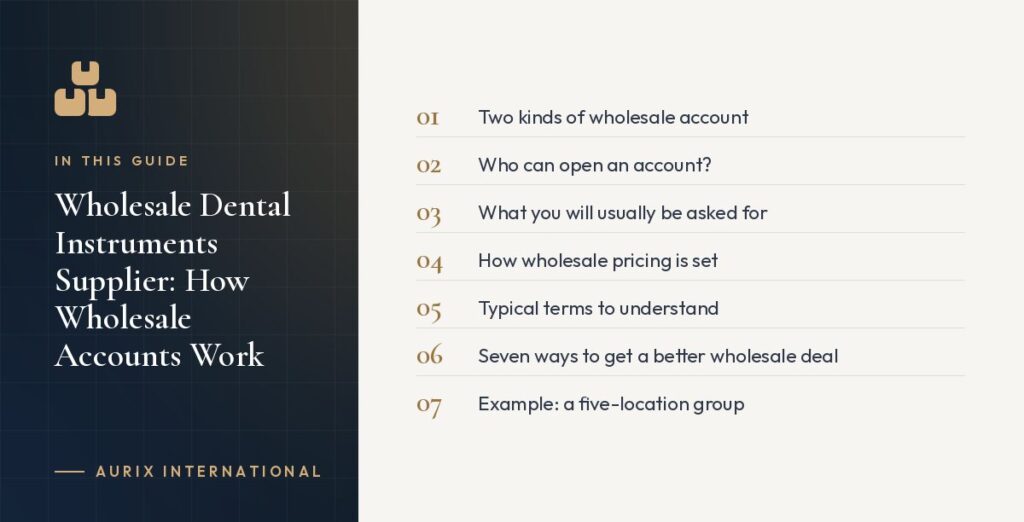
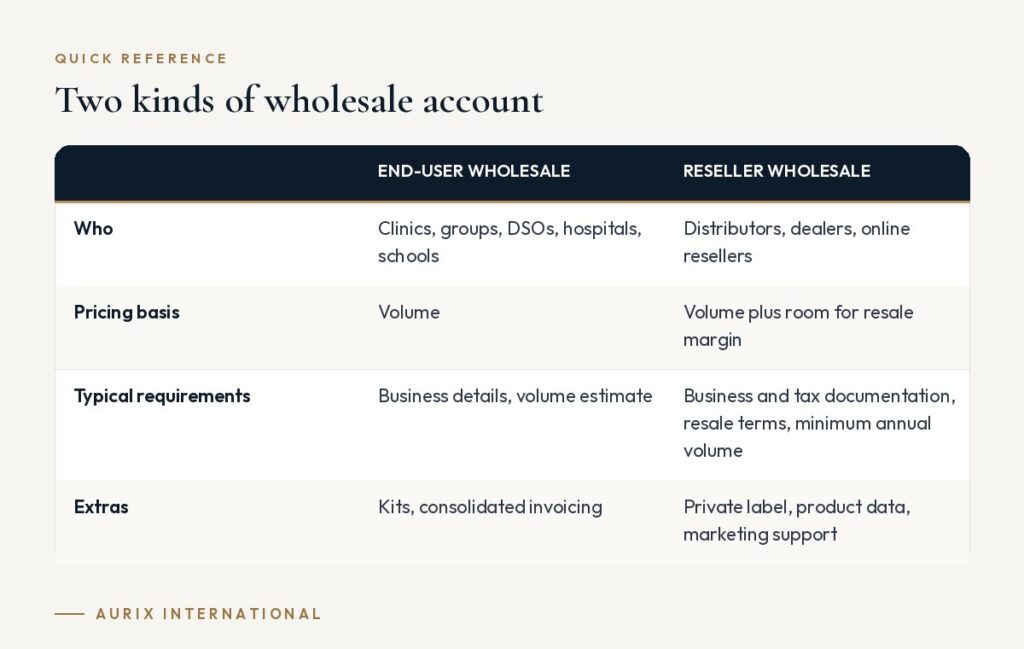
Two kinds of wholesale account
| End-user wholesale | Reseller wholesale | |
|---|---|---|
| Who | Clinics, groups, DSOs, hospitals, schools | Distributors, dealers, online resellers |
| Pricing basis | Volume | Volume plus room for resale margin |
| Typical requirements | Business details, volume estimate | Business and tax documentation, resale terms, minimum annual volume |
| Extras | Kits, consolidated invoicing | Private label, product data, marketing support |
Be clear which you need when you apply — a dental group buying for its own locations should not be treated as a reseller, and a distributor needs terms that support resale.
Who can open an account?
- Licensed dental practices and specialist clinics.
- Dental service organisations and multi-location groups.
- Hospitals, community health centres and school dental programmes.
- Dental schools and training providers.
- Distributors and resellers.
- Veterinary practices and groups.
What you will usually be asked for
- Legal business name, address and contact details.
- Professional licence or business registration details where required.
- Tax identification and, for resellers, resale documentation as applicable.
- An estimate of annual volume and the instruments or kits you need.
- Agreement to terms and conditions, including payment terms.
How wholesale pricing is set
| Factor | Effect |
|---|---|
| Order size | Larger orders unlock lower unit prices |
| Annual commitment | Forecast volume can secure a tier in advance |
| Product mix | Standard instruments and kits discount more easily than custom items |
| Payment terms | Advance payment can improve pricing |
| Delivery pattern | Fewer, larger deliveries cost less to fulfil |
Typical terms to understand
- Minimum order quantities — per instrument, per kit or per order.
- Payment — standard orders are often prepaid; bulk and distributor orders may require a substantial advance before processing or production.
- Lead times — separate for in-stock, custom and branded items.
- Warranty and returns — custom and branded items often have different return conditions.
- Price validity — how long tier pricing is guaranteed.
Read more in MOQs, lead times and payment terms.
Seven ways to get a better wholesale deal
- Standardise patterns across rooms and sites so you buy fewer SKUs in larger quantities.
- Buy kits rather than loose instruments where possible.
- Forecast honestly — suppliers reward predictability.
- Consolidate instruments and kits with one main supplier.
- Plan ahead — rush orders limit discounts.
- Pay promptly — reliable payers earn flexibility.
- Review annually — revisit tiers as volume grows.
Example: a five-location group
A group buying hygiene instruments separately at each location might use six different Gracey patterns from three vendors. Agreeing one standard hygiene kit and ordering centrally from one supplier reduces SKUs, unlocks a higher tier and makes training and auditing simpler — often saving more through standardisation than through negotiation.
Keeping the account healthy
- Order regularly so you stay in your agreed tier.
- Give notice of large orders so stock can be prepared.
- Report quality issues promptly with photos and order numbers.
- Meet once a year to review quality, delivery and pricing.
Is wholesale always right?
Not always. If you order rarely and in small quantities, minimums and payment terms may not suit you. A good supplier will tell you honestly whether standard pricing or a wholesale account fits your volume.
Frequently asked questions
Can a single clinic get wholesale pricing?
Often, if it orders enough volume — for example when equipping a new practice or replacing all kits at once.
Are wholesale instruments lower quality?
They should not be. Wholesale pricing reflects volume and terms, not a different product.
Do resellers need special documentation?
Usually business and tax documentation; regulatory obligations depend on whether you import, relabel or repackage. Seek advice for your market.
Next steps
Aurix offers wholesale accounts for clinics, groups, schools and distributors. Apply or ask a question, and see our US supplier guide for market context.