
Dental schools have requirements few other buyers share. Every student needs an identical kit, everything must arrive before term starts, kits must survive central sterilisation, and replacements must match exactly for years. Choosing the right dental instruments supplier is the difference between a smooth start to the year and weeks of chasing missing items. This guide sets out what to require, a planning timeline and how to support students through the course.
Key takeaways
- Require identical patterns across the whole order and for future replacements.
- Start planning six months before term.
- Laser marking and labelled cassettes reduce loss in shared sterilisation units.
- Agree a replacement process before the first order ships.
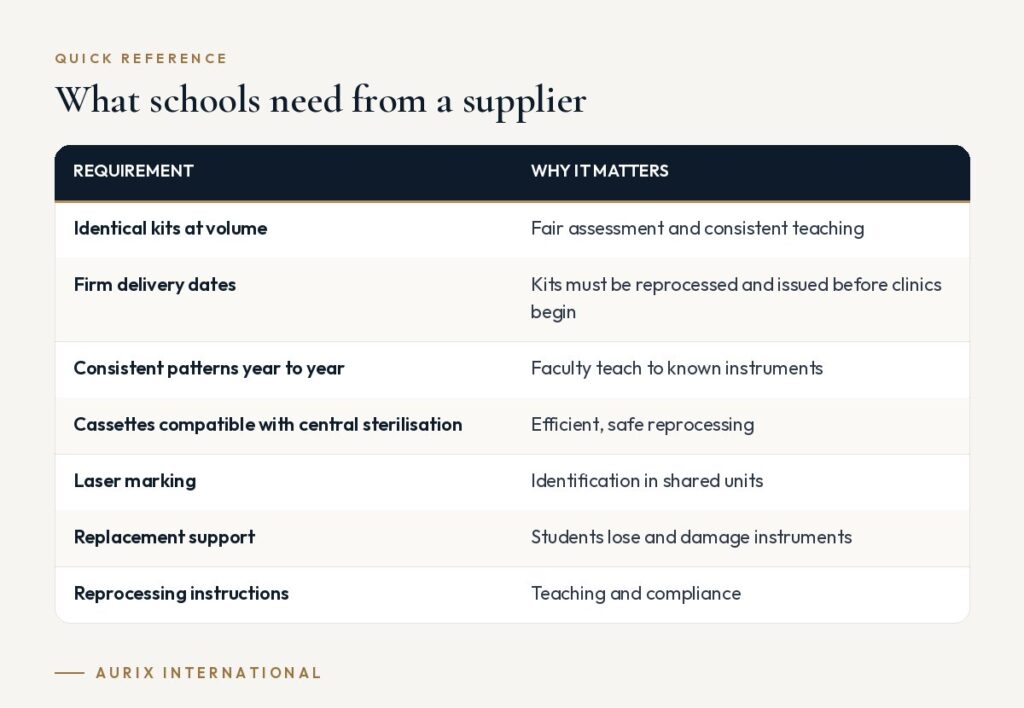
What schools need from a supplier
| Requirement | Why it matters |
|---|---|
| Identical kits at volume | Fair assessment and consistent teaching |
| Firm delivery dates | Kits must be reprocessed and issued before clinics begin |
| Consistent patterns year to year | Faculty teach to known instruments |
| Cassettes compatible with central sterilisation | Efficient, safe reprocessing |
| Laser marking | Identification in shared units |
| Replacement support | Students lose and damage instruments |
| Reprocessing instructions | Teaching and compliance |
Planning timeline
| When | Action |
|---|---|
| 6 months before term | Faculty agree kit lists for each year group |
| 5 months | Request quotes and samples from shortlisted suppliers |
| 4 months | Evaluate samples; approve marking and cassette layout |
| 3 months | Place order with firm delivery date |
| 4–6 weeks | Receive, check, reprocess and prepare for issue |
| Term start | Issue kits with checklists and care guidance |
Designing student kits
- Phase by year: pre-clinical, hygiene and periodontics, restorative, oral surgery.
- Choose standard patterns students will meet in practice.
- Use cassettes so instruments stay organised from clinic to steriliser.
- Include a printed or photo checklist in each kit.
- Add spares of instruments that are frequently lost or bent, such as explorers and mirror heads.
Read more in equipping a dental school cohort.
Questions to ask suppliers
- Can you guarantee identical patterns across the whole order — and for replacements next year?
- Can you laser mark instruments with our name, year or student number?
- Can you supply kits in labelled cassettes that fit our sterilisers?
- How will students or the school order replacements during the course?
- Can you hold stock of our standard patterns for top-up orders?
- What happens if a pattern is discontinued?
- Can you provide reprocessing instructions for teaching?
Purchasing models
| Model | How it works | Pros | Cons |
|---|---|---|---|
| Central purchase | School buys and issues kits | Full control, best pricing | Large upfront budget |
| Approved student purchase | Students buy an approved kit from the supplier | Spreads cost, keeps consistency | Needs clear communication |
| Hybrid | School buys core kits; students buy approved extras | Balanced | More administration |
Supporting students beyond the first order
Students lose and damage instruments, curricula change and a new cohort arrives every year. A supplier that holds your standard patterns in stock, processes small replacement orders quickly and keeps records of each year’s configuration saves the school a great deal of administration.
Teaching instrument care
Schools are where future clinicians form lifelong habits. Pair kits with care guidance: prompt cleaning, correct ultrasonic use, lubrication and sharpening. Our articles on cleaning instruments after use, sharpening curettes and instrument care for students are written with students in mind.
Infection control context
CDC guidance for dental settings classifies instruments that penetrate soft tissue or bone — such as forceps, scalers and scalpels — as critical items to be sterilised after each use, and instruments that contact oral tissues without penetrating them — such as mirrors — as semicritical, normally heat-sterilised. Student kits and cassettes must therefore withstand repeated steam sterilisation.
Fairness and consistency
When every student has the same instruments, assessments are fairer and instructors can focus on technique rather than equipment differences. Standardised kits from a single supplier also make it easier to identify instruments in shared sterilisation units, especially when they are laser marked.
Frequently asked questions
Can students buy kits directly from the supplier?
Yes — many schools approve a kit that students order directly, keeping consistency while spreading cost.
What if a pattern is discontinued mid-course?
Agree in advance how equivalent patterns will be proposed, sampled and approved by faculty.
Is laser marking worth it?
For shared sterilisation units, yes. It reduces loss and mix-ups dramatically.
Next steps
Aurix supplies identical, marked student kits for schools and training programmes. Design yours in the kit builder or contact us. For a market overview, see our top US suppliers guide.