Dental scalers are instruments designed to remove calculus and deposits from tooth surfaces, most often above the gumline. The term covers sickle scalers, hoes, chisels and files, as well as powered ultrasonic units. Each design suits a particular area or type of deposit, and using the right one with the right technique makes debridement faster and more comfortable for the patient. Here are the ten scalers you are most likely to meet, with tips on how to use each.
Key takeaways
- Sickle scalers have a pointed tip, triangular cross-section and two cutting edges, and are mainly for supragingival calculus.
- Straight-shank sickles suit anterior teeth; contra-angled sickles reach posterior proximal surfaces.
- Hoes, chisels and files are specialist scalers for heavy or burnished calculus in accessible areas.
- Good technique means a stable fulcrum, correct angulation and short, controlled strokes.
The top 10 dental scalers
1. Straight anterior sickle scaler
A single-ended or double-ended sickle with a straight shank, designed for anterior teeth. It is particularly effective on lingual calculus of mandibular incisors.
How to use: insert the tip just below the deposit with the face at about 70 to 80 degrees to the tooth, then use short, firm vertical or oblique pull strokes away from the gingiva.
2. H6/H7 sickle scaler
The H6/H7 is a double-ended sickle with slightly angled shanks, widely used for anterior and premolar supragingival calculus. Its slim blade fits under contacts more easily than heavier sickles.
How to use: rest on a neighboring tooth, adapt the leading third of the blade and keep the tip pointed toward the contact.
3. 204S posterior sickle
A double-ended contra-angled sickle used on the proximal surfaces of premolars and molars. Its paired ends mirror each other, so one end works the mesial and the other the distal of the same tooth.
How to use: approach the proximal surface from the facial or lingual, slide the tip under the contact and use short pull strokes, rolling the handle to stay adapted around the line angle.
4. Nevi-style posterior sickle
Nevi scalers are posterior sickles with thin blades and angled shanks that many clinicians use for interproximal calculus in tight contacts.
How to use: because the blade is thin, use moderate pressure and sharpen gently to preserve the profile.
5. U15/30 (Towner-Jacquette) scaler
The U15/30 combines a curved Towner-style sickle on one end and a Jacquette-style straight blade on the other. It is a versatile choice for anterior and premolar supragingival work.
6. Jacquette scaler
Jacquette scalers have straight blades and a triangular cross-section. They are robust and well suited to heavy anterior supragingival deposits.
How to use: use the side of the blade, not the point, and keep strokes short to avoid slipping into soft tissue.
7. Periodontal hoe
The hoe has a single straight cutting edge at roughly 100 degrees to the shank. It removes heavy, ledge-like calculus on the facial and lingual surfaces of posterior teeth where pockets are shallow and open.
How to use: establish two-point contact (blade and shank against the tooth), then pull firmly toward the occlusal. Avoid rounding root surfaces or gouging.
8. Periodontal chisel
The chisel has a straight cutting edge in line with a slightly curved shank. It is used with a push stroke from facial to lingual on proximal surfaces of anterior teeth with open embrasures.
9. Periodontal file
Files such as the Hirschfeld and Orban types have multiple cutting edges on a small base. They fracture or roughen burnished calculus so a curette can then remove it.
How to use: use a firm pull stroke with the base flat against the deposit, then finish with a curette.
10. Ultrasonic scaler
Magnetostrictive and piezoelectric scalers vibrate a metal tip at high frequency, with water spray for cooling and flushing. Different tip designs suit heavy supragingival calculus, subgingival biofilm and furcations.
How to use: use a light grasp and light pressure, keep the tip moving with overlapping strokes, and adapt the side of the tip rather than the point.
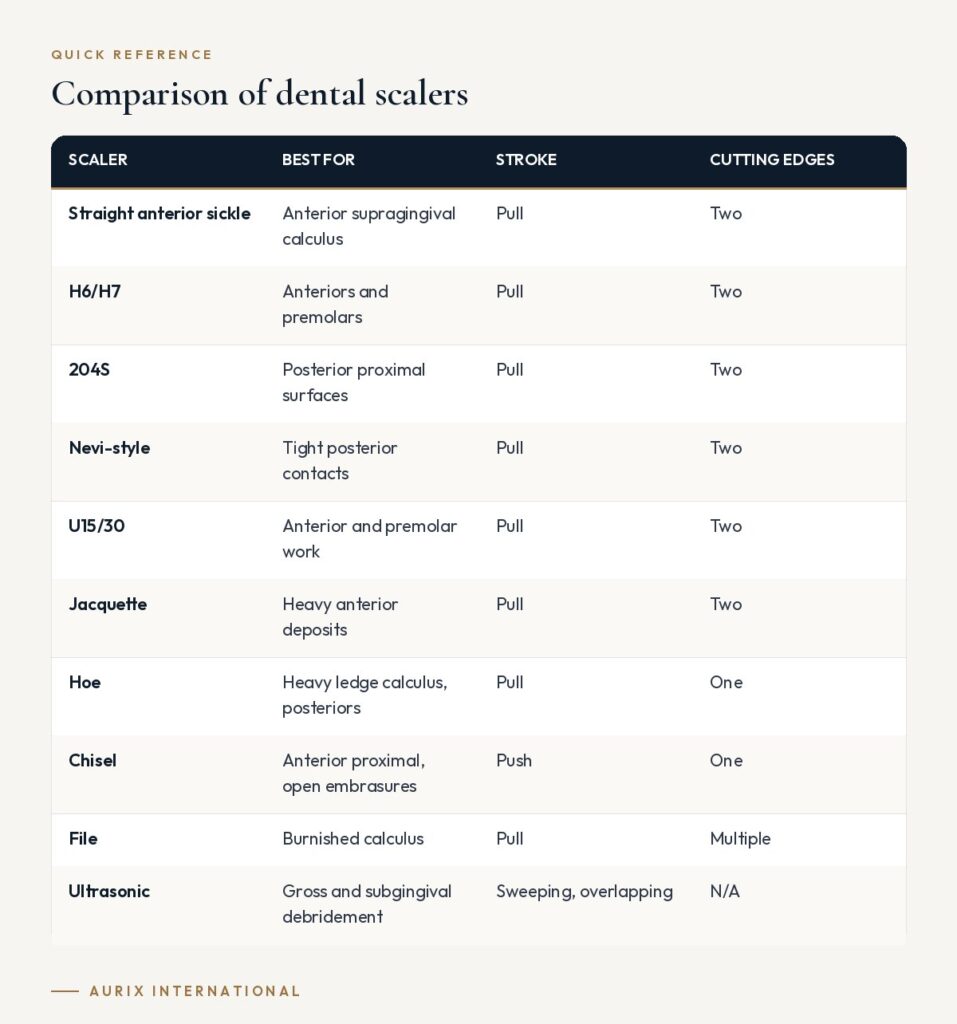
Comparison of dental scalers
| Scaler | Best for | Stroke | Cutting edges |
|---|---|---|---|
| Straight anterior sickle | Anterior supragingival calculus | Pull | Two |
| H6/H7 | Anteriors and premolars | Pull | Two |
| 204S | Posterior proximal surfaces | Pull | Two |
| Nevi-style | Tight posterior contacts | Pull | Two |
| U15/30 | Anterior and premolar work | Pull | Two |
| Jacquette | Heavy anterior deposits | Pull | Two |
| Hoe | Heavy ledge calculus, posteriors | Pull | One |
| Chisel | Anterior proximal, open embrasures | Push | One |
| File | Burnished calculus | Pull | Multiple |
| Ultrasonic | Gross and subgingival debridement | Sweeping, overlapping | N/A |
General technique for hand scalers
- Grasp: use a modified pen grasp with the pads of the thumb, index and middle fingers.
- Fulcrum: establish a stable finger rest on a tooth close to the working area.
- Adaptation: keep the leading third of the blade in contact with the tooth.
- Angulation: aim for 70 to 80 degrees between the face and the tooth surface.
- Stroke: use short, overlapping, controlled working strokes, activating through the wrist and forearm rather than the fingers alone.
How to choose dental scalers
- Match the scaler to your patients. A practice with many heavy-calculus patients may value Jacquettes and hoes; a maintenance-focused practice may rely mainly on slim sickles and ultrasonics.
- Look for edge retention. High-quality stainless steel holds its edge longer. Our article on surgical-grade stainless steel grades explains the differences.
- Keep them sharp. A dull scaler burnishes calculus instead of removing it. See our sharpening tips.
- Combine with curettes. Scalers handle supragingival work; pair them with curettes and other periodontal instruments for subgingival debridement.
Frequently asked questions
Can sickle scalers be used below the gumline?
Sickles are designed mainly for supragingival use. Their pointed tip and back can injure the soft tissue, so subgingival work is usually done with curettes or ultrasonic tips.
What is the difference between a 204S and an H6/H7?
Both are double-ended sickles. The H6/H7 is generally used on anteriors and premolars, while the 204S has contra-angled shanks designed to reach posterior proximal surfaces.
Is ultrasonic scaling better than hand scaling?
Neither replaces the other entirely. Ultrasonics are efficient for heavy and deep deposits, while hand scalers provide tactile control and are useful for finishing and for patients who cannot tolerate powered scaling.
How often should scalers be replaced?
Replace a scaler when the blade has become thin from sharpening, the tip is bent or broken, or the instrument shows corrosion or pitting that does not clean off.
Stock the scalers your team actually uses. Aurix supplies surgical-grade stainless steel sickles, hoes, files and curettes for clinics, distributors and wholesale buyers. Ask about wholesale scalers →