Every general practice stocks hundreds of items, but a small set of dental instruments does most of the daily work. This list covers the ten instruments that nearly every dentist reaches for, what each one does, and what to look for when you buy them. Whether you are equipping a first operatory or reviewing worn stock, these are the instruments to get right first.
Key takeaways
- The mirror, explorer, probe and cotton pliers form the basic exam setup used at almost every visit.
- Restorative essentials are the spoon excavator and plastic filling instrument; surgical essentials are 150/151 forceps and a straight elevator.
- Scalers and curettes keep hygiene and periodontal care in-house.
- Quality shows in balanced handles, sharp, well-aligned tips and smooth joints that survive repeated sterilization.
The top 10 dental instruments every dentist needs
1. Mouth mirror
The mouth mirror gives indirect vision of surfaces you cannot see directly, reflects light into the field and retracts the cheek or tongue. Mirror heads screw into a separate handle, so they can be replaced when scratched.
Tip: front-surface mirrors give a sharper image without the faint double reflection of standard mirrors. Size 4 and 5 heads are common for adults.
2. Explorer
An explorer has a fine, flexible tip used to feel tooth surfaces, detect calculus and check restoration margins. The No. 23 shepherd’s hook is the classic general-purpose pattern; curved pigtail or cowhorn explorers reach interproximal and subgingival areas.
Tip: use a light touch. Current caries assessment relies mainly on visual examination and radiographs, and heavy probing of suspected lesions can damage weakened enamel.
3. Periodontal probe
The probe measures pocket depths and attachment levels and helps detect bleeding on probing. Popular patterns include the UNC-15, marked at every millimeter to 15 with color bands, and the Williams probe, which has no markings at 4 and 6 mm.
Tip: standardize on one or two probe types across the practice so charting stays consistent between clinicians.
4. Cotton pliers
Also called college pliers, cotton pliers carry cotton rolls, pellets, wedges and small items into and out of the mouth. Serrated tips grip better, and locking versions stop small items from dropping.
Tip: check that the tips meet precisely along their full length. Misaligned tips are a common sign of a poorly made or damaged instrument.
5. Spoon excavator
The spoon excavator has a small, sharp, spoon-shaped blade for removing soft carious dentin, temporary restorations and excess cement. It comes in several blade sizes, often double-ended with mirror-image blades.
Tip: keep it sharp. A dull excavator tears dentin rather than lifting it cleanly.
6. Plastic filling instrument
Despite the name, this is usually a steel instrument; “plastic” refers to the materials it handles while they are still soft. One end is typically a flat paddle for carrying and shaping material, and the other a small condenser for packing it.
Tip: for composite, consider coated or highly polished versions that resist sticking.
7. Aspirating dental syringe
The aspirating syringe holds a local anesthetic cartridge and a disposable needle. A harpoon engages the cartridge stopper so the operator can aspirate before injecting to help avoid intravascular injection.
Tip: check that the harpoon is sharp and the thumb ring and threads are not worn, and follow the IFU for disassembly before cleaning and sterilization.
8. Scalers and curettes
Even practices with a hygienist need scalers and curettes. A sickle scaler such as the H6/H7 or 204S removes supragingival calculus, a universal curette such as the Columbia 13/14 adapts to most surfaces, and Gracey curettes give area-specific access for root planing.
Tip: a small starter set of a sickle, a universal curette and Gracey 11/12 and 13/14 covers most routine debridement. Our guide to which Gracey curette number to use explains the full series.
9. Extraction forceps 150 and 151
The 150 (upper universal) and 151 (lower universal) forceps handle incisors, canines and premolars in their respective arches, plus many roots. Most dentists add a 23 cowhorn for lower molars and upper molar forceps such as 88R/88L or 53R/53L.
Tip: look at how the beaks meet. They should contact the root surface along their length rather than at a single point, which reduces the chance of crushing or fracturing the tooth.
10. Straight elevator
The straight elevator, such as the 301 or 34S, is placed between tooth and bone to luxate a tooth before forceps are applied. It is one of the most used surgical instruments in general practice.
Tip: control force with a finger rest and use rotation and gentle wedging, not leverage against adjacent teeth. See our overview of root elevators and their uses for other patterns.
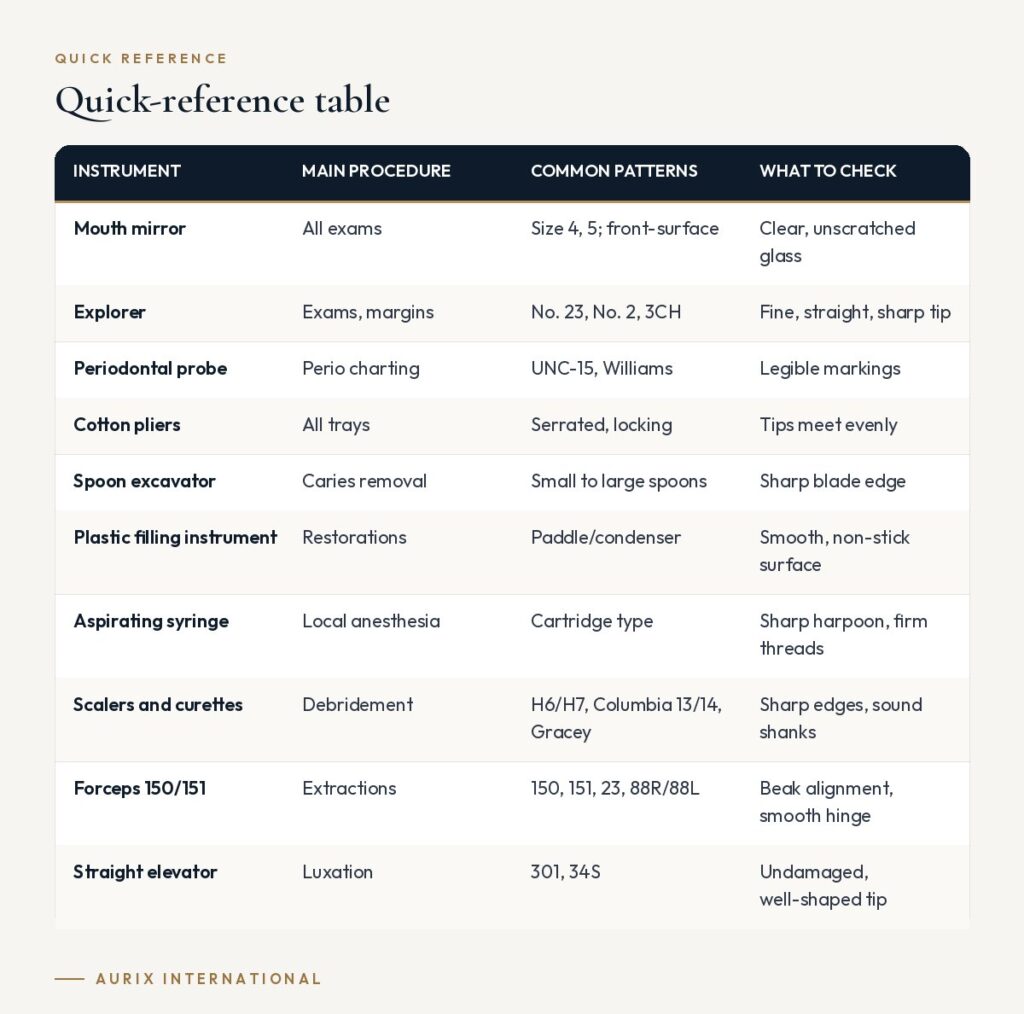
Quick-reference table
| Instrument | Main procedure | Common patterns | What to check |
|---|---|---|---|
| Mouth mirror | All exams | Size 4, 5; front-surface | Clear, unscratched glass |
| Explorer | Exams, margins | No. 23, No. 2, 3CH | Fine, straight, sharp tip |
| Periodontal probe | Perio charting | UNC-15, Williams | Legible markings |
| Cotton pliers | All trays | Serrated, locking | Tips meet evenly |
| Spoon excavator | Caries removal | Small to large spoons | Sharp blade edge |
| Plastic filling instrument | Restorations | Paddle/condenser | Smooth, non-stick surface |
| Aspirating syringe | Local anesthesia | Cartridge type | Sharp harpoon, firm threads |
| Scalers and curettes | Debridement | H6/H7, Columbia 13/14, Gracey | Sharp edges, sound shanks |
| Forceps 150/151 | Extractions | 150, 151, 23, 88R/88L | Beak alignment, smooth hinge |
| Straight elevator | Luxation | 301, 34S | Undamaged, well-shaped tip |
How to choose quality dental instruments
- Balance and feel. Pick up the instrument and hold it in a modified pen grasp. A well-balanced instrument does not feel tip-heavy, and the handle diameter should suit your hand.
- Steel and hardening. Cutting instruments such as curettes and excavators need a hardened stainless steel that holds an edge; non-cutting instruments such as mirrors and pliers need corrosion resistance and strength.
- Finish. Satin finishes reduce glare under the operating light; mirror finishes are smooth and easy to inspect. Both work if the surface is free of pits and rough spots.
- Hinges and joints. Forceps and pliers should open and close smoothly with no side-to-side play.
- Sterilization compatibility. Make sure each instrument can go through your cleaning, ultrasonic and autoclave process as described in the manufacturer’s IFU.
- Enough sets. Plan for several sets of each high-use instrument per operatory so you are never waiting on the sterilizer. Our new clinic equipment checklist helps with counts.
Frequently asked questions
What instruments are on a basic dental setup?
A basic setup usually includes a mouth mirror, an explorer, cotton pliers and a periodontal probe. Other instruments are added depending on the procedure.
Do general dentists need surgical instruments?
Most general dentists perform routine extractions, so a core set of forceps (150, 151, 23 and an upper molar pair), a straight elevator, a periosteal elevator and basic suturing instruments is common. More complex surgery usually calls for a fuller surgical kit or referral.
Should I buy instruments individually or in kits?
Kits are efficient for standard trays and for equipping several operatories identically. Individual instruments are useful for replacing worn items or adding specific patterns. Many practices combine both approaches.
How often should dental instruments be replaced?
Replace instruments when they fail inspection rather than on a fixed schedule: bent or thin tips, blades that can no longer be sharpened to a proper edge, loose joints, cracks or corrosion that cannot be removed.
Equip your operatories with confidence. Aurix International offers surgical-grade stainless steel dental instruments individually, in pre-assembled kits and in custom kits built around your procedures. Talk to our team →