
A well-run dental instrument inventory saves money, prevents last-minute shortages and supports traceability through the sterilization process. Many clinics only discover gaps when a procedure is delayed because a cassette is incomplete or a key forceps has gone missing. The ten tips below help small practices and multi-site groups know what they own, where it is and when to reorder, without needing complex systems.
Key takeaways
- Start with a complete baseline count using consistent instrument names and pattern numbers.
- Set par levels by procedure and track sets or cassettes, not just loose instruments.
- Link sterilization load records to sets so items can be traced if a load fails.
- Record repairs, losses and replacements to spot patterns and plan budgets.
The top 10 dental instrument inventory and tracking tips
1. Start with a full baseline count
Count every instrument in every operatory, cassette, drawer and storage area. Note the instrument name, pattern or catalog number, quantity, location and condition. This baseline often reveals duplicates in one room, shortages in another and worn instruments that should be retired.
Practical tip: count during a quiet day or split the work by room over a week, using the same spreadsheet template for everyone.
2. Use consistent names and pattern numbers
The same instrument can be called different things by different staff. “Gracey 11/12,” “posterior mesial curette” and “the green one” may all refer to one item. Agree on standard names and record pattern numbers, such as forceps 150 or 151, so orders and counts are accurate. Our guide to reading an instrument catalog explains common numbering.
3. Set par levels by procedure
A par level is the minimum number of each instrument or set you need on hand. Base it on how many procedures you perform per day and how long reprocessing takes, then add a buffer for repairs and unexpected demand. When stock falls below par, reorder.
4. Track cassettes and sets as units
Give each cassette or procedure set an ID, such as “HYG-03” or “EXT-02,” and keep a list of what it should contain. Tracking sets rather than individual loose instruments makes counts faster and makes it obvious when something is missing.
- Attach a tray map to each set listing its contents.
- Check sets against the map after reprocessing.
- Record missing or replaced items on the set’s log.
5. Mark instruments for identification
Laser etching, color-coded rings or instrument tape can identify which room, clinician or set an instrument belongs to. Laser marking is permanent and does not trap debris when done properly; tape and rings must be inspected and replaced when worn. Learn more about laser marking on instruments and the pros and cons of color coding.
6. Link sterilization records to sets
Label each pack or cassette with the sterilization date, sterilizer and load number, and record which sets went into each load. If a biological indicator fails, you can identify and recall the affected sets quickly. Some practices also record which set was used for which patient, depending on their policies and local requirements.
7. Schedule regular counts
Instead of one annual stocktake, many clinics use short cycle counts, such as checking one category each week or each month. Regular counts catch losses early, before they cause shortages. Combine counts with your monthly inspection checklist to review condition at the same time.
8. Log repairs, losses and replacements
Keep a simple record of every instrument sent for repair, sharpened, lost or replaced. Over time, this shows which instruments wear fastest, which rooms lose items and how much you spend on replacements. That data makes budgeting and supplier conversations much easier.
9. Use a system you will actually maintain
A shared spreadsheet works well for many single-site practices. Larger groups may benefit from inventory software, barcodes or 2D codes on sets. The best system is the one your team keeps up to date, so start simple and add features only when needed.
10. Standardize reorders and suppliers
Assign one person to approve reorders, keep a list of preferred patterns and order from a small number of suppliers where possible. Standardizing patterns across rooms and sites means instruments are interchangeable and reorders are predictable. For groups, consolidated or wholesale ordering can simplify purchasing.
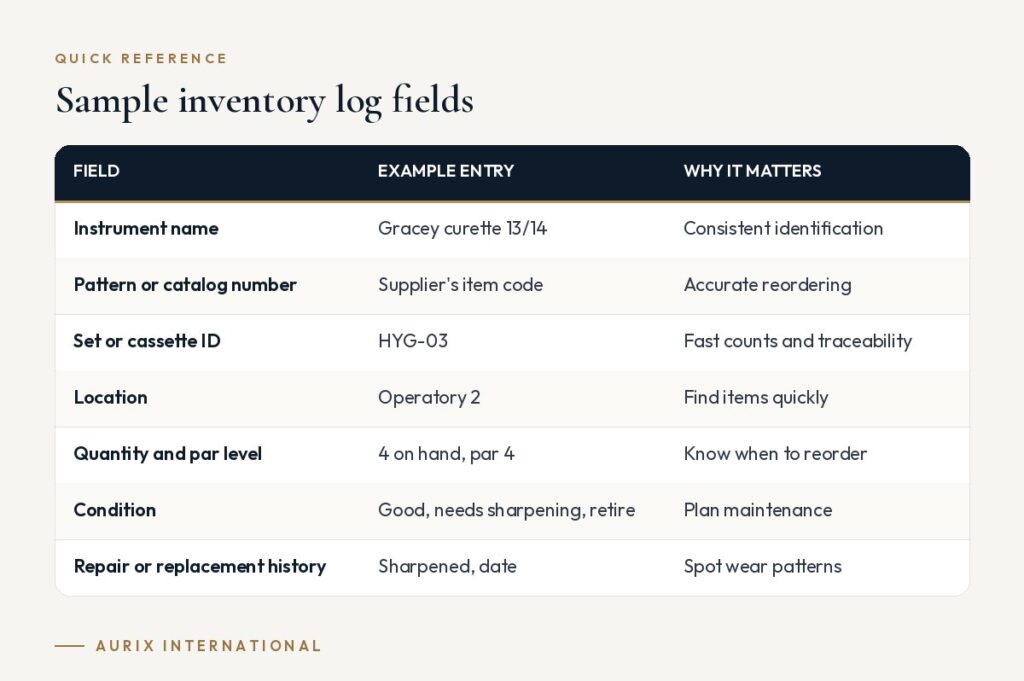
Sample inventory log fields
| Field | Example entry | Why it matters |
|---|---|---|
| Instrument name | Gracey curette 13/14 | Consistent identification |
| Pattern or catalog number | Supplier’s item code | Accurate reordering |
| Set or cassette ID | HYG-03 | Fast counts and traceability |
| Location | Operatory 2 | Find items quickly |
| Quantity and par level | 4 on hand, par 4 | Know when to reorder |
| Condition | Good, needs sharpening, retire | Plan maintenance |
| Repair or replacement history | Sharpened, date | Spot wear patterns |
Buying tips that make inventory easier
- Standardize patterns: fewer variations mean fewer stock lines to track.
- Buy matched kits: pre-assembled or custom kits arrive as complete sets, ready to label and track. See pre-assembled kits vs individual instruments.
- Ask about marking options: some suppliers offer laser marking for identification.
- Plan for lead times: keep par levels high enough to cover the time it takes for replacements to arrive.
- Consider wholesale accounts: multi-site groups often benefit from consolidated ordering.
Our article on instrument tracking and inventory for small clinics offers more detail.
Frequently asked questions
How often should a dental clinic count its instruments?
Many clinics combine a full annual count with smaller weekly or monthly cycle counts. Choose a schedule that catches losses before they cause shortages.
Do I need software to track instruments?
Not necessarily. A well-structured spreadsheet is enough for many single-site practices. Larger or multi-site groups may find software and barcoding worthwhile.
Is instrument tape safe for sterilization?
Instrument tape designed for sterilization can be used, but it must be applied according to the manufacturer’s directions and replaced when it lifts, cracks or peels, because damaged tape can trap debris.
Simplify purchasing across rooms and sites. Aurix International supplies standardized instruments and kits individually or through wholesale accounts for clinics, groups and distributors. Explore wholesale →