
These ergonomic tips for dental hand instruments are aimed at dentists, hygienists and assistants who want to reduce hand, wrist and shoulder strain. Repetitive pinching, gripping and awkward postures are part of daily clinical work, and the instruments you choose and how you hold them make a real difference. The ten tips below combine instrument selection with technique and work habits. They are general guidance; anyone with persistent pain should see a qualified health professional.
Key takeaways
- Lighter instruments with wider, textured handles generally need less pinch force.
- Sharp instruments reduce the force needed for scaling and root planing.
- A correct modified pen grasp, stable fulcrum and neutral wrist are as important as the instrument itself.
- Varying tasks and taking short breaks help reduce cumulative strain.
The top 10 ergonomic tips for dental hand instruments
1. Choose wider handle diameters
Very thin handles force the fingers into a tight pinch, which increases muscle effort. Many clinicians find larger-diameter handles more comfortable for long scaling sessions because they spread pressure across the fingers. Try a few diameters to find what suits your hand size.
Our article on handle diameter, weight and hand fatigue explores this in more detail.
2. Prefer lightweight handles
Hollow stainless steel and resin handles are generally lighter than solid steel handles. Over hundreds of strokes a day, a lighter instrument can reduce the effort needed to control it. Compare options in our guide to hollow, solid and resin handles.
3. Look for textured or knurled grips
A textured surface helps the fingers hold the instrument securely with less squeezing, especially with wet gloves. Smooth handles can encourage a tighter grip. Check that textures are easy to clean and suit your reprocessing method.
4. Keep cutting instruments sharp
Dull curettes and scalers need more lateral pressure and more strokes to remove calculus. Keeping a regular sharpening routine is one of the most effective ways to reduce hand load. Our sharpening guide covers technique and testing.
5. Use a correct modified pen grasp
The modified pen grasp uses the thumb and index finger to hold the handle, with the pad of the middle finger resting on the shank. Common problems include gripping too far up the handle, locking the finger joints or letting the middle finger slide off the shank. Check your grasp periodically, ideally with a colleague or instructor.
6. Establish a stable fulcrum
A fulcrum, usually the ring finger resting on a nearby tooth or an extraoral point, provides control and allows the hand and arm to move as a unit. Without it, the fingers do more of the work. Keep the fulcrum close to the working area where possible and adjust it for different areas of the mouth.
7. Keep the wrist neutral and position yourself well
Bent or twisted wrists increase strain on tendons. Adjust the patient chair height, patient head position and your own seating so you can work with a straight wrist, relaxed shoulders and elbows close to your sides. Magnification loupes with a suitable working distance can also help reduce neck strain.
8. Use the right instrument design for access
Area-specific instruments, such as Gracey curettes, and extended-shank or mini-bladed versions help you reach deep pockets and difficult surfaces without contorting your hand or wrist. Having the right design on the tray reduces awkward adaptation.
- Use anterior instruments for anterior teeth and posterior instruments for posterior teeth.
- Consider extended-shank designs for deeper pockets.
- Choose mini-bladed curettes for narrow pockets and furcations.
9. Use light grip pressure and relax between strokes
Many clinicians grip harder than necessary. Hold the instrument just firmly enough for control, apply pressure only during the working stroke and relax the fingers between strokes. This reduces sustained muscle tension.
10. Vary tasks and take micro-breaks
Alternating between heavy scaling and lighter tasks, and taking short pauses to stretch the hands, wrists and shoulders, can reduce cumulative strain. Where practical, schedule demanding appointments so they are not all back to back.
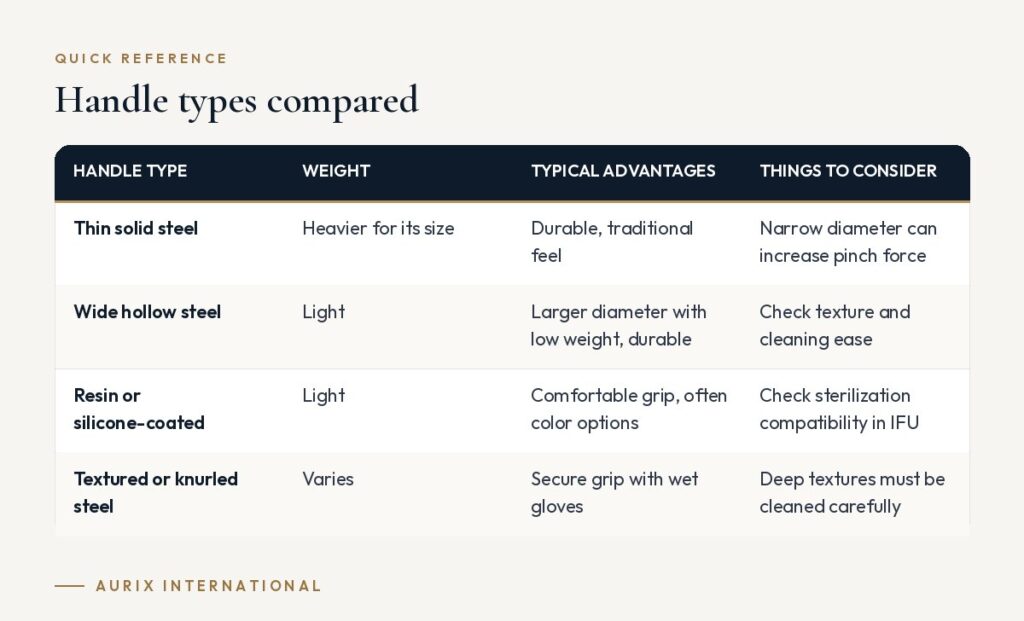
Handle types compared
| Handle type | Weight | Typical advantages | Things to consider |
|---|---|---|---|
| Thin solid steel | Heavier for its size | Durable, traditional feel | Narrow diameter can increase pinch force |
| Wide hollow steel | Light | Larger diameter with low weight, durable | Check texture and cleaning ease |
| Resin or silicone-coated | Light | Comfortable grip, often color options | Check sterilization compatibility in IFU |
| Textured or knurled steel | Varies | Secure grip with wet gloves | Deep textures must be cleaned carefully |
How to choose ergonomic hand instruments
- Try before standardizing: test a few instruments with different diameters and weights during real appointments.
- Balance comfort and tactile feel: very wide or soft handles may reduce tactile sensitivity for some clinicians.
- Check reprocessing: confirm that handle materials are compatible with your cleaning and sterilization methods.
- Consider replaceable tips: cone-socket designs let you keep a preferred handle while replacing worn working ends.
- Equip the whole team: assistants benefit from comfortable instruments too, especially those used frequently.
Frequently asked questions
Are wider instrument handles always better?
Not always. Many clinicians find moderately wide, lightweight handles more comfortable, but the best choice depends on hand size, preference and the need for tactile sensitivity. Try several options.
Does instrument weight really matter?
Over many strokes per day, lighter instruments can reduce the effort needed to control them. Weight is one factor alongside diameter, texture and sharpness.
How can I tell if my grasp is causing strain?
Signs include blanched fingertips, finger joints locking or hyperextending, and pain after appointments. Ask a colleague or instructor to observe your technique, and see a health professional for persistent symptoms.
Find instruments that feel right in your hand. Aurix International offers surgical-grade stainless steel hand instruments, including Gracey curettes, individually or in custom kits. Browse Gracey curettes →