
Colour coding helps teams identify instruments quickly: by procedure, by room, by clinician or by instrument type. It is popular, but it has drawbacks that are worth considering.
Ways to colour code
- Silicone instrument rings — slip onto handles.
- Autoclavable tape — wrapped around handles.
- Coloured resin handles — built into the instrument.
- Cassette tags and colour cassettes — code the whole kit.
Benefits
- Fast identification of instruments and kits.
- Instruments return to the correct room or kit.
- Helps new staff learn layouts.
- Useful for separating, for example, Gracey curettes by number.
Drawbacks
- Tape and rings can trap debris underneath if worn or loose.
- Rings and tape degrade over many sterilisation cycles and must be replaced.
- Extra time is needed to inspect and maintain them.
Best practice
- Prefer colour-coded cassettes over coding individual instruments where possible.
- If using rings or tape, inspect them at every reprocessing cycle.
- Replace any ring or tape that is loose, cracked or discoloured.
- Document your colour system so everyone uses it the same way.
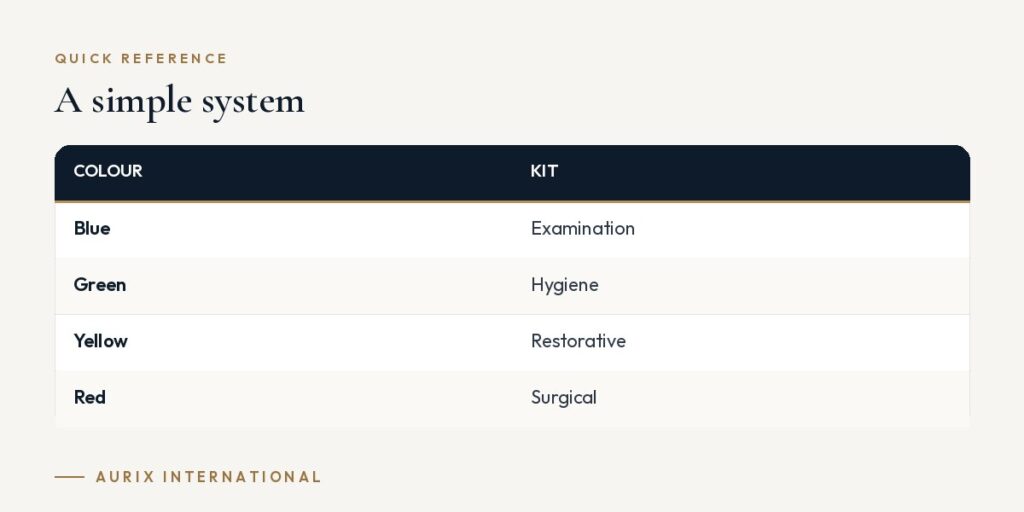
A simple system
| Colour | Kit |
|---|---|
| Blue | Examination |
| Green | Hygiene |
| Yellow | Restorative |
| Red | Surgical |
Aurix kits are supplied in cassettes that can be tagged for your system. Ask us about options.