
Matrix systems recreate the missing wall of a tooth so that the clinician can place restorative material with a proper contour and a tight contact. Also, choosing the right matrix for the tooth and material is one of the biggest factors in how a Class II or anterior restoration turns out. This list covers the 10 matrix systems and instruments most often found in restorative practices, how each works and how to choose between them.
Key takeaways
- Tofflemire retainers are versatile and familiar; sectional systems are popular for composite contacts.
- Wedges seal the gingival margin and help separate teeth for a tighter contact.
- Clear strips suit anterior composites; T-bands and retainerless bands have their own niches.
- Burnishing the band before placing material improves contour and contact.

The top 10 matrix systems and instruments
1. Tofflemire matrix retainer
The Tofflemire (universal) retainer holds a circumferential band around the tooth and tightens it with a screw mechanism. In addition, it is available in straight and contra-angle versions and works for both amalgam and composite.
Tip: Load the band so the slotted side of the retainer faces the gingiva and the smaller circumference of the band sits toward the gingival margin.
2. Tofflemire matrix bands
Tofflemire bands come in different shapes (universal, MOD, extended-height) and thicknesses. Generally, thinner bands make it easier to achieve a contact; thicker bands are stiffer and easier to handle.
3. Sectional matrix system
Sectional systems use small, pre-contoured bands that cover only the proximal surface under restoration, with a separating ring holding them in place. They are popular for posterior composites because the pre-contoured shape and ring separation help produce anatomical, tight contacts.
Our comparison of Tofflemire and sectional matrix systems explains the strengths of each approach.
4. Ring placement forceps
Ring forceps spread and place sectional matrix rings. A secure grip and controlled spreading reduce the risk of the ring springing off. Check that the forceps fit the rings you use.
5. Wedges
Wedges seal the band at the gingival margin to prevent overhangs and slightly separate the teeth to compensate for band thickness. Furthermore, wooden, plastic and anatomically shaped wedges are available in several sizes.
Tip: Insert the wedge from the side with the wider embrasure, usually lingual or palatal, and check that it sits just below the gingival margin of the preparation.
6. Wedge guards
Wedge guards combine a wedge with a thin metal shield. They protect the adjacent tooth from bur damage during preparation and can provide pre-wedging before you place the matrix.
7. Clear Mylar strips
Thin, clear polyester (Mylar) strips help with anterior Class III and Class IV composites. In practice, they let light pass for curing and give a smooth surface finish. Pre-contoured anterior strips can improve proximal shape.
8. Ivory matrix retainer
The Ivory retainer is an older design that holds a band using a screw clamp with prongs engaging the interproximal spaces. Moreover, the Ivory No. 1 helps with one proximal surface and the No. 8 can hold a band that encircles the tooth. Some clinicians still prefer it for specific cases.
9. Retainerless circumferential bands
Retainerless bands are pre-formed loops tightened with a small tool, without a bulky retainer. They give good access on teeth where a Tofflemire retainer is awkward, such as second molars or tight arches.
Copper or stainless steel T-bands, which are also used without a retainer, are a common choice in pediatric dentistry, especially for primary molars.
10. Ball burnisher and contouring instruments
A ball burnisher, or dedicated band contouring pliers, shapes the band to create a convex proximal contour and adapt it against the adjacent tooth. Also, this small step significantly improves the shape of the contact.
Tip: Burnish on a soft surface or in the mouth after wedging, depending on the band type and the manufacturer’s directions.
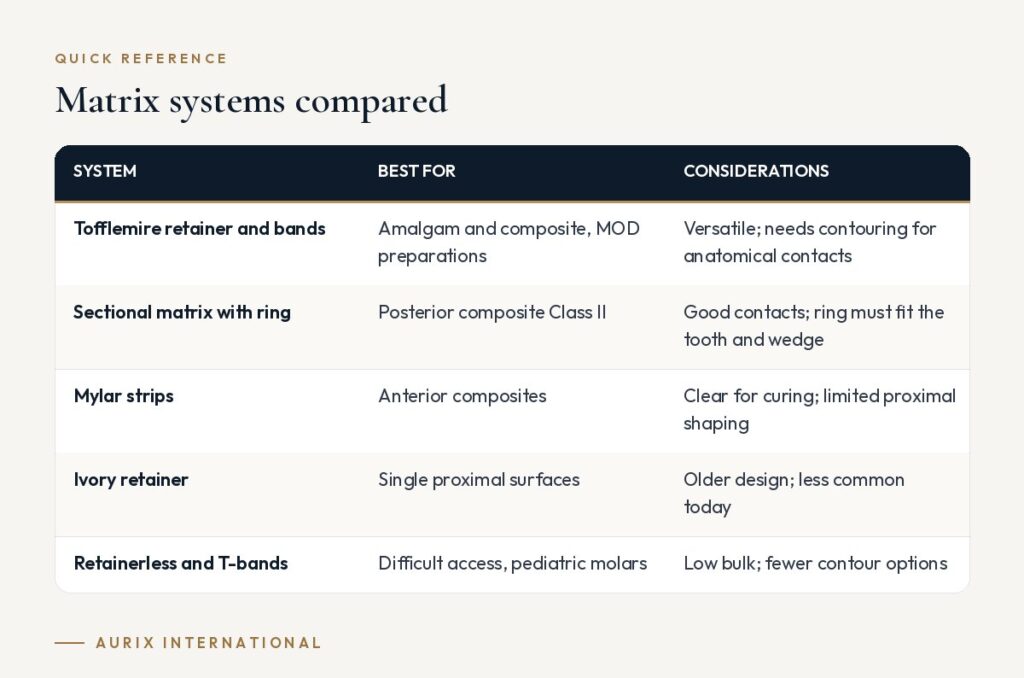
Matrix systems compared
| System | Best for | Considerations |
|---|---|---|
| Tofflemire retainer and bands | Amalgam and composite, MOD preparations | Versatile; needs contouring for anatomical contacts |
| Sectional matrix with ring | Posterior composite Class II | Good contacts; ring must fit the tooth and wedge |
| Mylar strips | Anterior composites | Clear for curing; limited proximal shaping |
| Ivory retainer | Single proximal surfaces | Older design; less common today |
| Retainerless and T-bands | Difficult access, pediatric molars | Low bulk; fewer contour options |
How to choose a matrix system
- Match the system to the material. Because you condense amalgam, it can push a band outward to form a contact; composite cannot, so pre-contoured sectional bands are often preferred.
- Stock a range of sizes. Bands, rings and wedges come in several sizes; a mixed selection covers premolars to molars.
- Keep matrix instruments with the tray. Store the retainer, ring forceps and burnisher in the restorative cassette. See our guide to setting up a restorative tray.
- Use the right placement instruments. Pair your matrix with non-stick composite instruments; our list of the top 10 composite placement instruments covers them.
- Plan for children. Pediatric practices often need T-bands and small retainers; see the top 10 pediatric dentistry instruments.
- Reprocess correctly. You can reuse retainers, forceps and rings according to the manufacturer’s instructions for use (IFU) and CDC guidance; bands and wedges are usually single-use.
Aurix International supplies matrix retainers and related hand instruments individually and as part of restorative kits.
Frequently asked questions
Which is better, Tofflemire or sectional matrix?
Neither is better for every case. Sectional systems are often preferred for posterior composite contacts, while Tofflemire retainers are versatile for large or multi-surface restorations and amalgam.
Why are wedges needed with a matrix?
They seal the gingival margin to prevent overhangs and separate the teeth slightly so the contact is tight once you remove the band.
Can matrix bands be reused?
Matrix bands are generally single-use. In addition, retainers, ring forceps and many rings are reusable according to the manufacturer’s IFU.
What is a Mylar strip used for?
It is a clear matrix used for anterior composite restorations, allowing light curing through the strip and giving a smooth surface.
Complete your restorative trays with the right matrix instruments. Aurix can add retainers, forceps and burnishers to a custom restorative kit for every operatory. Build your restorative kit →