When a restoration replaces a proximal wall, a matrix creates a temporary wall for the material to be packed against. The matrix system you choose has a big effect on the contact point and contour of the final restoration.
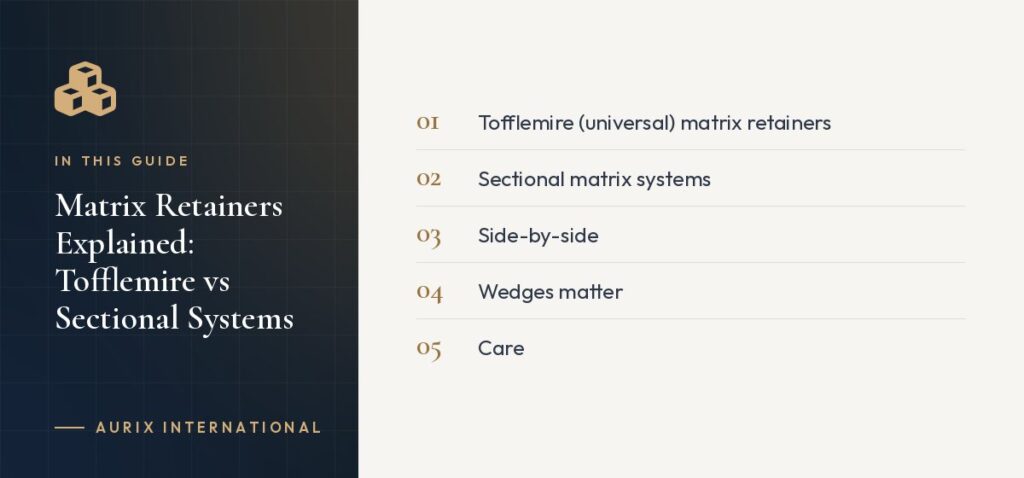
Tofflemire (universal) matrix retainers
The Tofflemire retainer holds a circumferential metal band around the tooth. Turning the knobs tightens the band and locks it in place.
Advantages
- Versatile: one retainer for many teeth.
- Good for large restorations involving several surfaces.
- Inexpensive and familiar to most clinicians.
Limitations
- Bands are straight, so contacts can be flat or open without careful wedging.
- The retainer is bulky in the mouth.
Sectional matrix systems
Sectional systems use small, pre-contoured metal matrices that cover only one proximal surface, held by a separating ring.
Advantages
- Produce tight, anatomically shaped contacts.
- The ring separates the teeth slightly, compensating for band thickness.
- Ideal for Class II composite restorations.
Limitations
- More components to manage.
- Less suitable for very large restorations.
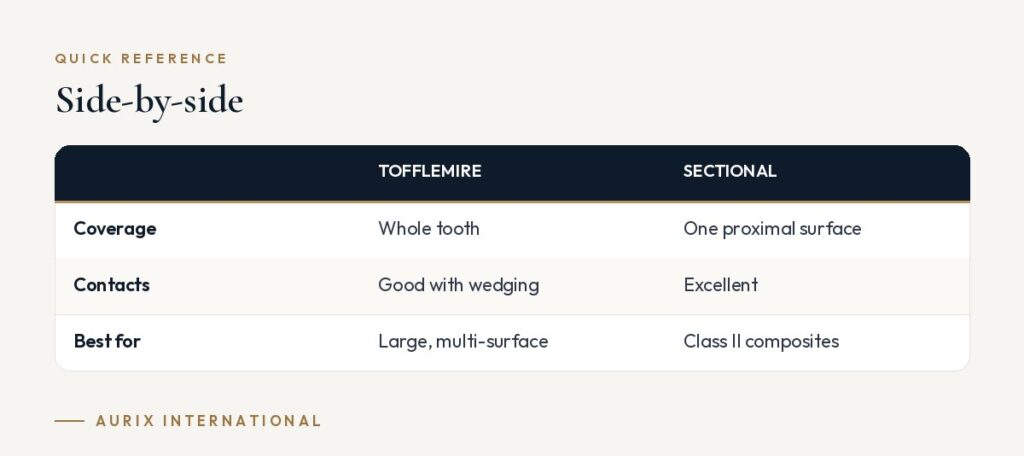
Side-by-side
| Tofflemire | Sectional | |
|---|---|---|
| Coverage | Whole tooth | One proximal surface |
| Contacts | Good with wedging | Excellent |
| Best for | Large, multi-surface | Class II composites |
Wedges matter
Whichever system you use, a well-fitted wedge seals the gingival margin and prevents overhangs.
Care
Tofflemire retainers should be cleaned with the band removed and the mechanism opened. Inspect the threads and slots regularly.
Aurix International lists matrix retainers in its catalogue. Ask us about options for your restorative trays.