The clamp is the anchor of a rubber dam. A clamp that fits well stays put, seals around the tooth and stays comfortable for the patient. However, a poor fit slips off, damages gingiva or fractures enamel. So here is how to choose.
Winged vs wingless clamps
- Winged clamps have extensions that hold the dam, allowing clamp, dam and frame to be placed together.
- Wingless clamps give better visibility and are easier to place on partially erupted or broken-down teeth; the clamp is placed first and the dam stretched over it.
Clamps by tooth type
Molars
For example, molar clamps have larger jaws to fit the wide cervical area. Also, some have serrated or inverted jaws for broken-down or partially erupted teeth.
Premolars
By contrast, premolar clamps are smaller with narrower jaws. In addition, universal premolar clamps fit most upper and lower premolars.
Anterior teeth
Meanwhile, clinicians often isolate anterior teeth without clamps, using floss ligatures or wedges. Generally, butterfly clamps can be used for cervical restorations.
Fit checklist
- First, the clamp should contact the tooth at four points.
- Second, the jaws should sit below the height of contour without impinging on gingiva.
- The clamp should not rock when gently pressed.
- Finally, always tie floss to the clamp bow for retrieval.
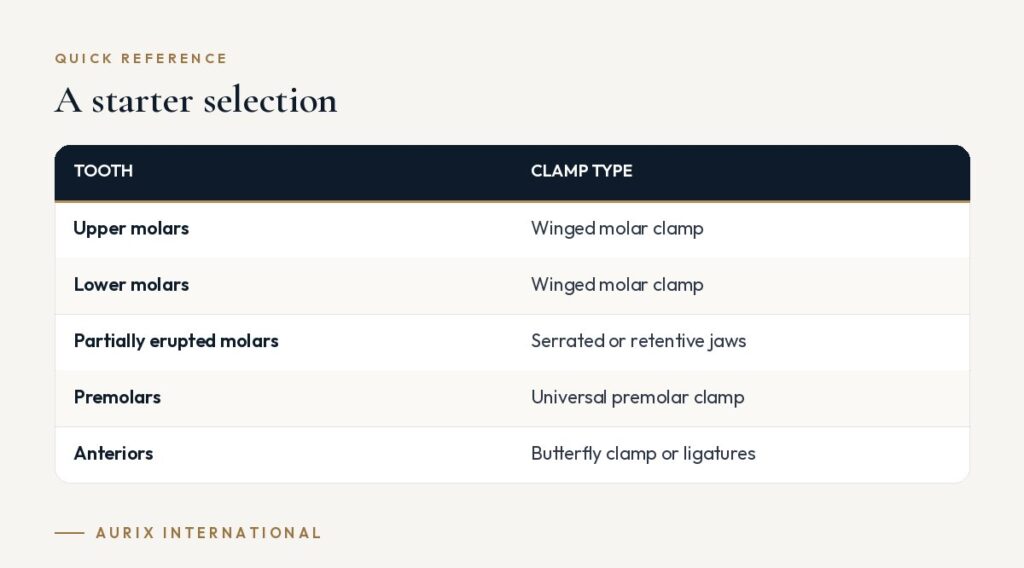
A starter selection
| Tooth | Clamp type |
|---|---|
| Upper molars | Winged molar clamp |
| Lower molars | Winged molar clamp |
| Partially erupted molars | Serrated or retentive jaws |
| Premolars | Universal premolar clamp |
| Anteriors | Butterfly clamp or ligatures |
Care and inspection
Clamps can weaken and crack after many sterilisation cycles. Furthermore, inspect the bow for cracks and replace any clamp that has lost its spring.
See the Aurix rubber dam kit guide for the full set of components.