“Plastic filling instrument” is one of the most confusing names in dentistry. The instruments are usually stainless steel; the word “plastic” refers to the material they handle — materials that are soft and mouldable (plastic) when placed, such as composite, glass ionomer and temporary cements.
Plastic filling instruments (PFIs)
A PFI typically has a flat, paddle-shaped blade at one end and a small condenser or ball at the other. The blade carries and places material; the condenser packs it into the cavity.
Common uses
- Placing lining and base materials.
- Carrying and adapting composite and glass ionomer.
- Placing temporary restorations.
- Removing excess cement.
Condensers (pluggers)
Condensers have flat or slightly serrated circular ends used to pack restorative material into a preparation. They come in different diameters for small and large cavities.
- Smooth ends — for composite and glass ionomer.
- Serrated ends — traditionally for amalgam, to help layers bond.
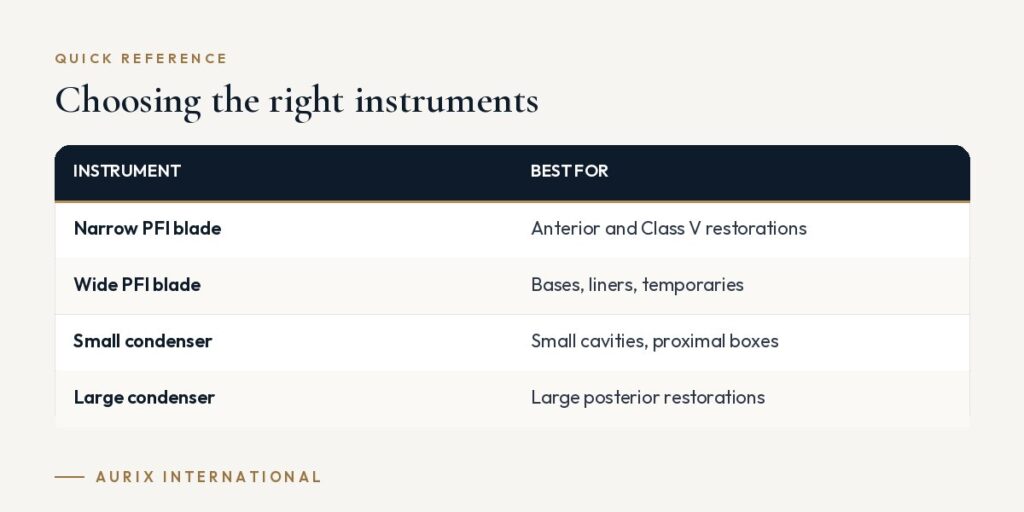
Choosing the right instruments
| Instrument | Best for |
|---|---|
| Narrow PFI blade | Anterior and Class V restorations |
| Wide PFI blade | Bases, liners, temporaries |
| Small condenser | Small cavities, proximal boxes |
| Large condenser | Large posterior restorations |
Coated or uncoated?
Titanium nitride or similar coatings reduce sticking with composite. For general use with liners and temporary materials, uncoated stainless steel is perfectly adequate and more economical.
Care
Clean material from instruments before it sets. Set glass ionomer and cement are hard to remove and can damage working ends if scraped off aggressively. Inspect blades for bends.
Plastic filling instruments and condensers are included in Aurix composite filling sets and can be added to any custom kit.