
Composite restorations demand precise placement and shaping. Unlike amalgam, composite is sticky and sensitive to contamination, so the instruments used to handle it need smooth, non-stick surfaces and well-designed working ends.
Core instruments in a composite set
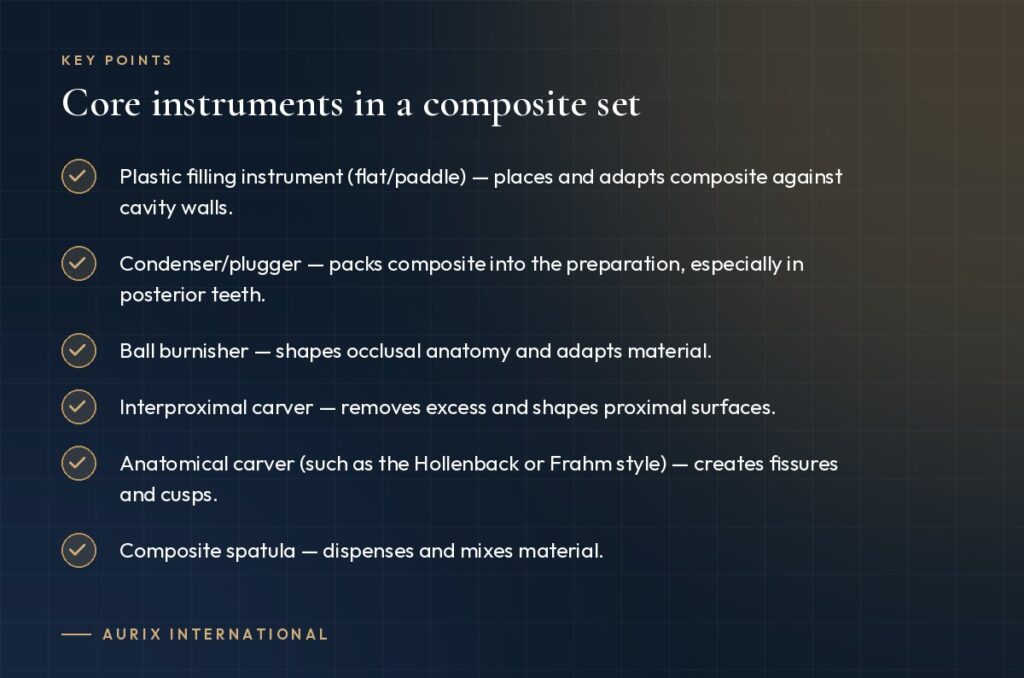
- Plastic filling instrument (flat/paddle) — places and adapts composite against cavity walls.
- Condenser/plugger — packs composite into the preparation, especially in posterior teeth.
- Ball burnisher — shapes occlusal anatomy and adapts material.
- Interproximal carver — removes excess and shapes proximal surfaces.
- Anatomical carver (such as the Hollenback or Frahm style) — creates fissures and cusps.
- Composite spatula — dispenses and mixes material.
Surface coatings
Many composite instruments are coated with titanium nitride or similar non-stick coatings. These reduce sticking and pulling of composite and are usually gold-coloured. Uncoated stainless steel instruments are less expensive but composite may stick more.
Shapes for different areas
- Anterior work: thin, flat blades for veneers and Class III/IV restorations.
- Posterior work: condensers and ball ends for Class I and II restorations.
- Cervical work: small, curved instruments for Class V restorations.
Choosing a set
- Decide whether you need coated or uncoated instruments.
- Check that working ends are smooth with no scratches or pits, which cause sticking.
- Choose comfortable handles; composite work is detailed and lengthy.
- Include duplicates of the instruments you use most.
Care
Avoid abrasive cleaning that could damage coatings. Clean promptly after use so that cured composite does not harden on the instrument, and inspect coatings for wear.
Aurix International offers composite filling sets. Contact us for contents and pricing, or add composite instruments to a custom kit.