
Sinus lift instruments let the surgeon raise the Schneiderian membrane and place graft material beneath it so that implants can be placed in the posterior maxilla. The two main approaches, the lateral window and the crestal (osteotome) technique, use different tools, but both depend on gentle, controlled membrane handling. This list covers the ten instruments most often found in a sinus lift kit and what each contributes.
Key takeaways
- Lateral window lifts rely on window preparation tools and angled sinus membrane elevators and curettes.
- Crestal lifts rely on osteotomes, a surgical mallet and careful depth control.
- The sinus membrane is thin and easily perforated, so instrument tips should be smooth and rounded.
- Graft carriers and pluggers deliver material without excessive pressure on the membrane.
- Flap access, retraction and suturing instruments are just as important as the sinus-specific tools.
The top 10 sinus lift instruments
1. Scalpel handle and blades
A No. 3 handle with No. 15 or 15C blades makes the crestal and vertical releasing incisions needed for lateral window access. Also, incision design should leave the flap margins on sound bone away from the planned window.
2. Periosteal elevator
A Molt No. 9 or similar periosteal elevator reflects a full-thickness flap high enough to expose the lateral wall of the maxilla. In addition, gentle, complete reflection gives a clear view of the window site.
3. Retractors
A Minnesota, Seldin or broad flap retractor holds the flap and cheek away from the window. Steady retraction is essential while burs or piezoelectric inserts are in use near the soft tissue.
4. Lateral window burs or piezoelectric inserts
The bony window is usually outlined with round diamond burs or with piezoelectric surgery inserts. Diamond burs and piezo tips are favored because they are less likely to tear the membrane than sharp carbide burs.
Tip: thin the bone until the bluish membrane shows through, then stop and switch to hand instruments.
5. Sinus membrane elevators
Sinus membrane elevators have thin, rounded, spoon- or disc-shaped tips on angled shanks. Generally, they begin separating the membrane from the bone around the margins of the window, keeping the edge in contact with bone at all times.
Kits typically include several angulations so the operator can reach the anterior, posterior and floor walls of the sinus.
6. Angled sinus curettes
Sinus curettes have larger, more strongly angled or offset blades that continue the elevation across the sinus floor and up the medial wall. Furthermore, their curved shanks follow the internal contour of the sinus.
Smooth, polished, rounded edges are important; a sharp or burred tip increases the risk of perforation.
7. Osteotomes
For the crestal approach, osteotomes with concave tips (in the style described by Summers) are common in increasing diameters. In practice, they compact bone and push it, together with any graft, upward to lift the membrane through the implant osteotomy. Straight and offset designs are available for different access.
Depth marks on the osteotome help control how far it is advanced relative to the measured residual bone height.
8. Surgical mallet
A surgical mallet delivers controlled taps to the osteotome. Moreover, mallets with replaceable or resin faces reduce rebound and noise. Light, measured taps are the norm; warn the patient beforehand because the sensation can be startling.
9. Bone graft carrier and plugger
A graft carrier delivers particulate graft through the window or osteotomy, and a small plugger gently distributes it beneath the elevated membrane. Pressure should be gentle so the membrane is not stretched or torn.
10. Suturing instruments
A needle holder, tissue forceps and suture scissors are needed for tension-free primary closure over the window. A well-sealed flap helps protect the graft and any membrane placed over the window.
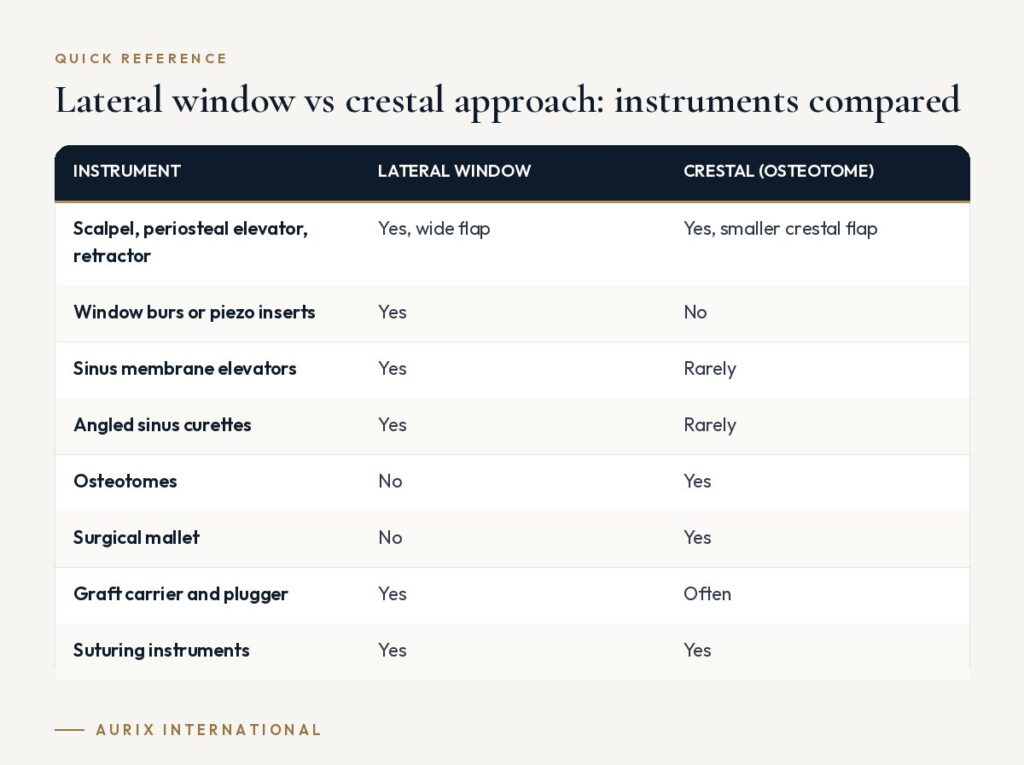
Lateral window vs crestal approach: instruments compared
| Instrument | Lateral window | Crestal (osteotome) |
|---|---|---|
| Scalpel, periosteal elevator, retractor | Yes, wide flap | Yes, smaller crestal flap |
| Window burs or piezo inserts | Yes | No |
| Sinus membrane elevators | Yes | Rarely |
| Angled sinus curettes | Yes | Rarely |
| Osteotomes | No | Yes |
| Surgical mallet | No | Yes |
| Graft carrier and plugger | Yes | Often |
| Suturing instruments | Yes | Yes |
How to choose sinus lift instruments
- Decide which approaches you use. A crestal-only practice needs osteotomes and a mallet; lateral window work needs membrane elevators, curettes and window tools.
- Inspect the tips closely. Membrane elevator and curette tips should be thin, smooth and free of nicks or burrs. Check them under magnification after each processing cycle.
- Get a range of angles. Several angulations make it easier to reach every wall without levering against the window edge.
- Choose clearly marked osteotomes. Laser-etched depth lines stay legible longer than printed marks.
- Keep a dedicated kit. Sinus instruments are delicate and used less often than general surgical tools, so a dedicated cassette protects them between cases.
Our guide to sinus lift instrument kits for lateral and crestal approaches covers each technique in more detail. Most sinus lifts are combined with grafting and implant placement, so it is worth reviewing the top 10 bone grafting instruments and the top 10 dental implant surgery instruments when planning the tray.
Frequently asked questions
What instruments help with a crestal sinus lift?
Mainly osteotomes in increasing diameters, a surgical mallet, the implant drill sequence, and a graft carrier if grafting. Also, basic flap, retraction and suturing instruments complete the tray.
What is the difference between a sinus membrane elevator and a sinus curette?
Both lift the sinus membrane. Membrane elevators usually have smaller, finer tips for starting the separation at the window margins, while sinus curettes have larger, more angled blades for continuing elevation across the floor and walls.
Why are piezoelectric inserts used for the lateral window?
Piezoelectric inserts cut mineralized bone selectively and are less likely to damage soft tissue, so many surgeons find they reduce the risk of tearing the membrane while preparing the window.
How should sinus lift instruments be maintained?
Clean them promptly, inspect the fine tips under magnification, protect them in a cassette, and sterilize according to the IFU. Replace any elevator or curette with a damaged or roughened edge.
Put your sinus instruments in one protected kit. Aurix International can assemble membrane elevators, curettes, osteotomes and supporting surgical instruments into a custom sinus lift kit. Build a sinus lift kit →