
Bone grafting instruments help you harvest, prepare, deliver and contain graft material, whether you are preserving a socket, augmenting a ridge or grafting around an implant. Using the right instrument for each step keeps the material clean, reduces waste and makes placement more predictable. Here are the ten instruments most commonly found on a dental bone grafting tray.
Key takeaways
- Grafting instruments fall into four groups: harvesting, preparing, delivering and containing the graft.
- A clean, debrided recipient site matters as much as the graft material; bone curettes do that job.
- Graft carriers and pluggers place particulate material without contaminating or overcompressing it.
- Membrane instruments and fixation tools help keep the graft stable during healing.
- A tension-free flap, released with a periosteal elevator and scalpel, is essential to close over a graft.
The top 10 bone grafting instruments
1. Bone curettes (Lucas and Molt)
Lucas curettes (often numbered 85, 86 and 87 in different sizes) and Molt curettes remove granulation tissue and soft-tissue remnants from extraction sockets and defects. Thorough debridement exposes bleeding bone, which supports graft integration.
Curettes can also collect small amounts of autogenous bone from nearby sites.
2. Bone scraper
A bone scraper is a hand instrument with a sharp blade and a collection chamber. Drawn across the cortical surface, it shaves thin curls of autogenous bone and stores them ready for use. It is a common way to harvest modest volumes from the ramus, the zygomatic buttress or the area near the defect.
Tip: keep the blade sharp and the chamber moist with saline or blood so the harvested chips stay viable.
3. Rongeur
Rongeurs trim bone edges and can harvest small pieces of bone that are later milled. Side-cutting and end-cutting patterns such as the Blumenthal are popular in dental surgery.
4. Bone mill or crusher
A bone mill or crusher reduces harvested bone blocks or rongeur pieces into particulate graft of a consistent size. Manual mills are simple to clean and process; follow the IFU, as some have several parts to disassemble.
5. Mixing well and graft spoon
A stainless steel mixing well or dappen dish holds the graft while it is hydrated with saline or the patient’s blood, or mixed with autogenous chips. A small graft spoon or spatula transfers and mixes the material.
A well with a stable base and smooth interior is easy to clean and does not trap particles.
6. Bone graft carrier (syringe)
A graft carrier is a syringe-style instrument that loads particulate graft from the well and delivers it directly into the socket or defect. It reduces handling, contamination and spillage compared with spooning material into place.
Carriers come in different tip diameters and angles; an angled tip helps in posterior sites.
7. Bone packer (plugger or condenser)
Bone packers have flat or slightly serrated round tips in several diameters. They gently condense particulate graft into the defect so it fills the space without voids.
Tip: condense lightly. Over-compacting particulate graft can reduce the space available for new bone and blood vessels.
8. Membrane placement instruments
Fine tissue forceps, a small membrane spatula or plastic instrument, and fine scissors trim, position and tuck barrier membranes under the flap. Smooth, non-toothed forceps are less likely to tear a collagen membrane.
9. Membrane fixation tools
For guided bone regeneration where the membrane must stay immobile, small tacks or screws hold it in place. These come with a dedicated applicator, driver and mallet or handle, usually supplied as part of a fixation system.
10. Periosteal elevator and scalpel for flap release
Grafts add volume, so the flap must be released to close without tension. A periosteal elevator reflects the flap, and a fresh blade scores the periosteum at the base to let it advance. Without a tension-free closure, exposure of the graft or membrane becomes more likely.
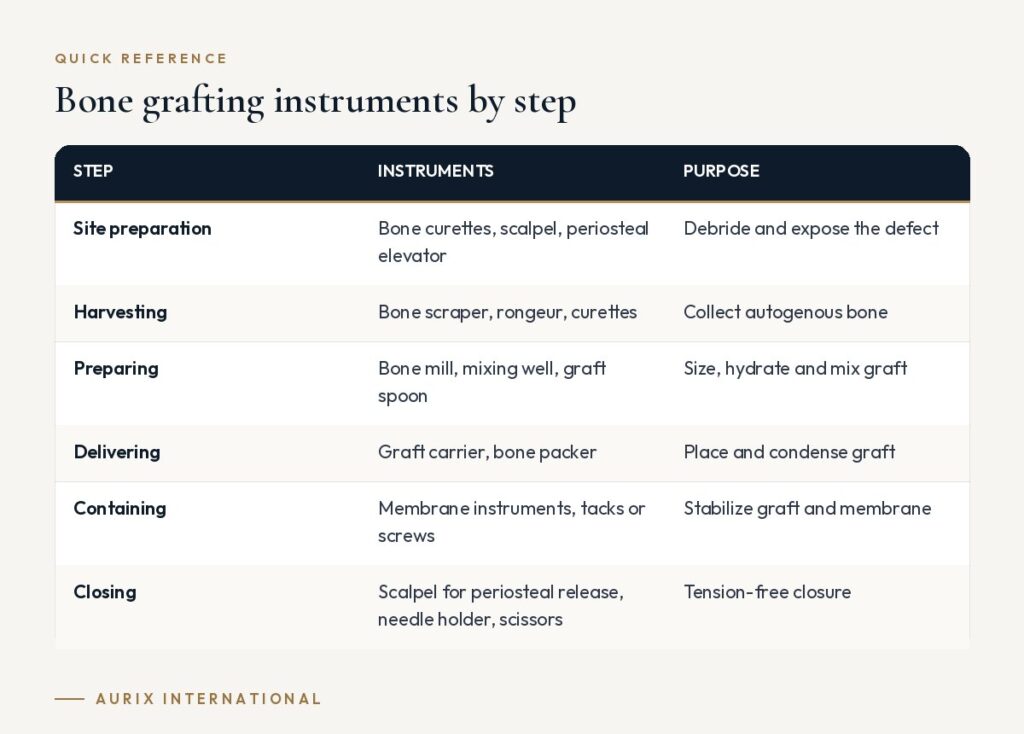
Bone grafting instruments by step
| Step | Instruments | Purpose |
|---|---|---|
| Site preparation | Bone curettes, scalpel, periosteal elevator | Debride and expose the defect |
| Harvesting | Bone scraper, rongeur, curettes | Collect autogenous bone |
| Preparing | Bone mill, mixing well, graft spoon | Size, hydrate and mix graft |
| Delivering | Graft carrier, bone packer | Place and condense graft |
| Containing | Membrane instruments, tacks or screws | Stabilize graft and membrane |
| Closing | Scalpel for periosteal release, needle holder, scissors | Tension-free closure |
How to choose bone grafting instruments
- Match the instruments to your cases. Socket preservation needs curettes, a carrier, packers and membrane instruments. Ridge augmentation adds harvesting tools and fixation.
- Pick carriers with several tip sizes. Narrow tips suit sockets and small defects; wider tips move more material at once.
- Check that every part can be cleaned. Carriers, mills and scrapers have channels and chambers. Choose designs that disassemble for cleaning and follow the IFU.
- Keep grafting instruments together. A dedicated grafting cassette avoids last-minute searches during surgery.
- Consider sinus work. If you graft the sinus, you will also need membrane elevators and osteotomes; see the top 10 sinus lift instruments.
For more detail, read our guide to bone grafting instruments: carriers, packers and mixing wells, the overview of bone curettes for socket debridement and grafting, and rongeurs and bone files for alveoloplasty.
Frequently asked questions
What is a bone graft carrier used for?
A bone graft carrier is a syringe-like instrument that picks up particulate graft from a mixing well and delivers it directly into a socket or defect, reducing handling and spillage.
What is the difference between a bone packer and a bone condenser?
The terms are used interchangeably. Both describe instruments with flat or serrated tips that gently compact particulate graft into a defect.
Can I use an amalgam carrier for bone graft?
It is better to use a dedicated graft carrier. Graft carriers target particulate material and surgical sites, and keeping surgical and restorative instruments separate simplifies processing and tracking.
How should bone grafting instruments be cleaned?
Remove graft material promptly before it dries, disassemble carriers and mills as the IFU directs, clean channels thoroughly, then package and sterilize as critical instruments in line with CDC guidance.
Keep every grafting step on one tray. Aurix International can combine curettes, carriers, packers and membrane instruments into a custom grafting kit for your procedures. Create a bone grafting kit →