Generally, after a tooth is removed, the socket often contains granulation tissue, infected debris or small fragments. Leaving these behind can delay healing. Also, the surgical bone curette is the instrument designed to clean them out.
What a bone curette is
A bone curette has a spoon-shaped working end with a sharp rim. In addition, it is used with a scraping motion against the bony walls of a socket or defect. Unlike periodontal curettes, which are fine and designed for root surfaces, bone curettes are larger and sturdier.
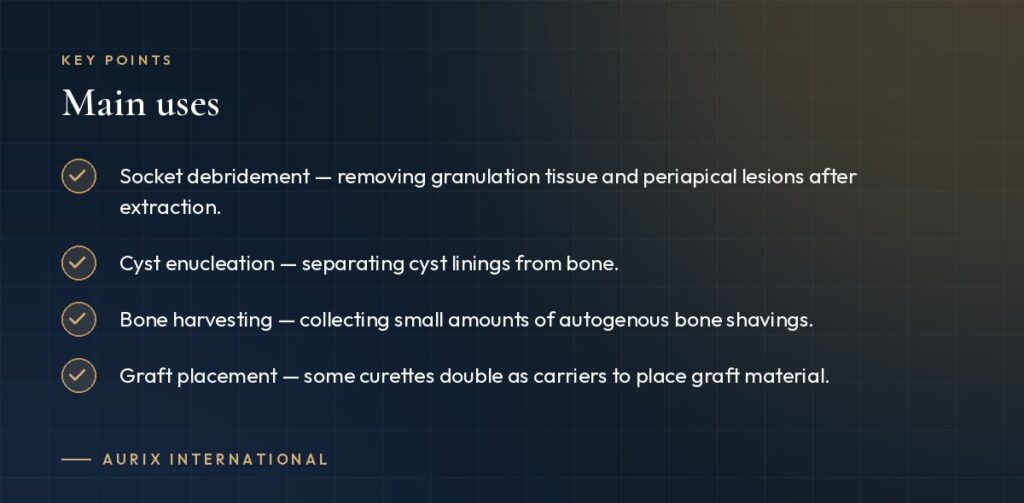
Main uses
- Socket debridement — removing granulation tissue and periapical lesions after extraction.
- Cyst enucleation — separating cyst linings from bone.
- Bone harvesting — collecting small amounts of autogenous bone shavings.
- Graft placement — some curettes double as carriers to place graft material.
Choosing a curette
Size
In general, curettes are made in several cup sizes. Additionally, small cups reach the apex of narrow sockets; larger cups clean molar sockets and cystic cavities more quickly.
Shape
Straight curettes suit anterior and premolar sockets. Angled patterns, such as the Lucas or Molt styles, reach posterior sites more comfortably.
Double-ended designs
Generally, double-ended curettes give two sizes or angles in one instrument, reducing tray clutter.
Technique
- Work around the walls of the socket with firm, controlled strokes.
- In general, keep the rim against bone to lift tissue out in one piece where possible.
- Avoid over-curetting healthy bone, particularly thin buccal walls.
- Irrigate to check that the socket is clean.
Care
Generally, bone debris dries quickly inside the cup. Keep curettes moist until cleaning and use a brush on the inside of the cup before ultrasonic cleaning. Check the rim for nicks; a damaged edge tears tissue rather than cutting it.
Aurix International lists bone curettes individually and in its bone management kits. Contact us for sizes and availability.