Periodontal surgery instruments target precise work on gingiva, root surfaces and the thin bone around teeth. Flap surgery, gingivectomy, crown lengthening and osseous surgery all call for specialized knives, elevators, curettes and bone instruments that differ from a general extraction tray. Here are the ten instruments that appear most often in periodontal surgical setups, with notes on how each is used.
Key takeaways
- Periodontal knives such as the Kirkland and Orban target gingivectomy and interdental incisions.
- Fine scalpel blades and thin periosteal elevators allow precise, conservative flaps.
- Gracey and surgical curettes debride roots and remove granulation tissue once the flap is open.
- Chisels and bone files reshape bone in osseous surgery and crown lengthening.
- Sharp edges are essential; plan for regular sharpening and inspection.
The top 10 periodontal surgery instruments
1. Kirkland knife
The Kirkland knife has a kidney-shaped blade that is sharp around its whole periphery. It is the classic instrument for the primary external bevel incision in gingivectomy and also helps with gingivoplasty on facial and lingual surfaces.
It is usually double-ended, with mirror-image blades for different surfaces.
2. Orban knife
The Orban knife has a narrow, spear-shaped blade with cutting edges on both sides. It helps with interdental incisions, freeing the interdental papilla after the primary gingivectomy incision. Its slim profile fits between teeth where the Kirkland cannot reach.
3. Scalpel handles and blades
Most modern periodontal flaps are made with a No. 3 or round microsurgical handle and No. 15, 15C, 12 or 12B blades. The 15C is popular for sulcular and papilla incisions; the 12 and 12B reach distal and interproximal areas.
Tip: keep a fresh blade ready; thin periodontal tissue is unforgiving of a dull edge.
4. Periosteal elevators
Thin, sharp periosteal elevators such as the Prichard, the Glickman 24G or a narrow Molt reflect full-thickness flaps without tearing the papillae. Narrow working ends help with tunneling and delicate tissue.
5. Surgical curettes
Larger, stronger curettes such as the Prichard surgical curette or Columbia 13/14 remove granulation tissue and fibrous interdental tissue after flap reflection. Their heavier blades handle tissue that would strain a fine scaling curette.
6. Gracey curettes
Once the flap is open, area-specific Gracey curettes debride root surfaces under direct vision. Standard sets cover anterior teeth (1/2, 3/4), premolars and anteriors (5/6), posterior facial and lingual surfaces (7/8, 9/10) and posterior mesial and distal surfaces (11/12, 13/14, 15/16, 17/18). Extended-shank and mini-blade versions reach deeper pockets and narrow furcations.
7. Periodontal chisels
Ochsenbein chisels, with a semicircular notch that lets the blade straddle a tooth, and Wedelstaedt or back-action chisels are common in osseous surgery to remove and reshape bone. They give fine control when recontouring the crest during crown lengthening.
They pair with push or pull strokes, depending on the design, while keeping the edge in contact with bone.
8. Bone files
Periodontal bone files such as the Sugarman and Schluger patterns are thin, serrated instruments for smoothing interdental bone and removing small bony ledges. The Schluger commonly helps with interdental areas; the Sugarman works in both interdental and interradicular areas.
9. Pocket marking forceps
Crane-Kaplan pocket markers look like a pair of tissue forceps with one straight, smooth beak and one beak with a small right-angled tip. The smooth beak goes into the pocket and, when closed, the tip makes a bleeding point on the outer gingiva at the pocket depth. The row of points guides the gingivectomy incision.
10. Tissue forceps, scissors and needle holder
Fine tissue forceps (Adson, micro or Corn suture pliers), Goldman-Fox scissors for trimming tissue tags, and a needle holder (often a Castroviejo for fine sutures) complete the surgical tray. Many periodontal closures use 4-0 to 6-0 sutures, so fine instruments are the norm.
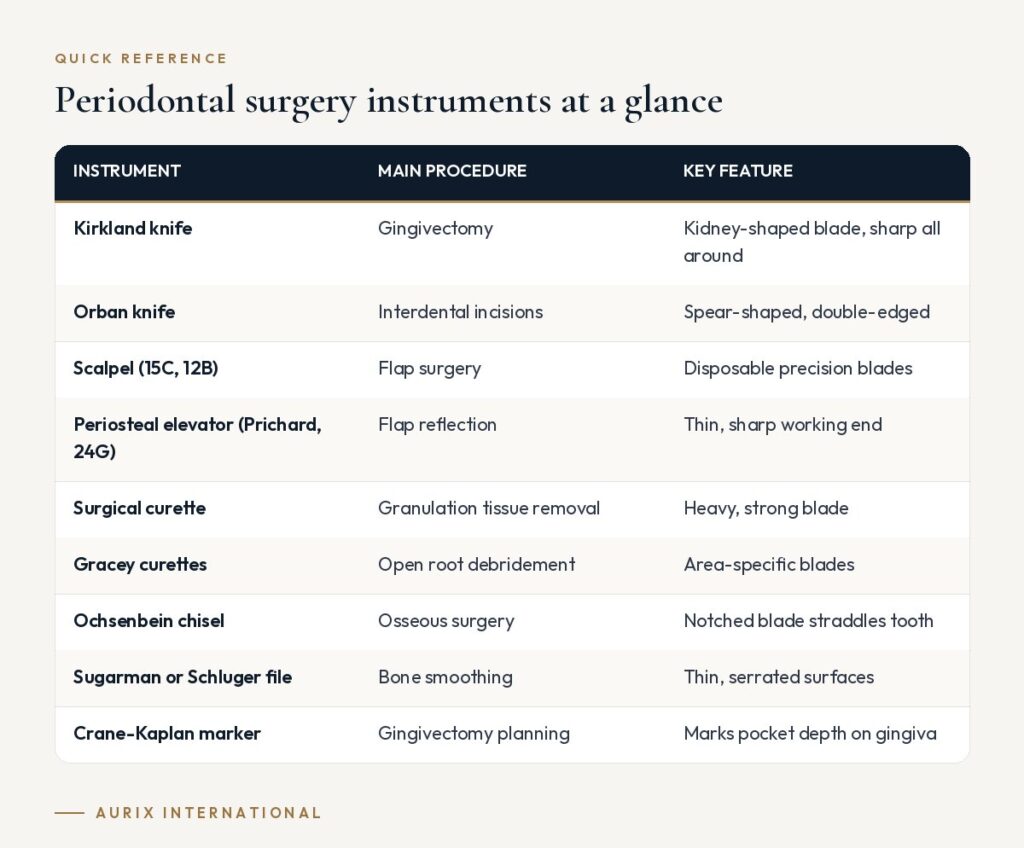
Periodontal surgery instruments at a glance
| Instrument | Main procedure | Key feature |
|---|---|---|
| Kirkland knife | Gingivectomy | Kidney-shaped blade, sharp all around |
| Orban knife | Interdental incisions | Spear-shaped, double-edged |
| Scalpel (15C, 12B) | Flap surgery | Disposable precision blades |
| Periosteal elevator (Prichard, 24G) | Flap reflection | Thin, sharp working end |
| Surgical curette | Granulation tissue removal | Heavy, strong blade |
| Gracey curettes | Open root debridement | Area-specific blades |
| Ochsenbein chisel | Osseous surgery | Notched blade straddles tooth |
| Sugarman or Schluger file | Bone smoothing | Thin, serrated surfaces |
| Crane-Kaplan marker | Gingivectomy planning | Marks pocket depth on gingiva |
How to choose periodontal surgery instruments
- Build around your procedures. A practice that mainly does flap surgery and crown lengthening needs fine blades, thin elevators, curettes, chisels and files. Gingivectomy adds Kirkland and Orban knives and pocket markers.
- Insist on sharp, well-tempered edges. Periodontal knives, chisels and curettes must take and hold an edge. Our article on sharpening curettes and scalers explains how to maintain them.
- Choose Gracey sets thoughtfully. Standard, extended-shank and mini-blade versions suit different pocket depths; see which Gracey number for which tooth.
- Consider handle comfort. Long procedures reward lightweight, larger-diameter handles with good texture.
- Protect fine tips. Use cassettes with secure holders so knives and chisels do not knock against each other.
For the full periodontal toolkit, including non-surgical instruments, see the top 10 periodontal instruments. Teams building or replacing a periodontal setup may also find our guide to choosing a supplier for periodontists and hygiene teams helpful.
Frequently asked questions
What is a Kirkland knife used for?
The Kirkland knife is used mainly for gingivectomy and gingivoplasty. Its kidney-shaped blade, sharp around the edge, makes the primary external bevel incision on facial and lingual surfaces.
What is the difference between a Kirkland and an Orban knife?
The Kirkland has a broad, kidney-shaped blade for the main gingivectomy incision. The Orban has a narrow, spear-shaped blade for interdental incisions where a broader knife cannot fit.
Are Gracey curettes used in periodontal surgery?
Yes. After the flap is reflected, Gracey curettes debride root surfaces under direct vision. Heavier surgical curettes are usually used first to remove granulation tissue.
How are periodontal chisels used?
Chisels such as the Ochsenbein remove and reshape small amounts of bone during osseous surgery and crown lengthening. They pair with controlled push or pull strokes, keeping the edge against bone.
Equip your periodontal tray with sharp, reliable instruments. Aurix International supplies surgical-grade stainless steel Gracey curettes in standard and specialty designs, along with other periodontal instruments. Browse Gracey curettes →