Learning the main surgical instrument families is the fastest way for clinic staff to make sense of a crowded tray. Almost every instrument belongs to a family defined by its job, such as cutting, grasping, clamping or retracting, and the instruments in a family share recognizable features. This guide explains ten families you will meet in dental and oral surgery, with typical examples and tips for telling them apart.
Key takeaways
- Instruments are grouped by function: what they do tells you which family they belong to.
- Ring handles and ratchets show up across several families, so look at the jaws or tips to identify the instrument.
- Instrument names usually combine a pattern name (often a surgeon’s name) with a number or size.
- Learning families makes training, tray setup and ordering faster and more accurate.
- Each family has specific care needs, especially hinged and sharp instruments.
The top 10 surgical instrument families
1. Cutting and dissecting instruments
This family includes scalpel handles and blades, surgical scissors and periodontal knives. Their job is to incise or divide tissue. In dentistry you will see No. 3 scalpel handles with 15, 15C and 12 blades, Goldman-Fox and Iris scissors for tissue, and Kirkland or Orban knives in periodontal trays.
ID tip: scissors have cutting blades that slide past each other; hemostats and needle holders have jaws that meet.
2. Grasping and holding instruments
Tissue forceps (thumb forceps or pickups) such as Adson, Gerald and DeBakey hold tissue without a lock. Tips may be smooth, serrated or toothed (for example 1×2 teeth). College or cotton pliers used in general dentistry are a close relative.
3. Clamping and occluding instruments
Hemostats (mosquito, Kelly, Crile) and clamps such as Allis and Kocher have ring handles, a box joint and a ratchet that locks the jaws closed. They compress vessels, hold tissue or grasp small objects such as root tips.
4. Retracting and exposing instruments
Retractors hold tissue out of the way so the surgeon can see and work. Common dental examples include the Minnesota, Seldin, Weider tongue retractor, Austin and Obwegeser retractors, plus mouth props and bite blocks that keep the mouth open.
5. Suturing instruments
Needle holders such as the Mayo-Hegar and Castroviejo hold curved needles. They often have tungsten carbide jaw inserts, commonly identified by gold-colored handles. Combination instruments such as the Olsen-Hegar include a scissor edge for cutting suture.
ID tip: a needle holder has shorter, stouter jaws with a fine crosshatch pattern; a hemostat has longer, slimmer jaws with transverse grooves.
6. Elevating instruments
Elevators lift tissue or teeth. Periosteal elevators (Molt No. 9, Prichard) reflect mucoperiosteal flaps; root and tooth elevators (straight, Cryer, Heidbrink, luxating) loosen teeth and roots before extraction.
7. Extracting instruments
Extraction forceps are designed for specific teeth and arches, for example 150 and 151 universals for upper and lower teeth, 23 cowhorn for lower molars and 88R/88L for upper molars. Root tip forceps and pediatric forceps belong here too.
8. Bone cutting and contouring instruments
Rongeurs, bone files, chisels, osteotomes and surgical mallets cut, trim, smooth or compact bone. Examples include Blumenthal rongeurs, Miller bone files, Ochsenbein chisels and concave-tipped osteotomes for crestal sinus lifts.
9. Curettes and scraping instruments
Curettes remove tissue or debris from surfaces and cavities. Surgical bone curettes such as the Lucas and Molt clean sockets and defects, while periodontal curettes such as Gracey and universal patterns debride root surfaces. Bone scrapers harvest small amounts of bone.
10. Suction, irrigation and accessory instruments
Surgical aspirator tips (for example Frazier-style tips), irrigation syringes, towel clamps, sponge forceps and mixing wells support the procedure without acting directly on the surgical site. They are easy to overlook but essential for visibility and a clean field.
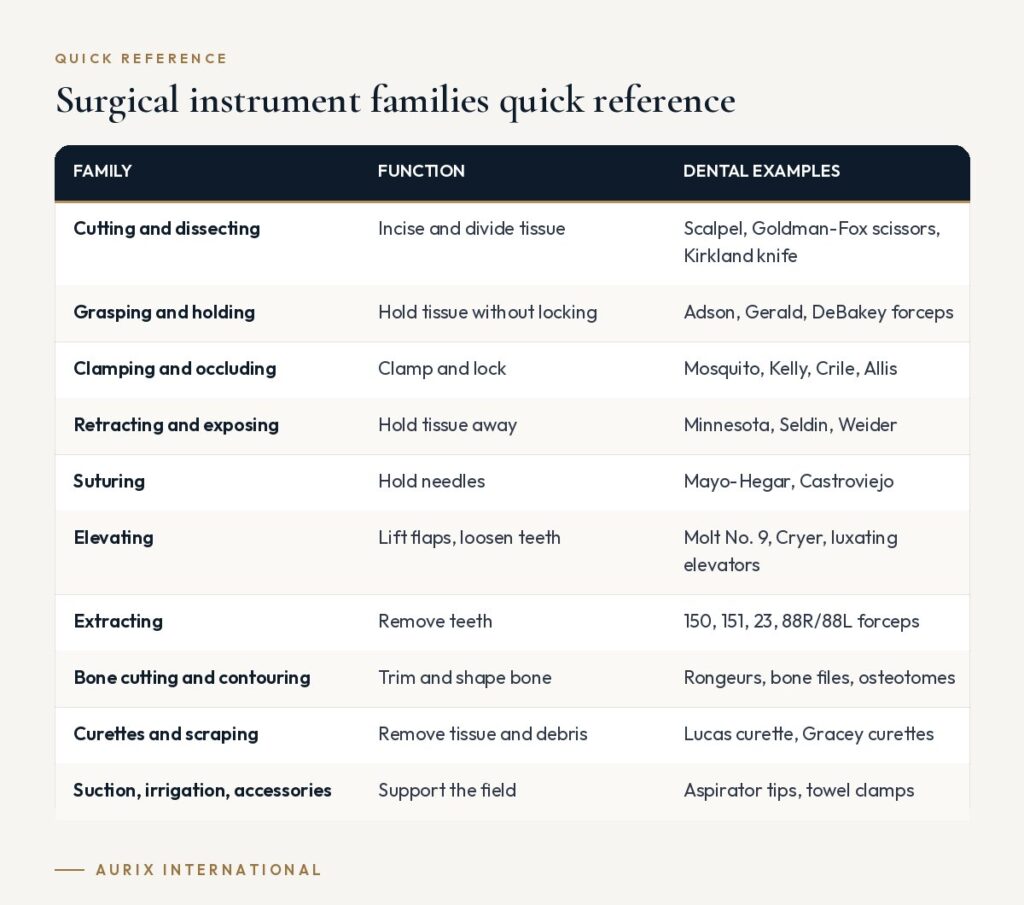
Surgical instrument families quick reference
| Family | Function | Dental examples |
|---|---|---|
| Cutting and dissecting | Incise and divide tissue | Scalpel, Goldman-Fox scissors, Kirkland knife |
| Grasping and holding | Hold tissue without locking | Adson, Gerald, DeBakey forceps |
| Clamping and occluding | Clamp and lock | Mosquito, Kelly, Crile, Allis |
| Retracting and exposing | Hold tissue away | Minnesota, Seldin, Weider |
| Suturing | Hold needles | Mayo-Hegar, Castroviejo |
| Elevating | Lift flaps, loosen teeth | Molt No. 9, Cryer, luxating elevators |
| Extracting | Remove teeth | 150, 151, 23, 88R/88L forceps |
| Bone cutting and contouring | Trim and shape bone | Rongeurs, bone files, osteotomes |
| Curettes and scraping | Remove tissue and debris | Lucas curette, Gracey curettes |
| Suction, irrigation, accessories | Support the field | Aspirator tips, towel clamps |
How to use instrument families in training and buying
- Teach by family first. New assistants learn faster when they group instruments by function before memorizing individual names. Our guide to training new assistants on instrument identification has practical exercises.
- Learn the anatomy. Terms such as ring handle, ratchet, box joint, shank and working end apply across families. The glossary of dental instrument terms covers them.
- Order by family. When reviewing inventory, check each family for gaps: do you have enough needle holders, the right retractors, sharp scissors?
- Care by family. Hinged instruments need opening and lubrication; sharp instruments need sharpening and safe handling; delicate tips need protection in cassettes.
For a broader introduction, see surgical instrument basics: names and families for clinic staff, and for a procedure-based view of the same instruments, the top 15 oral surgery instruments.
Frequently asked questions
What are the main categories of surgical instruments?
The most common grouping is by function: cutting, grasping, clamping, retracting, suturing, plus specialty families such as elevating, extracting, bone cutting and curettes. Different textbooks group them slightly differently.
Why are so many surgical instruments named after people?
Many patterns are named after the surgeon who designed or popularized them, such as Kelly, Mayo, Adson or Gracey. The name identifies the pattern; numbers usually identify a size or working-end variation.
How can I tell a needle holder from a hemostat?
Look at the jaws. Needle holders have short, wide jaws with a fine crosshatch pattern, often with carbide inserts. Hemostats have longer, narrower jaws with transverse serrations.
Do instrument families need different cleaning methods?
The basic process is the same, but follow each IFU. Hinged instruments must be processed open and lubricated, and instruments with lumens such as aspirator tips need channel cleaning.
Need help filling gaps across instrument families? Aurix International supplies surgical-grade stainless steel instruments in every core family, individually or as kits. Talk to our team →