
Oral surgery instruments follow the sequence of a procedure: incise, reflect, retract, remove, smooth, clean and close. Knowing the core instruments, what each one does and how they work together helps surgeons, assistants and purchasing staff build trays that are complete without being cluttered. This list covers the 15 instruments most oral surgery and general dental practices rely on for surgical extractions and minor oral surgery.
Key takeaways
- A basic surgical tray covers five stages: incision, flap reflection, tooth or bone removal, debridement and closure.
- The #3 scalpel handle with a 15 or 15C blade is the standard for intraoral incisions.
- Retractors such as the Minnesota, Seldin and Weider protect soft tissue and improve visibility.
- Rongeurs, bone files and surgical curettes manage bone and clean the socket.
- Needle holders, tissue forceps and suture scissors complete the closure set.
The top 15 oral surgery instruments
1. Scalpel handle and blades
The #3 scalpel handle is the standard for oral surgery, used with the 15 blade for most intraoral incisions, the smaller 15C for papillae and tight areas, and the curved 12 or 12B for incisions behind the molars and around tooth necks.
Tip: Use a blade remover or forceps to load and unload blades, never fingers.
2. Periosteal elevator
The periosteal elevator, most often the Molt #9, reflects a full-thickness mucoperiosteal flap from the bone. The pointed end lifts papillae and starts reflection, while the broad end continues the elevation.
Tip: Keep the instrument in contact with bone to avoid tearing the flap. See our guide to choosing periosteal elevators for widths and tips.
3. Minnesota retractor
The Minnesota retractor is an offset, curved retractor used to hold back the cheek and a reflected flap at the same time. It is one of the most common retractors in third molar surgery.
4. Seldin retractor
The Seldin retractor has a smooth, curved blade used to retract the mucoperiosteal flap and protect it during bone removal. Many surgeons use it alongside a Minnesota or in place of a periosteal elevator for flap retraction.
5. Weider tongue retractor
The Weider has a broad, heart-shaped blade with a serrated surface that holds the tongue away from the lingual side of the mandible, protecting it from burs and blades.
Tip: Position it gently and avoid pressure on the floor of the mouth.
6. Surgical suction tip
A narrow surgical aspirator, such as a Frazier-style tip, removes blood, irrigant and debris to keep the field visible. Most have a thumb port to control suction strength and a stylet for clearing blockages.
7. Elevators
Straight elevators luxate teeth and roots, while paired elevators such as Cryers and fine root tip picks deal with multi-rooted teeth and fractured apices. Our list of the top 10 dental elevators covers the main patterns.
8. Extraction forceps
Forceps deliver the tooth once it has been loosened. A surgical tray usually includes a universal upper and lower pair (150 and 151) plus molar patterns like the 53R/53L or 23, chosen according to the planned extraction.
9. Rongeur
Rongeurs have sharp, cup-shaped jaws that cut and remove bone. Side- and end-cutting designs such as the Blumenthal are used to trim sharp alveolar edges and contour bone after extractions.
Tip: Take small bites rather than large ones to avoid stressing the hinge.
10. Bone file
Bone files, such as Miller-pattern files, smooth small bony irregularities left after rongeur use. They cut on the pull stroke, so they should be drawn rather than pushed across the bone.
11. Surgical curette
Surgical curettes (often Lucas-pattern or Molt-pattern) are spoon-shaped instruments used to remove granulation tissue, small cysts and debris from extraction sockets. Learn more in our article on bone curettes for socket debridement.
12. Hemostat
Curved or straight mosquito hemostats clamp small vessels, retrieve small root fragments and hold tissue or sutures. Their locking ratchet keeps the grip without hand pressure.
13. Tissue forceps
Adson forceps, with or without teeth, stabilize the flap during suturing and handling. Toothed (1×2) versions grip securely with less crushing pressure than serrated jaws.
14. Needle holder
The Mayo-Hegar is the most common needle holder in oral surgery, with a locking ratchet and serrated or carbide-insert jaws. Finer patterns such as the Castroviejo are preferred for small-gauge sutures.
15. Suture scissors
Suture scissors cut suture tails after knotting. Dean or Goldman-Fox scissors are also used to trim soft tissue, while dedicated stitch scissors are kept for suture removal.
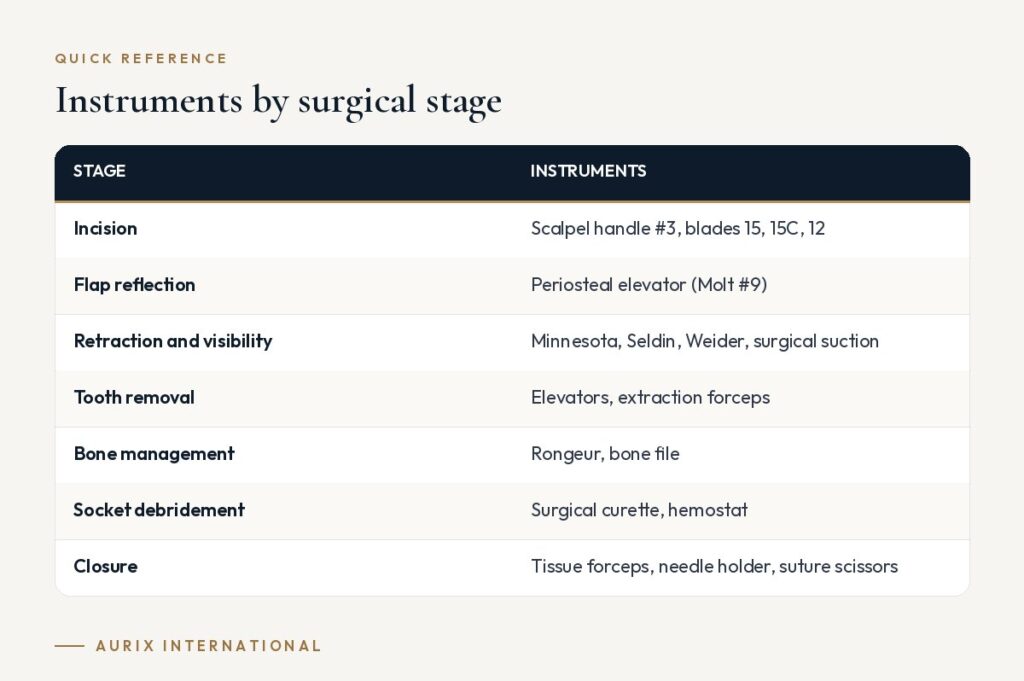
Instruments by surgical stage
| Stage | Instruments |
|---|---|
| Incision | Scalpel handle #3, blades 15, 15C, 12 |
| Flap reflection | Periosteal elevator (Molt #9) |
| Retraction and visibility | Minnesota, Seldin, Weider, surgical suction |
| Tooth removal | Elevators, extraction forceps |
| Bone management | Rongeur, bone file |
| Socket debridement | Surgical curette, hemostat |
| Closure | Tissue forceps, needle holder, suture scissors |
How to choose oral surgery instruments
- Build around procedures. List the surgeries you perform most and assemble a tray for each, rather than buying instruments one at a time without a plan.
- Prioritize steel quality. Cutting instruments such as rongeurs and scissors need hardened stainless steel that holds an edge; retractors need rigidity.
- Check hinges and ratchets. Needle holders and hemostats should lock securely and release cleanly.
- Use cassettes. Keeping a complete set in a cassette protects instruments and speeds up setup and sterilization.
- Consider kits. Pre-assembled or custom surgical kits make sure nothing is missing at chairside.
- Follow the IFU. Clean, inspect, package and sterilize each instrument according to the manufacturer’s instructions and CDC guidance.
Frequently asked questions
What instruments are used in a surgical extraction?
A typical surgical extraction uses a scalpel, periosteal elevator, retractors, surgical suction, a handpiece and bur for bone removal or sectioning, elevators, forceps, a rongeur or bone file, a surgical curette and suturing instruments.
Which scalpel blade is most common in oral surgery?
The 15 blade on a #3 handle is the most common choice for intraoral incisions. The 15C and 12 or 12B are used for tighter or curved areas.
What is the difference between a rongeur and a bone file?
A rongeur cuts and removes bone with its jaws, making it suited to larger corrections. A bone file smooths small irregularities that remain after the rongeur.
Do I need a separate tray for each type of oral surgery?
Many practices use one core surgical tray and add procedure-specific instruments, such as implant or grafting instruments, as needed. Dedicated trays for frequent procedures save setup time.
Put together a complete oral surgery tray. Aurix International offers surgical-grade stainless steel oral surgery instruments individually or in custom kits built around your procedures. Build your surgical kit →