
Dental elevators loosen teeth and roots before you apply forceps, and in many cases they complete the extraction on their own. Also, using the right elevator reduces the force needed, protects the buccal plate and lowers the risk of fractured roots. Below are the 10 elevator patterns most commonly found on extraction trays, with notes on when to use each and how to choose.
Key takeaways
- Straight elevators are the first instrument used in most extractions to sever fibers and luxate the tooth.
- Paired angled elevators such as the Cryer, Potts and Apexo reach roots that a straight blade cannot.
- Fine root tip picks (Heidbrink, Flohr, Bein) retrieve fractured apices.
- Luxating elevators are wedging and cutting instruments, not levers.
- Always use a finger rest and protect adjacent teeth and soft tissue.

The top 10 dental elevators
1. Straight elevator
The straight elevator has a concave blade on a straight shank and is the most widely used elevator in general practice. In addition, common sizes include the 301 (small), 34S, 46 and 77R (larger blades). You place it into the periodontal ligament space and rotate it to expand the socket and luxate the tooth.
Tip: Keep the concave side facing the tooth and never use the adjacent tooth as a fulcrum unless you are also extracting it.
2. Cryer elevators (East and West)
Cryer elevators come in pairs, with triangular blades angled to the left and right. Clinicians classically use them to remove the remaining root of a mandibular molar after the other root has been taken out: the tip is placed into the empty socket and turned to engage the interradicular bone and the remaining root.
Tip: Cryers produce significant force, so use controlled rotation and watch the bone between roots.
3. Coupland elevators
Coupland elevators have a chisel-like, gouge-shaped blade and usually come in graduated sizes 1, 2 and 3. Generally, they enter the PDL space, luxate teeth and roots, and can help split sectioned roots apart.
Tip: Start with the smallest size to create space, then step up as the socket expands.
4. Bein elevator
The Bein is a straight elevator with a narrow, slightly concave blade. Furthermore, it helps with smaller teeth, narrow interproximal spaces and roots where a standard straight elevator is too wide.
Tip: It works well for initial luxation of anterior teeth and premolars where bone is thin.
5. Heidbrink root tip picks
Heidbrink elevators are fine, delicate root tip picks, typically sold as a set of three (1, 2 and 3) with different angulations. In practice, they tease out small fractured apical fragments once they have gained access.
Tip: These are thin instruments, so use gentle pressure and do not use them to luxate whole teeth.
6. Flohr elevators
Flohr elevators are fine root elevators with slender blades, often supplied as a straight and paired angled set. They help with root fragments and residual roots, particularly where a wider elevator would damage surrounding bone.
Our article on Heidbrink, Bein, Flohr and Cryer elevators compares these fine patterns side by side.
7. Potts elevators
Potts elevators come as a pair of angled elevators used to reach roots and teeth in the posterior mandible where a straight blade cannot be seated at the right angle. Moreover, they often help with lower molar roots and third molars.
Tip: Choose the side (right or left) so the blade engages the root from the mesial or buccal aspect without straining your wrist.
8. Apexo-pattern elevators
Apexo-style elevators come as a straight elevator and a paired set of angled elevators with fine, slender tips. Also, they target apical root fragments and roots in posterior areas where access is tight.
Tip: Good lighting and suction are essential when working near the apex, especially in the posterior maxilla close to the sinus.
9. Crane pick
The Crane pick is a heavy, single-ended pick used as a lever. A purchase point is often drilled into the root with a bur, and the clinician seats the pick tip in that point to elevate the root out of the socket.
Tip: Use bone as the fulcrum, not adjacent teeth, and keep a finger rest close to the working area.
10. Luxating elevators
Luxating elevators have very thin, sharp blades designed to cut the periodontal ligament and wedge gently down the root surface. In addition, they are popular in atraumatic extraction techniques where preserving bone for implant placement matters.
Tip: Never use luxators to pry or lever, as the fine blade can bend or chip. Read more in luxating elevators vs traditional elevators.
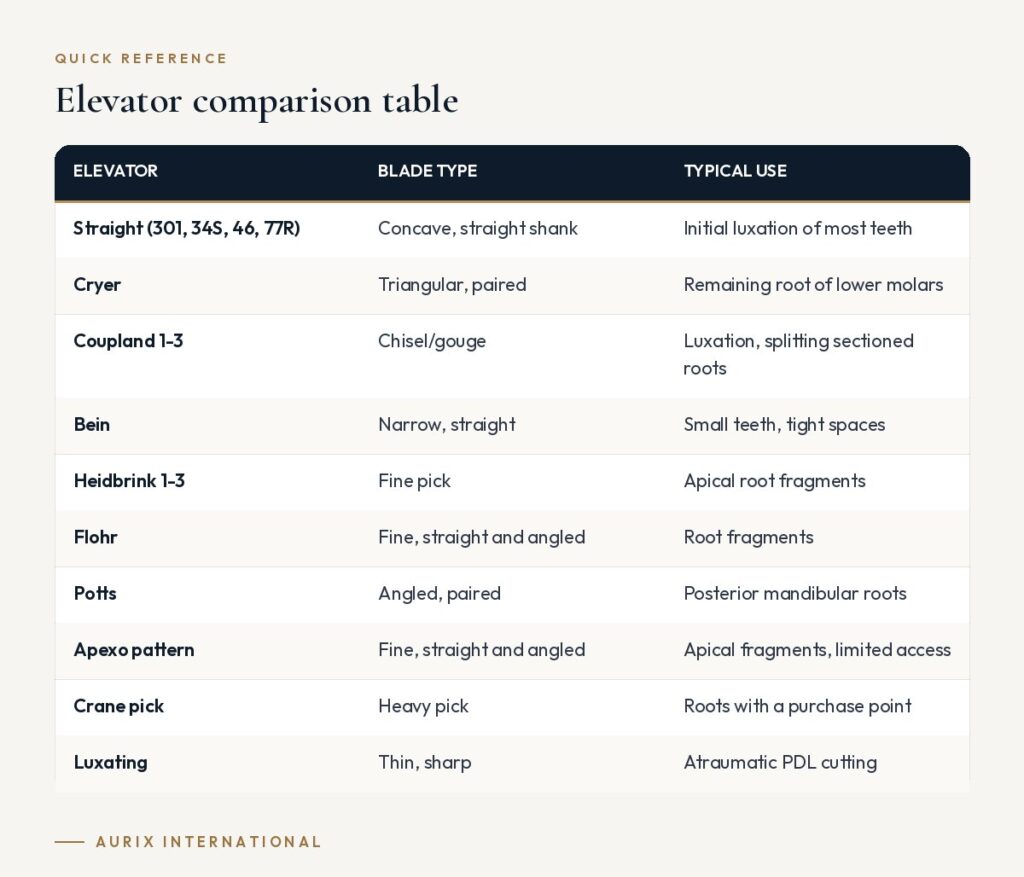
Elevator comparison table
| Elevator | Blade type | Typical use |
|---|---|---|
| Straight (301, 34S, 46, 77R) | Concave, straight shank | Initial luxation of most teeth |
| Cryer | Triangular, paired | Used when remaining root of lower molars |
| Coupland 1-3 | Chisel/gouge | Luxation, splitting sectioned roots |
| Bein | Narrow, straight | Small teeth, tight spaces |
| Heidbrink 1-3 | Fine pick | Apical root fragments |
| Flohr | Fine, straight and angled | Root fragments |
| Potts | Angled, paired | Posterior mandibular roots |
| Apexo pattern | Fine, straight and angled | Apical fragments, limited access |
| Crane pick | Heavy pick | Roots with a purchase point |
| Luxating | Thin, sharp | Atraumatic PDL cutting |
How to choose dental elevators
- Cover the basics first. A small and a large straight elevator, a pair of Cryers and a set of fine root tip picks will handle most routine extractions.
- Match the blade to your technique. If you aim to preserve bone for implants, add luxating elevators and fine Apexo-style instruments.
- Look at the handle. Pear-shaped or palm handles give more control for rotational movements, while slimmer handles suit fine picks.
- Inspect the working end. Blades should be sharp and free of burrs, and tips should be symmetrical in paired sets.
- Maintain the edge. Check luxators regularly and replace bent or chipped instruments rather than trying to straighten them.
Our guide to root elevators, types and uses covers the less common patterns in more depth.
Frequently asked questions
What is the most commonly used dental elevator?
Clinicians use the straight elevator most often. It is the first instrument introduced into the PDL space in most extractions and comes in several blade widths.
What is the difference between an elevator and a luxator?
A traditional elevator works mainly by leverage, wheel-and-axle and wedge actions. A luxator has a thinner, sharper blade designed to cut the PDL and wedge along the root, and you should not use it as a lever.
When are Cryer elevators used?
Cryers commonly help with mandibular molars once you have removed one root, by placing the tip into the empty socket to engage the remaining root and the interradicular bone.
How do I avoid damaging adjacent teeth with an elevator?
Use bone rather than neighboring teeth as the fulcrum, maintain a stable finger rest, and keep forces controlled. Generally, protect soft tissues with a finger or retractor in case the instrument slips.
Need elevators for a busy surgical practice? Aurix International supplies surgical-grade stainless steel elevators individually, in pre-assembled kits and at wholesale volumes for practices and distributors. Explore wholesale options →