
Many oral surgery kits list elevators by name: Heidbrink, Bein, Flohr, Cryer. For new clinicians and assistants the names can be confusing. Here is what each pattern looks like and when it is used.
Bein elevators
The Bein is a straight elevator with a slightly concave blade. It starts luxation of single-rooted teeth and to loosen roots before forceps are applied. Bein elevators come in several blade widths: narrower blades for incisors and premolars, wider ones for larger roots.
When to use: the first instrument into the socket on most routine extractions.
Cryer elevators
Cryer elevators have a short, triangular blade set at an angle to the shank, and they are supplied as a left and right pair. The point is placed into an empty root socket or into the furcation, and the instrument is rotated so the blade engages the remaining root and lifts it out.
When to use: removing the second root of a lower molar after the first has been extracted, or elevating sectioned roots.
Heidbrink elevators
Heidbrink root elevators have very fine, pointed blades. They target the delicate work of removing small apical fragments that remain after a root fractures.
When to use: retained root tips at the base of the socket, particularly where you want to avoid removing extra bone.
Flohr elevators
Flohr elevators have angled working ends that reach roots where straight instruments cannot, for example in the posterior maxilla. Like Cryers, they often come as a pair.
When to use: root fragments with restricted access or awkward angles.
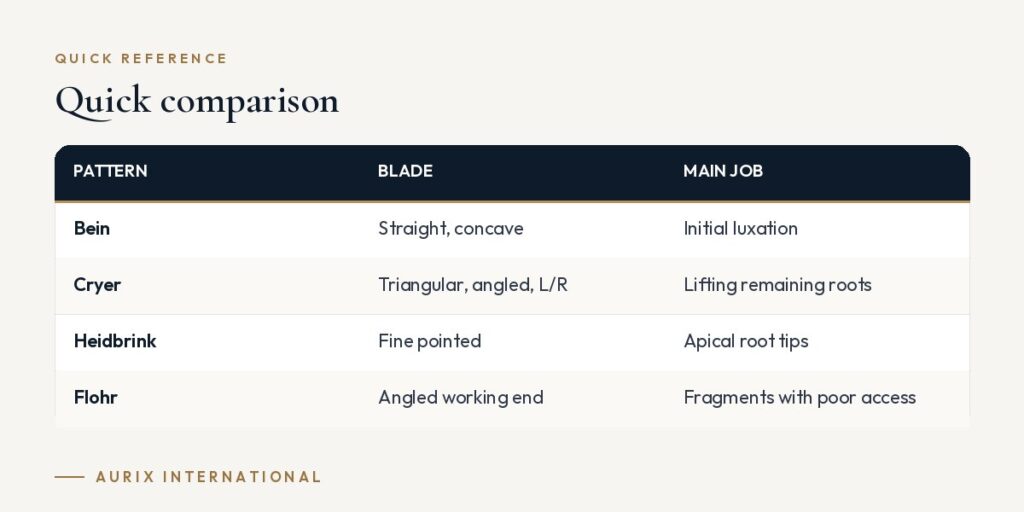
Quick comparison
| Pattern | Blade | Main job |
|---|---|---|
| Bein | Straight, concave | Initial luxation |
| Cryer | Triangular, angled, L/R | Used when lifting remaining roots |
| Heidbrink | Fine pointed | Apical root tips |
| Flohr | Angled working end | Fragments with poor access |
Keeping elevators sharp
Elevators work best with a crisp edge and point. Inspect them under magnification each month; a rounded point slips and increases the risk of injury. Fine-pointed patterns such as the Heidbrink can bend if used as heavy levers, so reserve them for fragments.
Finding them in one kit
The Aurix Root Elevation Instrument Kit includes Heidbrink, Bein, Flohr and Cryer patterns together with double-ended periosteal elevators and a sterilisation cassette, so every elevator you need for root work is in one place.