
Luxating elevators, often called luxators, have become standard in many practices as interest in atraumatic extraction has grown. They look like elevators, but they are designed and used differently. Mixing up the two is a common reason luxators break.
How a traditional elevator works
A traditional elevator is a lever. Also, its blade is relatively thick and strong. It is placed between tooth and bone and rotated or levered to expand the socket and lift the tooth.
How a luxator works
A luxator has a thin, sharp, tapered blade. In addition, it is pushed gently down the periodontal ligament (PDL) space with a slight rocking motion, cutting the ligament fibres and creating space around the root. It works by severing and wedging, not by leverage.
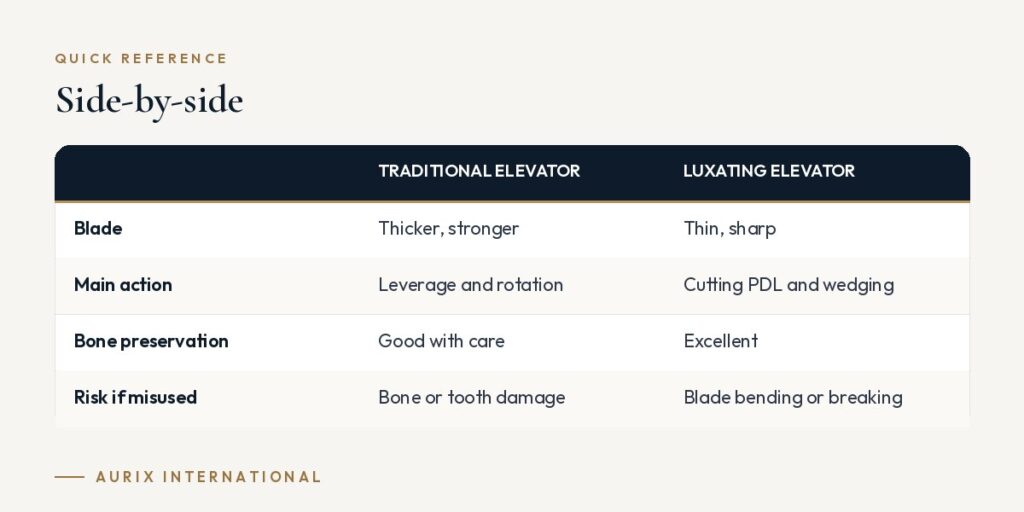
Side-by-side
| Traditional elevator | Luxating elevator | |
|---|---|---|
| Blade | Thicker, stronger | Thin, sharp |
| Main action | Leverage and rotation | Used when cutting PDL and wedging |
| Bone preservation | Good with care | Excellent |
| Risk if misused | Bone or tooth damage | Blade bending or breaking |
Why clinicians use luxators
- They help preserve the buccal plate, which matters when an implant is planned.
- They reduce the force needed for forceps delivery.
- They can reduce post-operative discomfort when used gently.
Using luxators correctly
- Hold the luxator with the handle in the palm and the index finger close to the blade.
- Insert the blade into the PDL space parallel to the root.
- Advance apically with gentle pressure and small rocking movements around the circumference of the tooth.
- Switch to an elevator or forceps once the tooth is mobile.
A luxator is a scalpel for the ligament, not a crowbar for the tooth.
Caring for luxators
Store luxators in a cassette with blade protectors and keep them separate from heavier instruments. Generally, check the edge regularly and have them resharpened or replaced when the tip becomes rounded.
Using both together
Most clinicians use luxators to begin, then switch to straight elevators for controlled leverage and finally forceps. The Aurix Atraumatic Luxation System is an 8-piece luxating elevator kit designed for exactly this workflow.