Haemostats and clamps (spelled “hemostats” in the US) are among the most versatile instruments on a dental surgery tray. Originally designed to clamp bleeding vessels, they are common in the mouth to grasp root tips, retrieve fragments, hold gauze and tissue, and secure drapes. Knowing the differences between the common patterns helps you stock the right ones and use each for its intended job.
Key takeaways
- Small mosquito hemostats are the most useful pattern for intraoral work.
- Kelly hemostats have serrations on the tip half of the jaw; Crile hemostats are serrated along the full jaw.
- Toothed clamps such as Kocher and Allis hold tissue firmly but are traumatic, so use them only where that grip is needed.
- Hemostats are not needle holders and should not be used to hold suture needles.
- Always process hemostats unlocked and lubricate the box joint as the IFU directs.
The top 10 haemostats and clamps for dental surgery
1. Halsted mosquito hemostat, straight
The straight Halsted mosquito is a small, fine-jawed hemostat with transverse serrations along the full jaw. In dentistry it grasps small bleeding points, hold suture ends, pick up small fragments and handle gauze in tight spaces.
Its slim tips make it the most practical general-purpose clamp for the oral cavity.
2. Halsted mosquito hemostat, curved
The curved version has the same fine jaws with a gentle curve that improves visibility and access around the arch. Many clinicians prefer curved mosquitos for retrieving root tips or debris from a socket because the curve keeps the hand out of the line of sight.
Tip: keep at least one curved mosquito in every extraction setup; it often saves time when a small fragment needs to be lifted out.
3. Hartmann mosquito hemostat
The Hartmann is an even smaller mosquito pattern with short, delicate jaws. It suits very fine work, such as handling small tissue tags or fine sutures in periodontal and pediatric procedures.
Because it is delicate, avoid using it on heavy tissue or bone fragments that could spring the jaws.
4. Kelly hemostat
The Kelly is a medium-sized hemostat with transverse serrations on the distal (tip) half of the jaws only. It is sturdier than a mosquito and is useful for clamping larger tissue, holding gauze packs and retrieving larger fragments.
It is more common in oral and maxillofacial surgery than in general dental trays.
5. Crile hemostat
The Crile looks very similar to the Kelly, but its serrations run the full length of the jaws. Also, that gives a more secure grip along the whole jaw, which some surgeons prefer for holding tissue or packing.
The simplest way to tell a Kelly from a Crile is to look at the serrations: half-length means Kelly, full-length means Crile.
6. Rochester-Pean forceps
The Rochester-Pean is a larger hemostat with full-length transverse serrations and broad jaws. In dental settings it is mostly used in hospital-based oral and maxillofacial surgery for heavier tissue and for holding sponges or drapes.
7. Kocher (Ochsner) forceps
Kocher forceps resemble a large hemostat but have interlocking 1×2 teeth at the tip. The teeth give a very secure hold on dense or slippery tissue, at the cost of more tissue trauma.
Use them selectively, usually in maxillofacial procedures where a firm grip on fibrous tissue is essential.
8. Allis tissue forceps
Allis forceps have ring handles, a ratchet and a row of fine interlocking teeth at the tip. They grasp and hold tissue that will be excised, such as a soft-tissue lesion during biopsy, while the surgeon dissects around it.
Because the teeth can mark healthy tissue, Allis forceps are best kept for tissue that is being removed.
9. Backhaus towel clamp
The Backhaus towel clamp has sharp, curved, pointed tips that meet when the ratchet closes. It secures drapes, towels and suction or handpiece tubing to the drape during sterile surgical procedures.
Tip: handle towel clamps with the same care as other sharps. In addition, the points can puncture gloves and skin.
10. Foerster sponge forceps
Foerster sponge forceps have long shanks and ring-shaped, serrated jaws. They hold gauze sponges for skin preparation and for blotting or packing during larger procedures.
They are common in hospital and surgical-center oral surgery setups and less frequent in general dental offices.
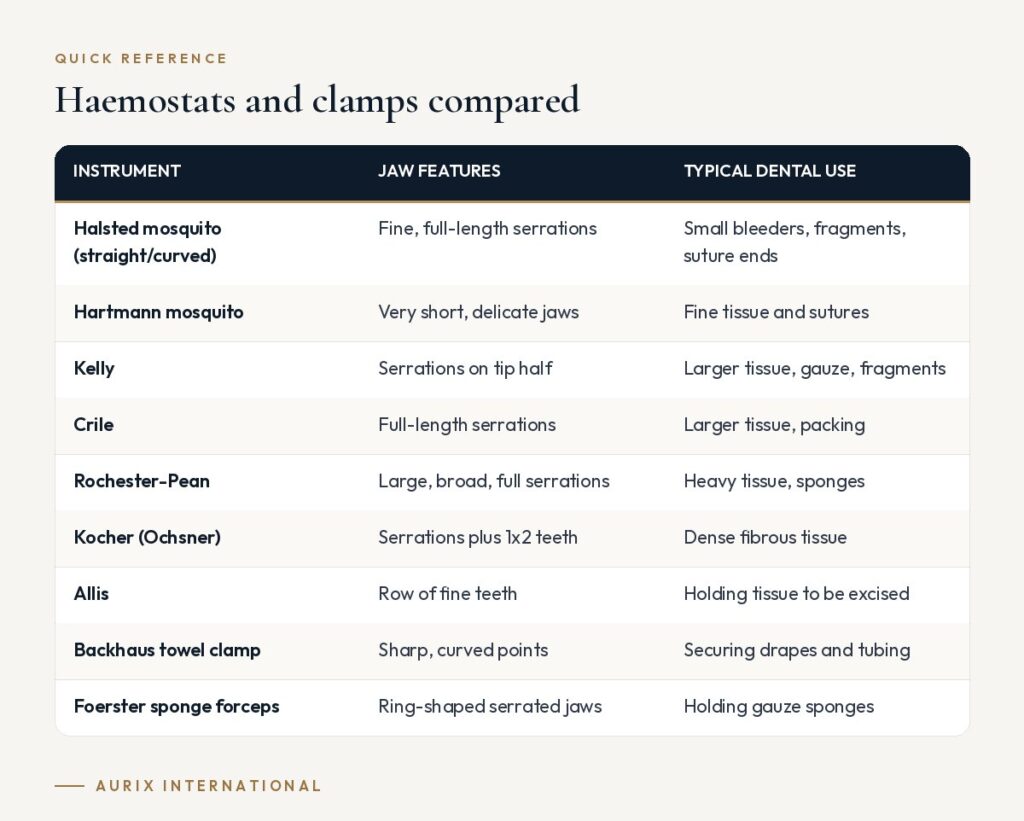
Haemostats and clamps compared
| Instrument | Jaw features | Typical dental use |
|---|---|---|
| Halsted mosquito (straight/curved) | Fine, full-length serrations | Small bleeders, fragments, suture ends |
| Hartmann mosquito | Very short, delicate jaws | Fine tissue and sutures |
| Kelly | Serrations on tip half | Larger tissue, gauze, fragments |
| Crile | Full-length serrations | Larger tissue, packing |
| Rochester-Pean | Large, broad, full serrations | Heavy tissue, sponges |
| Kocher (Ochsner) | Serrations plus 1×2 teeth | Dense fibrous tissue |
| Allis | Row of fine teeth | Used when holding tissue to be excised |
| Backhaus towel clamp | Sharp, curved points | Used when securing drapes and tubing |
| Foerster sponge forceps | Ring-shaped serrated jaws | Holding gauze sponges |
How to choose haemostats and clamps
- Stock by procedure, not by catalog. Most general practices need two or three mosquito hemostats (straight and curved). Oral surgery and hospital practices add Kelly or Crile, Allis and towel clamps.
- Check jaw alignment. Close the instrument on the first ratchet: the tips should meet first and the serrations should mesh without overlapping or gaps.
- Test the ratchet. Each click should hold firmly and release with a light squeeze. A ratchet that springs open is a safety problem.
- Inspect the box joint. Stains, cracks or stiffness in the joint are signs that cleaning or lubrication is falling short, or that the instrument needs replacing.
- Keep sets consistent. Using the same patterns across operatories makes training simpler and trays faster to assemble.
For a deeper comparison of patterns, read our guide to haemostats and clamps in dental surgery, and see tissue forceps and pickups for oral surgery for the non-locking alternatives. Hinged instruments last much longer when they are cleaned promptly and processed unlocked; our article on lubricating hinged instruments explains why. A broader overview of the tray is in our list of the top 15 oral surgery instruments.
Frequently asked questions
What is the difference between a Kelly and a Crile hemostat?
Both are medium-sized curved or straight hemostats. A Kelly has serrations only on the distal half of the jaws, while a Crile has serrations along the full length of the jaws.
Which hemostat is best for dental extractions?
A curved Halsted mosquito hemostat is the most useful for extractions. Generally, it is small enough to work in the socket and can retrieve root fragments, debris or a dislodged restoration piece.
Can hemostats be used to hold suture needles?
No. Hemostat jaws are not designed for needles and can damage them. Use a needle holder, which has jaws made specifically to grip curved needles.
Should hemostats be sterilized locked or open?
Open or on the first ratchet at most, as directed by the IFU. Locked instruments trap debris in the box joint and keep steam from contacting all surfaces, and constant tension can stress the joint.
Equip every surgical tray with the right clamps. Aurix International supplies surgical-grade stainless steel hemostats and clamps for clinics, groups and resellers, including wholesale quantities. Ask about wholesale hemostats →