
Hinged instruments — extraction forceps, scissors, needle holders, haemostats and rongeurs — rely on smooth joints. Repeated cleaning and sterilisation remove natural lubrication from the joint, leading to stiffness, wear and eventually cracking.
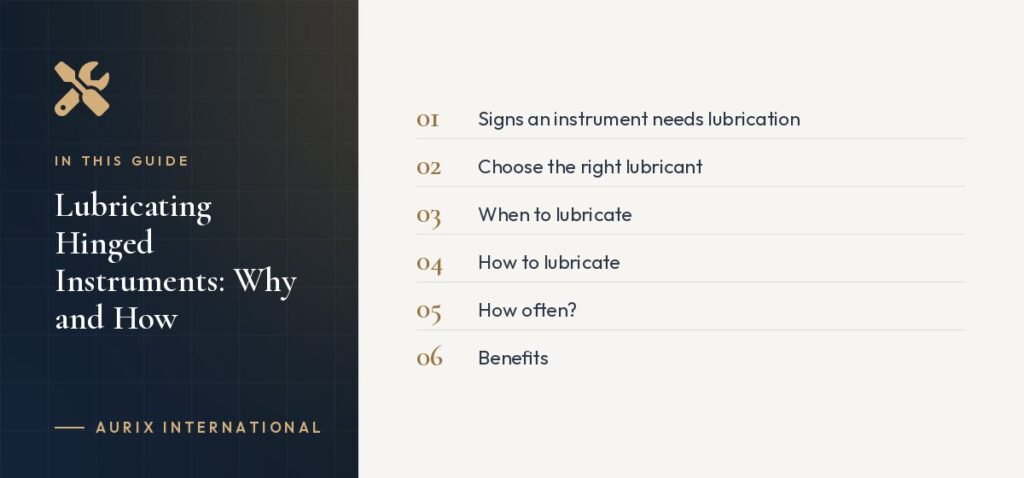
Signs an instrument needs lubrication
- The joint feels stiff or gritty.
- Scissors or forceps squeak when opened.
- Ratchets do not engage smoothly.
- Stains appear around the joint.
Choose the right lubricant
Use a water-soluble, steam-permeable instrument lubricant (sometimes called instrument milk) or a lubricant spray designed for surgical instruments. Do not use household oils or silicone sprays; they block steam penetration and attract debris.
When to lubricate
Lubricate after cleaning and before sterilisation, so the lubricant is sterilised with the instrument.
How to lubricate
- Clean and rinse the instrument thoroughly.
- With the joint open, apply lubricant to the hinge, box joint and ratchet — either by dipping in instrument milk or by spraying.
- Work the joint open and closed a few times.
- Remove excess lubricant (follow the product instructions — some are left to drain).
- Package and sterilise.
How often?
Follow the lubricant manufacturer’s guidance. Many clinics lubricate hinged instruments after every cleaning cycle; others weekly. Instruments cleaned in washer-disinfectors with aggressive detergents generally need more frequent lubrication.

Benefits
- Smoother action and better control.
- Less wear on joints and ratchets.
- Reduced risk of stress cracks.
- Longer instrument life.
Combine lubrication with a monthly inspection to catch problems early.