Haemostats are ring-handled, locking clamps. Their original job is to clamp bleeding vessels, but in dentistry they are used for much more: holding tissue, grasping root fragments, retrieving dropped items and securing drapes or suction tubing.
How a haemostat works
A haemostat has serrated jaws, a box joint and a ratchet between the finger rings. Closing the rings engages the ratchet so the jaws stay clamped without the user holding them. Squeezing slightly and moving the rings apart releases the lock.
Common patterns
Mosquito (Halsted) haemostat
Small and fine, with narrow jaws. The most common haemostat in dentistry, used for small vessels, fragments and fine tissue. Available straight or curved.
Kelly haemostat
Larger, with serrations only on the distal half of the jaws. Useful where a firmer grip on larger tissue is needed.
Crile haemostat
Similar in size to the Kelly but with serrations along the full jaw length.
Kocher clamp
Has teeth at the tip for a secure hold on dense tissue. Less common in routine dentistry.
Towel clamps
Backhaus and similar towel clamps hold drapes and tubing in place during longer surgical procedures.
Everyday dental uses
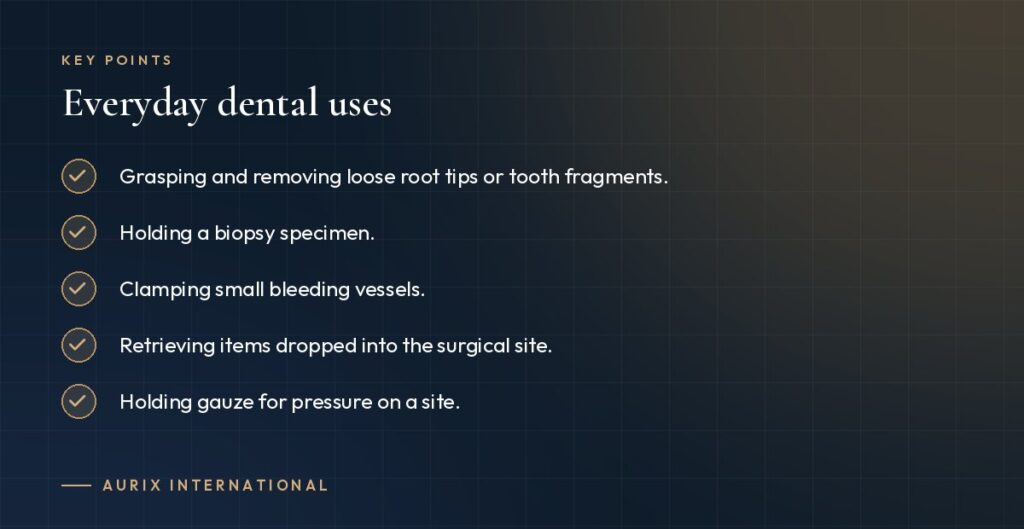
- Grasping and removing loose root tips or tooth fragments.
- Holding a biopsy specimen.
- Clamping small bleeding vessels.
- Retrieving items dropped into the surgical site.
- Holding gauze for pressure on a site.
Choosing clamps
Most clinics only need a curved mosquito in every surgical kit plus a straight one as a back-up. Larger patterns and towel clamps are useful in clinics that perform longer procedures under sedation.
Care
Always open the ratchet and jaws before cleaning and sterilisation; a locked clamp traps debris in the box joint and puts stress on the metal, which can lead to cracks. Lubricate joints regularly and check that the ratchet holds firmly.
Aurix International lists clamps in its catalogue and includes them in suturing and surgical kits. Ask our team for patterns and sizes.