Surgical stainless steel is the material behind almost every reusable dental hand instrument, from mirrors and explorers to forceps, elevators and curettes. Yet the term is widely used and rarely explained. Understanding a few core facts about the steel helps you buy better instruments, care for them properly and spot misleading marketing claims.
Key takeaways
- Stainless steel resists corrosion because chromium forms a thin, self-repairing passive layer.
- Cutting instruments use hardenable martensitic grades; some non-cutting items use austenitic grades.
- “Stainless” does not mean stain-proof: chlorides, residues and poor water quality cause spotting and pitting.
- Correct cleaning, drying and lubrication following the IFU keep instruments in service longer.
The top 10 facts about surgical stainless steel instruments
1. Chromium is what makes steel “stainless”
Stainless steels contain at least about 10.5% chromium. The chromium reacts with oxygen to form an extremely thin chromium oxide film on the surface, known as the passive layer. This layer protects the steel underneath and can re-form when scratched, as long as oxygen is available and the surface is clean.
2. Most dental cutting instruments use martensitic stainless steel
Instruments that need a hard, sharp edge, such as scalers, curettes, chisels and many elevators, typically use martensitic stainless steels in the 400 series, such as 410, 420 and 440A. These grades can be hardened by heat treatment, which lets them hold an edge. Our comparison of 410, 420 and 440A explains how they differ.
3. Austenitic grades are used where corrosion resistance matters more than hardness
Austenitic stainless steels, such as the 300 series grades 304 and 316, cannot be hardened by heat treatment, so they are not suited to cutting edges. They have excellent corrosion resistance, however, and commonly help with items such as trays, cassettes, bowls and some non-cutting instruments.
4. There is a trade-off between hardness and corrosion resistance
Higher carbon content allows a martensitic steel to reach greater hardness and hold a sharper edge, but it can make the steel somewhat more sensitive to corrosion if care is poor. Manufacturers balance grade selection and heat treatment to suit each instrument, which is why a curette and a mirror handle are not made the same way.
5. Heat treatment matters as much as the grade
The same grade can perform very differently depending on how it is hardened and tempered. Correct heat treatment gives the right combination of hardness, toughness and corrosion resistance. Poor heat treatment can leave blades too soft to hold an edge, or too brittle so tips chip or snap. This is one reason two instruments with the same label can perform very differently.
6. Martensitic stainless steel is magnetic
Martensitic grades used for cutting instruments are magnetic, while austenitic grades are generally non-magnetic in the annealed state. A magnet therefore cannot tell you whether an instrument is “real” stainless steel; it simply indicates the family of steel. Be wary of anyone who claims otherwise.
7. Passivation strengthens the protective layer
After manufacturing, instruments are usually passivated, a chemical treatment, commonly with nitric or citric acid solutions, that removes free iron and contaminants from the surface and helps the chromium oxide layer form uniformly. Good finishing and passivation improve corrosion resistance. Read more in our article on passivation and finishing.
8. “Stainless” does not mean stain-proof
Stainless steel can still stain, spot, pit and rust. Common causes include chlorides from blood, saline and some disinfectants, dried organic residue, detergents with the wrong pH, prolonged soaking, high mineral content in sterilizer water and contact with corroding carbon steel instruments. Our guide to preventing rust and staining covers how to avoid these problems.
9. Standards define surgical instrument steels
Steels for surgical instruments are covered by recognized standards, including ASTM F899, which specifies wrought stainless steels for surgical instruments, and ISO 7153-1, which covers metallic materials for surgical instruments. European steel numbers such as 1.4021 are also often quoted; this grade corresponds broadly to the 420 family. Labels like “German stainless” describe origin or marketing, not a specific grade.
10. Care determines service life
Even the best steel will fail early if instruments are left dirty, soaked too long, packed wet or never lubricated. Clean promptly, use detergents recommended in the IFU, dry thoroughly, lubricate hinged instruments and follow the sterilizer and instrument manufacturers’ instructions. Consistent care is the single biggest factor in how long stainless instruments last.
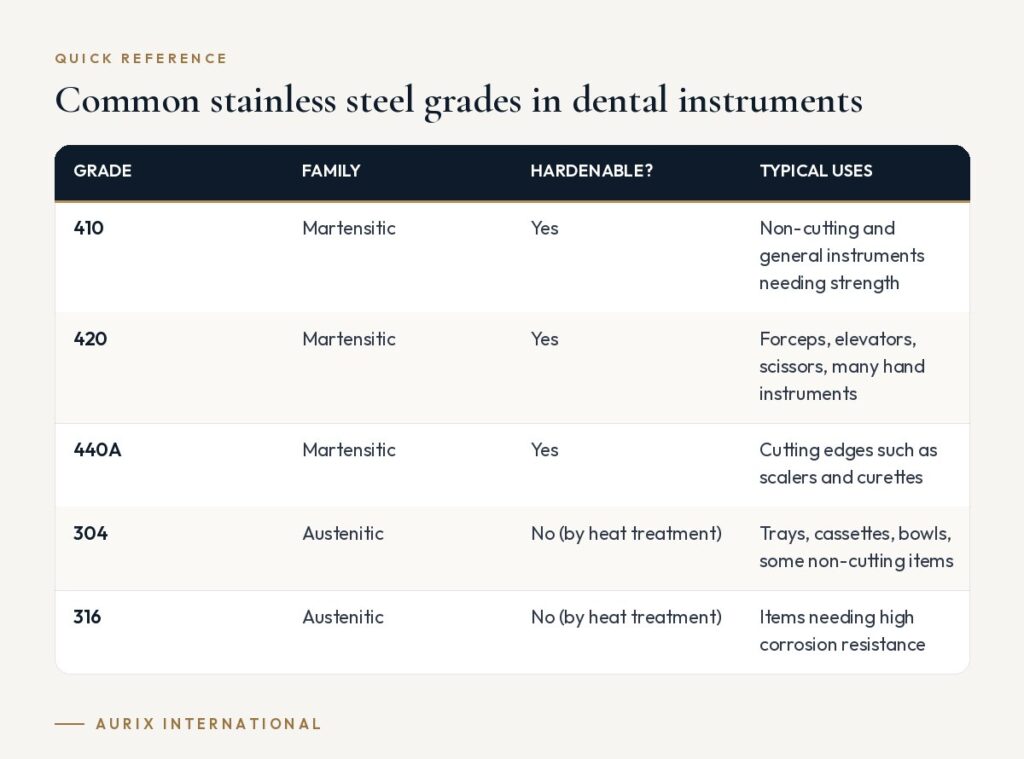
Common stainless steel grades in dental instruments
| Grade | Family | Hardenable? | Typical uses |
|---|---|---|---|
| 410 | Martensitic | Yes | Non-cutting and general instruments needing strength |
| 420 | Martensitic | Yes | Forceps, elevators, scissors, many hand instruments |
| 440A | Martensitic | Yes | Used when cutting edges such as scalers and curettes |
| 304 | Austenitic | No (by heat treatment) | Trays, cassettes, bowls, some non-cutting items |
| 316 | Austenitic | No (by heat treatment) | Items needing high corrosion resistance |
How to choose stainless steel instruments wisely
- Ask for the grade by instrument type. A supplier should be able to tell you which grade helps with cutting and non-cutting instruments.
- Look beyond the label. Terms like “surgical grade” and “German steel” are not specifications. Our article on what “surgical grade” really means explains why.
- Check the finish. Smooth, uniform surfaces without pits or grinding marks are easier to clean and resist corrosion better.
- Test edge retention on samples of scalers and curettes before buying in volume.
- Request IFUs so your team can reprocess instruments correctly.
Frequently asked questions
Why do my stainless steel instruments have brown spots?
Brown or orange spots are often surface deposits or rust transferred from other items, or early corrosion caused by residue, chlorides or water quality. Identify and fix the cause in your cleaning and sterilization process, and remove pitted instruments from service.
Is titanium better than stainless steel for dental instruments?
Titanium is lighter and has excellent corrosion resistance, and it helps with some instruments such as those designed for implant maintenance. Stainless steel remains the standard for most hand instruments because it can be hardened to hold a sharp edge.
Can stainless steel instruments be autoclaved repeatedly?
Yes. Quality stainless steel instruments target repeated steam sterilization when cleaned, dried and processed according to the manufacturer’s IFU.
Instruments built on the right steel. Aurix International supplies surgical-grade stainless steel dental and surgical instruments backed by four generations of instrument-making heritage. Browse oral instruments →