
“Surgical grade” is one of the most widely used phrases in instrument marketing. It suggests suitability for medical use, but it is not a single, precise standard. Understanding what it implies helps you compare instruments more effectively.
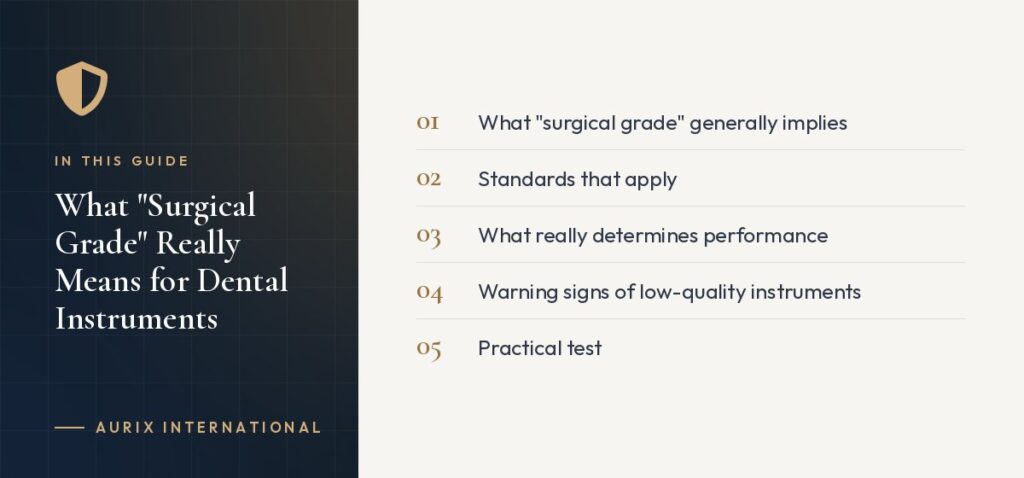
What “surgical grade” generally implies
In practice, “surgical-grade stainless steel” usually refers to stainless steels that are suitable for surgical instruments: corrosion-resistant, able to be hardened, and able to withstand repeated cleaning and sterilisation. Common examples are martensitic grades such as 410, 420 and 440A for hand instruments.
Standards that apply
International standards exist for stainless steels used in surgical instruments and for instrument performance. Reputable manufacturers can tell you which standards or specifications their materials meet.
What really determines performance
- Material composition — the right grade for the instrument type.
- Heat treatment — correct hardness and toughness.
- Finishing — smooth surfaces with no pits or cracks.
- Passivation — a strong protective surface layer.
- Inspection — checking each instrument before it ships.
Warning signs of low-quality instruments
- Rust or staining after the first few sterilisation cycles.
- Tips that bend or blunt quickly.
- Rough joints and misaligned tips.
- Very low prices with no material information.

Practical test
Order a small number of instruments first and put them through your normal reprocessing for a few weeks. Check for staining, edge retention and joint smoothness.
Learn more in our guides to stainless steel grades and warning signs of low-quality instruments.