Dental materials companies make the composites, adhesives, cements, impression materials and other consumables that end up in patients’ mouths, so choices here affect clinical results directly. The category is led by a mix of large dental groups and long-established materials specialists in the US, Europe and Japan. This list introduces 10 notable companies and how to approach choosing materials.
Key takeaways
- The 10 companies are listed in no particular order and are not ranked.
- Most offer broad restorative ranges; some are known for specific categories such as finishing or impression materials.
- Choose materials on evidence, handling and your clinical technique, then standardize.
- The right hand instruments, such as composite instruments and matrices, help materials perform.
How we chose these companies
We selected manufacturers whose main focus includes restorative and dental materials, chosen for breadth of range, specialization and market presence. Where a company has a US subsidiary, we mention it within the parent’s entry. The list is in no particular order and is not a ranking by revenue or quality. The full, searchable list is in the Aurix supplier directory.
The top 10 dental materials companies
1. Dentsply Sirona
Dentsply Sirona, headquartered in Charlotte, North Carolina, makes equipment, consumables, endodontic and implant systems, with restorative materials among its main areas.
2. Solventum
Solventum of Maplewood, Minnesota, is a health-care company spun off from 3M in 2024. Its dental business includes the former 3M oral care products, covering restorative materials and orthodontics.
3. Ivoclar
Ivoclar is a Liechtenstein-based maker of dental materials and equipment, headquartered in Schaan.
4. GC Corporation
GC Corporation of Tokyo, Japan, makes dental materials. In the US, GC America in Alsip, Illinois, is its US arm.
5. Kerr Dental
Kerr Dental, based in Brea, California, makes restorative materials and endodontic products. It is an Envista brand.
6. Kulzer
Kulzer is a maker of dental materials; its US arm, Kulzer US, is based in South Bend, Indiana.
7. VOCO
VOCO is a German maker of dental materials based in Cuxhaven.
8. Coltene
Coltene, a Swiss dental group based in Altstätten, makes consumables, endodontic and infection-control products, including restorative materials.
9. Ultradent Products
Ultradent Products of South Jordan, Utah, is a US manufacturer of dental materials, instruments and equipment, with restorative and endodontic products in its focus.
10. Shofu
Shofu, based in Kyoto, Japan, makes dental materials and finishing products. Its US arm, Shofu Dental Corporation, is in San Marcos, California.
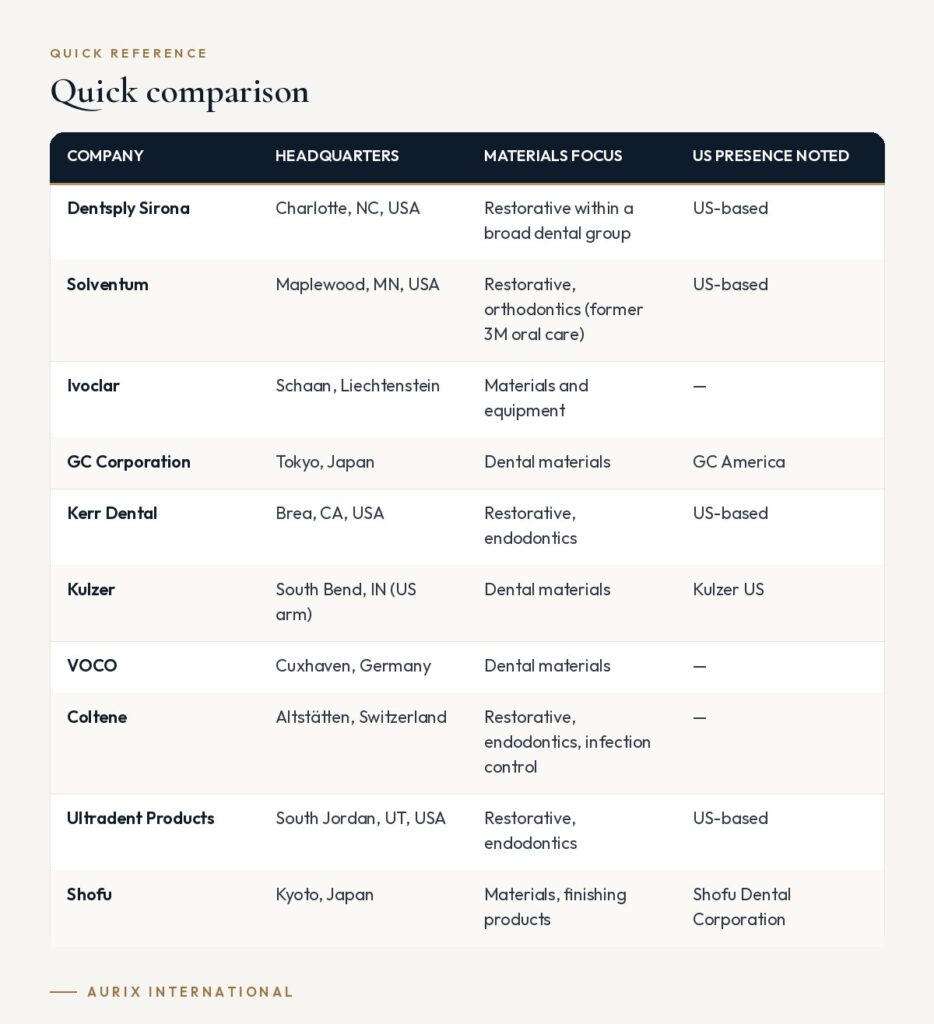
Quick comparison
| Company | Headquarters | Materials focus | US presence noted |
|---|---|---|---|
| Dentsply Sirona | Charlotte, NC, USA | Restorative within a broad dental group | US-based |
| Solventum | Maplewood, MN, USA | Restorative, orthodontics (former 3M oral care) | US-based |
| Ivoclar | Schaan, Liechtenstein | Materials and equipment | — |
| GC Corporation | Tokyo, Japan | Dental materials | GC America |
| Kerr Dental | Brea, CA, USA | Restorative, endodontics | US-based |
| Kulzer | South Bend, IN (US arm) | Dental materials | Kulzer US |
| VOCO | Cuxhaven, Germany | Dental materials | — |
| Coltene | Altstätten, Switzerland | Restorative, endodontics, infection control | — |
| Ultradent Products | South Jordan, UT, USA | Restorative, endodontics | US-based |
| Shofu | Kyoto, Japan | Materials, finishing products | Shofu Dental Corporation |
Broad ranges and category specialists
Several companies on this list, including Dentsply Sirona, Solventum, Ivoclar, GC, Kerr and Coltene, offer broad ranges across composites, adhesives, cements and other restorative materials. That breadth makes it easier to build a compatible system from one manufacturer. Others are often chosen for particular categories, such as Shofu for finishing and polishing products.
Many companies sell in the US through local subsidiaries such as GC America, Kulzer US and Shofu Dental Corporation, which handle distribution, education and technical support. When comparing materials, ask about local technical support and continuing education as well as product range, since good technique is just as important as the material itself.
It is also worth reviewing your materials list once a year. Practices often accumulate several composites, adhesives and cements that do similar jobs, each with its own shade guide, instructions and expiry dates. Trimming the list to a small, well-understood set reduces waste, simplifies ordering and helps every clinician in the practice use each product correctly. When a new product is introduced, retire the one it replaces rather than adding to the shelf.
How to choose dental materials and a supplier
- Start with the clinical evidence. Look at independent research and professional guidance for each material category, not just marketing claims.
- Test handling. Viscosity, working time, shade matching and polishability affect results day to day. Trial materials with your team before switching.
- Keep systems consistent. Using adhesives and composites designed to work together reduces technique errors, and the manufacturer’s instructions should be followed exactly.
- Manage stock and expiry. Materials have shelf lives and storage requirements. A first-in, first-out system avoids waste.
- Match your instruments. Non-stick composite instruments, condensers and the right matrix system make placement easier. Our guides to composite filling instrument sets and Tofflemire vs sectional matrix systems explain the options.
- Compare across channels. Many materials are available from several distributors and online stores, so compare total cost including shipping and minimum orders.
For groups and multi-location practices, a shared formulary of approved materials keeps clinical results consistent between sites and strengthens your position when negotiating with distributors.
Frequently asked questions
Is this list ranked by market share?
No. The companies are listed in no particular order, chosen for breadth of range, specialization and market presence.
Do I need to buy materials directly from the manufacturer?
Usually not. Most dental materials are sold through distributors and online stores, though some manufacturers also offer direct accounts or education programs.
Can I mix adhesives and composites from different companies?
Many clinicians do, but compatibility is not guaranteed. Check the instructions for use of both products, and when in doubt use components from the same system.
What instruments pair with composite materials?
Typical composite trays include plastic filling instruments, condensers, burnishers, a matrix system and finishing instruments. See our list of top 10 composite placement instruments.
Great materials deserve the right instruments. Aurix International supplies surgical-grade restorative hand instruments individually or as pre-assembled and custom kits for your restorative tray. Build a restorative kit →