Dental equipment manufacturers build the chairs, delivery units, handpieces, imaging systems and sterilizers that shape how a practice runs. Equipment is a large, long-term investment, so service support and compatibility count as much as specifications. This list introduces 10 notable equipment makers from the US, Europe and Asia.
Key takeaways
- The 10 manufacturers are listed in no particular order and are not ranked.
- They cover chairs and units, handpieces, imaging and sterilization equipment.
- Local service and parts availability are as important as features.
- Sterilization equipment and instruments should be chosen together so cycles match the instrument IFU.
How we chose these manufacturers
We included manufacturers whose main focus is dental equipment, chosen for breadth of range, specialization and market presence across chairs, handpieces, imaging and sterilization. Also, the list is in no particular order and is not a ranking by revenue or quality. The full, searchable list is in the Aurix supplier directory.
The top 10 dental equipment manufacturers
1. Dentsply Sirona
Dentsply Sirona, headquartered in Charlotte, North Carolina, makes equipment, consumables, endodontic and implant systems. In addition, its breadth makes it a candidate for practices that want equipment and consumables from one group.
2. Planmeca
Planmeca of Helsinki, Finland, makes dental units and imaging. The Planmeca Group also includes KaVo (since 2022) and the distributor Plandent.
3. KaVo
KaVo, based in Biberach an der Riss, Germany, makes dental units, handpieces and equipment. It has been owned by Planmeca since 2022.
4. A-dec
A-dec of Newberg, Oregon, manufactures dental chairs, delivery systems and equipment.
5. J. Morita
J. Morita, based in Kyoto, Japan, makes dental equipment and imaging, with endodontics also in its focus.
6. W&H
W&H of Bürmoos, Austria, makes handpieces, surgical units and sterilizers. Its mix of handpieces and sterilization equipment is relevant when reviewing reprocessing as well as treatment rooms.
7. NSK (Nakanishi)
NSK, based in Kanuma, Japan, makes dental handpieces and motors. Meanwhile, NSK America, in Hoffman Estates, Illinois, serves as its US arm.
8. Bien-Air Dental
Bien-Air Dental of Biel/Bienne, Switzerland, makes dental handpieces and motors.
9. Vatech
Vatech, based in Hwaseong, South Korea, makes dental imaging systems.
10. Midmark
Midmark is an Ohio-based US maker of dental and medical equipment and sterilization products.
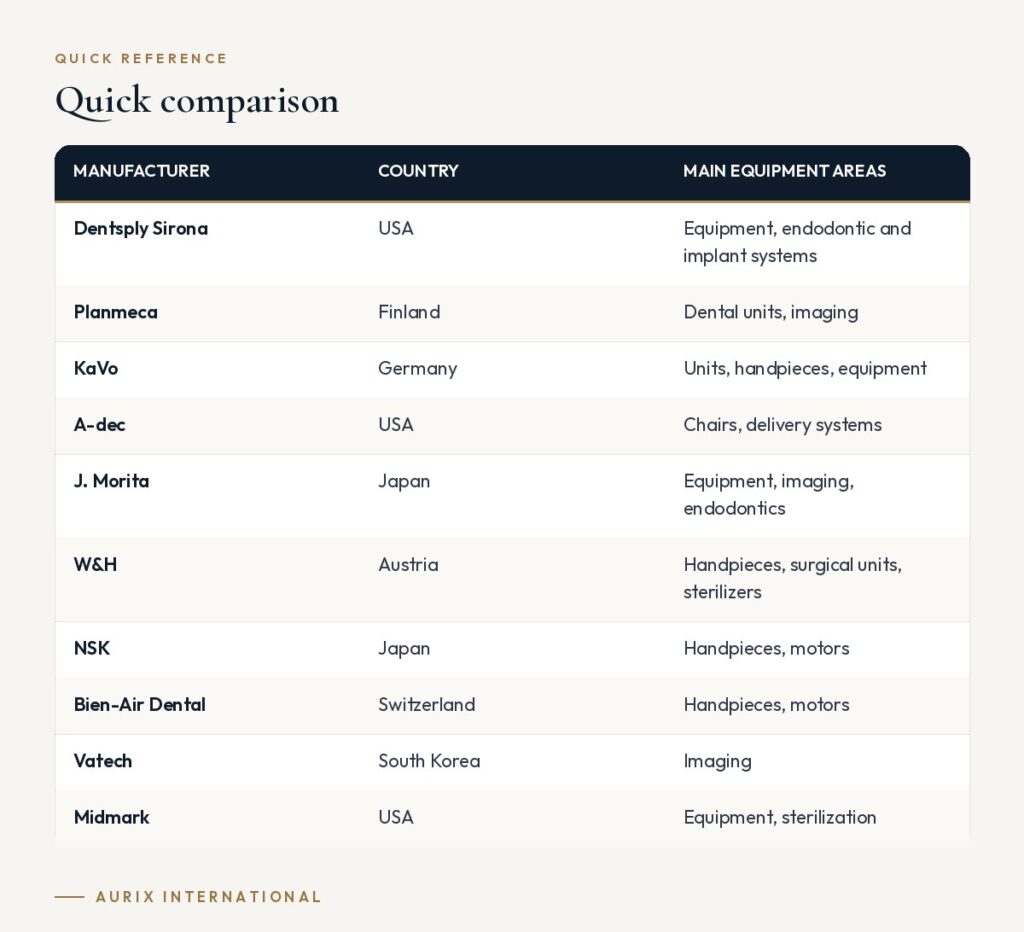
Quick comparison
| Manufacturer | Country | Main equipment areas |
|---|---|---|
| Dentsply Sirona | USA | Equipment, endodontic and implant systems |
| Planmeca | Finland | Dental units, imaging |
| KaVo | Germany | Units, handpieces, equipment |
| A-dec | USA | Chairs, delivery systems |
| J. Morita | Japan | Equipment, imaging, endodontics |
| W&H | Austria | Handpieces, surgical units, sterilizers |
| NSK | Japan | Handpieces, motors |
| Bien-Air Dental | Switzerland | Handpieces, motors |
| Vatech | South Korea | Imaging |
| Midmark | USA | Equipment, sterilization |
Equipment categories at a glance
The manufacturers above cover different parts of the practice. Chair and delivery-system makers such as A-dec, Planmeca, KaVo and Dentsply Sirona shape the treatment room itself. Handpiece specialists such as NSK, Bien-Air and W&H supply the high-speed and slow-speed handpieces and motors used every day. Imaging companies such as Vatech, Planmeca and J. Morita provide radiography systems, while W&H and Midmark also supply sterilization equipment for the reprocessing area.
Most practices end up with equipment from several of these companies. A clear plan for each room and for the sterilization area, built with your distributor and service provider, helps avoid compatibility problems and makes future upgrades easier.
Timing matters too. Generally, equipment decisions are often driven by a new build, a renovation or a failing unit, and rushed choices can be expensive to undo. Where possible, visit showrooms or trade shows, sit in the chairs, handle the handpieces and see imaging software in use. Ask colleagues who run similar practices what they would choose again, and involve assistants and hygienists, who often spend more time with the equipment than the dentist.
How to choose dental equipment
- Service first. Ask who services the equipment in your area, typical response times and how parts are supplied. Furthermore, your distributor’s service team often matters as much as the brand.
- Plan the room, not just the chair. Delivery system position, assistant access, cabinetry, imaging and utilities need to work together. In practice, consider ergonomics for both clinician and assistant.
- Check compatibility. Handpiece couplings, imaging software and practice management integration should fit your current setup or planned upgrades.
- Size sterilization to your instrument flow. Sterilizer capacity and cycle times should match how many cassettes you process each day. See autoclave cycles explained and organizing cassettes for faster room turnover.
- Follow IFU for both equipment and instruments. Sterilizer cycles should be compatible with the instructions for the instruments you load, and monitored in line with CDC guidance.
- Look at lifetime cost. Maintenance, consumables, software licenses and expected service life all affect total cost.
Equipping a new practice? Our instrument checklist for a new dental clinic covers the hand instruments you will need once the equipment is in place.
Finally, keep good records for every piece of equipment. A simple log of equipment purchase dates, service visits, sterilizer test results and repairs makes it easier to plan replacements, support warranty claims and show that reprocessing equipment is being maintained and monitored as recommended by the manufacturer and in line with CDC guidance.
Frequently asked questions
Should I buy dental equipment directly from the manufacturer?
In the US, most equipment is sold and installed through dental distributors, who also provide service. Some manufacturers sell directly in certain markets, so ask about both routes.
How long does dental equipment last?
Service life varies by equipment type, use and maintenance. Ask the manufacturer and your service provider about expected life, parts availability and recommended maintenance intervals.
Are handpieces equipment or instruments?
Handpieces sit between the two. They are reusable devices that need cleaning, lubrication and sterilization according to the manufacturer’s IFU after every patient.
Why does sterilization equipment matter for instruments?
The right sterilizer, cycle and loading protect both patients and instruments. Moreover, overloading, wrong cycles or poor water quality can cause wet packs, spotting and corrosion.
Equipment in place, now the instruments? Aurix International supplies surgical-grade dental and surgical instruments and pre-assembled kits to equip new and growing practices. Ask about equipping your practice →