Oral and maxillofacial surgery practices put instruments under more stress than almost any other dental setting. Elevators carry heavy loads, rongeurs cut dense cortical bone, needle holders grip curved needles hundreds of times a week and every instrument is steam-sterilised after each use. A surgical and dental instruments supplier for this environment needs depth, durability and consistency — not just a long catalogue.
Key takeaways
- Look for depth in elevators, luxators, bone instruments and fine suturing instruments.
- Material and heat treatment matter more under surgical loads.
- Procedure kits in cassettes speed up turnover and protect fine tips.
- Insist on pattern matching for replacements.
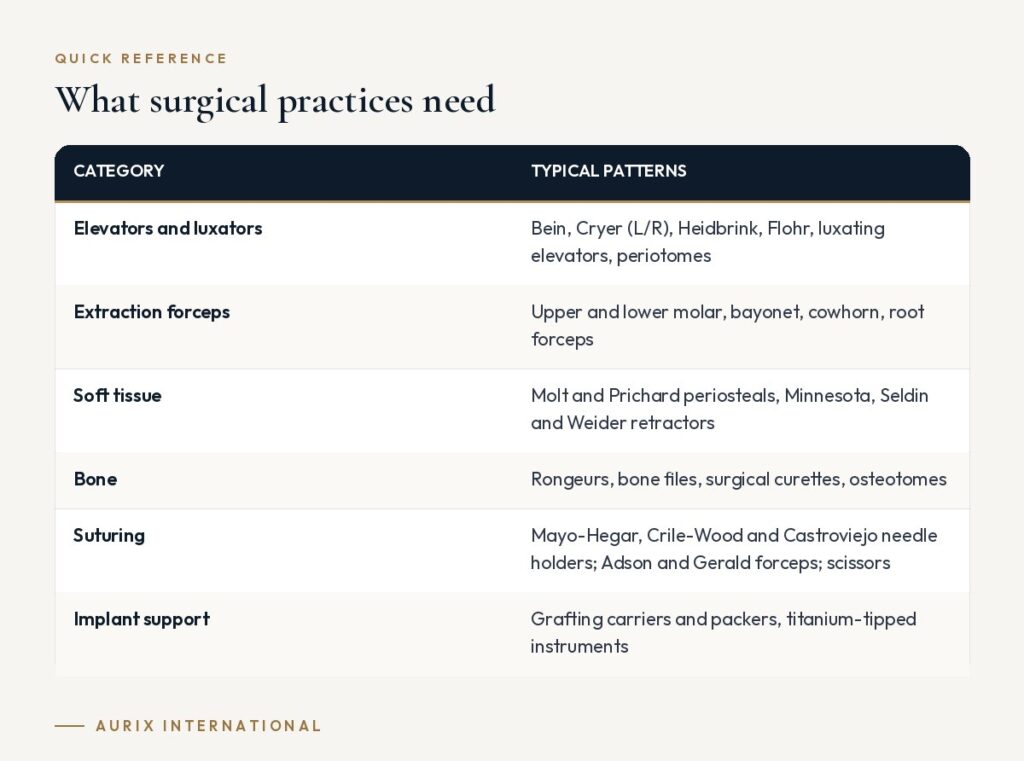
What surgical practices need
| Category | Typical patterns |
|---|---|
| Elevators and luxators | Bein, Cryer (L/R), Heidbrink, Flohr, luxating elevators, periotomes |
| Extraction forceps | Upper and lower molar, bayonet, cowhorn, root forceps |
| Soft tissue | Molt and Prichard periosteals, Minnesota, Seldin and Weider retractors |
| Bone | Rongeurs, bone files, surgical curettes, osteotomes |
| Suturing | Mayo-Hegar, Crile-Wood and Castroviejo needle holders; Adson and Gerald forceps; scissors |
| Implant support | Grafting carriers and packers, titanium-tipped instruments |
Why material matters more in surgery
Surgical loads expose weaknesses quickly. An elevator that is too soft rounds its tip; one that is too hard can chip. Needle holder jaws must grip without wearing; rongeur springs must survive thousands of cycles. Ask your supplier which stainless grades are used for elevators, rongeurs and needle holders, how they balance hardness with toughness, and whether instruments are passivated after finishing. Tungsten carbide inserts on needle holders and scissors are worth considering for high-volume practices.
Supplier capabilities that matter
- Procedure kits for extraction, luxation, bone management and suturing, supplied in cassettes.
- Custom kits to match each surgeon’s preferred patterns.
- Quality evidence: specifications, inspection and samples.
- Pattern matching so replacements feel identical.
- Repair or replacement guidance for higher-value instruments such as rongeurs and carbide needle holders.
- Reprocessing instructions for every product.
Kits that suit surgical practices
| Kit | Typical use |
|---|---|
| Root Elevation Instrument Kit (12 pieces) | Root elevation, retained root retrieval, flap reflection |
| Atraumatic Luxation System (8 pieces) | Bone-preserving extractions before implants |
| Surgical Extraction & Luxation System (13 pieces) | Surgical extractions from one cassette |
| Surgical Extraction & Bone Management System (13 pieces) | Debridement, alveoloplasty, ridge preservation |
Evaluating surgical instruments before you buy
- Inspect elevator tips and luxator blades under magnification.
- Test rongeur springs, beak alignment and cutting.
- Check needle holders hold your usual needles without rotation.
- Run samples through several sterilisation cycles and look for staining, stiffness and edge loss.
Use our sample testing protocol for a structured approach.
Keeping surgical kits complete
An incomplete kit mid-procedure is more than an inconvenience. Use photo checklists in the sterilisation area, keep sterile back-up pouches of commonly needed instruments — a second root-tip elevator, an extra needle holder — and replace damaged instruments promptly. Our monthly inspection checklist catches wear early.
How many kits do you need?
Calculate from daily case load per chair and your sterilisation turnaround. Many surgical practices keep at least three of each primary kit per operatory, plus spare loose instruments for the most frequently dropped or damaged items.
Supporting new procedures
When a practice adds sinus lifts or guided bone regeneration, the right supplier helps assemble membrane elevators, osteotomes, graft carriers and fine suturing instruments. See sinus lift kits and bone grafting instruments.
Frequently asked questions
Do oral surgery practices need different instruments from general practices?
Many patterns overlap, but surgical practices need more specialist elevators, bone instruments and fine suturing instruments, and higher durability.
Are carbide-insert instruments worth the extra cost?
For high-volume suturing and scissors use, they usually last considerably longer and keep their grip or edge.
Should instruments be repaired or replaced?
Repair can make sense for higher-value instruments; replace anything cracked, bent or with thin blades. See repair, re-tip or replace.
Next steps
Aurix specialises in surgical and dental instruments and kits. Ask for a surgical kit quote, design your own in the kit builder, or see our US supplier overview.