Choosing a dental instruments supplier is a decision you live with every day, because the instruments you buy end up in your hands, your trays and your sterilization room for years. A short, structured conversation before the first order tells you far more than a catalog page ever will. These ten questions help clinics, group practices, schools and distributors separate dependable suppliers from risky ones.
Key takeaways
- Ask about the steel grade used for each instrument type, not just “stainless steel”.
- Request documentation and care instructions (IFU) before you commit to volume.
- Always test samples in your own clinical and reprocessing workflow.
- Clarify lead times, minimum order quantities, returns and after-sales support in writing.
The top 10 questions to ask a dental instruments supplier
1. What steel grades do you use, and for which instruments?
Different instruments need different steel. Cutting and scraping instruments such as curettes, scalers and chisels are usually made from hardenable martensitic stainless steels (for example 420 or 440A grades) so they can hold an edge. Non-cutting items such as retractors or mirrors handles may use other grades chosen for corrosion resistance and toughness.
A knowledgeable supplier can tell you which grade goes into which product family and why. If the only answer is “German stainless” or “surgical grade” with no detail, keep asking. Our guide to 410, 420 and 440A stainless steel explains the differences.
2. Who manufactures the instruments, and how is quality controlled?
Some suppliers manufacture, some source from partner workshops, and many do both. Neither model is wrong, but you should know which one you are dealing with. Ask how forging, heat treatment, grinding and finishing are checked, and whether every batch is inspected or only a sample.
Good answers mention hardness testing for cutting instruments, joint and tip alignment checks for forceps and pliers, and visual inspection of finish and markings.
3. What documentation and instructions for use do you provide?
Every reusable instrument should come with reprocessing guidance. Ask for the instructions for use (IFU) covering cleaning, lubrication and sterilization parameters, and ask what product documentation is available for your records or for regulatory purposes. Clinics need IFUs to follow CDC infection-control guidance; distributors and private-label buyers usually need more.
4. Can I test samples before placing a larger order?
A confident supplier expects you to evaluate their product. Request samples of the instruments you use most and run them through your normal workflow: chairside use, ultrasonic cleaning, autoclave cycles and storage. Our sample testing protocol outlines what to look for over several weeks of use.
5. How broad is your range, and do you offer kits?
Buying from one source simplifies ordering and gives your trays a consistent look and feel. Ask whether the supplier covers diagnostic, periodontal, restorative, surgical and orthodontic instruments, and whether pre-assembled procedure kits or custom kits are available.
Custom kits are especially useful for multi-chair practices that want every room set up identically.
6. What are your minimum order quantities and pricing tiers?
Wholesale and volume pricing usually depends on quantity, product mix and whether items are standard or customized. Ask for the minimum order quantity (MOQ) per item, how tiered pricing works, and whether you can mix patterns within a tier. Get these terms in writing so later invoices match the quote.
7. What lead times should I plan around?
Standard stock items, large wholesale orders and custom or private-label work all have different lead times. Ask for realistic ranges for each, what happens if an item is back-ordered, and how you will be notified. Reliable communication matters more than an optimistic promise.
8. What is your return, exchange and defect policy?
Ask how the supplier handles instruments that arrive damaged, fail early, or simply turn out to be the wrong pattern. Clarify the time window, who pays for return shipping, and whether defects are replaced or credited. A clear written policy is a strong sign of a supplier that stands behind its products.
9. Do you offer repair, re-tipping or sharpening support?
Not every supplier repairs instruments, and that is fine, but you should know your options before a forceps joint stiffens or a curette blade wears thin. Ask whether they offer repair or re-tipping, or can recommend a service. This affects your total cost of ownership over the life of the instrument.
10. Can you support custom branding, OEM or private label?
This question matters most for distributors, dental schools and DSOs. Ask whether laser marking, custom packaging or fully private-label programs are possible, what the MOQs are, and how artwork and approvals work. Even clinics sometimes want their practice name marked on instruments for tracking.
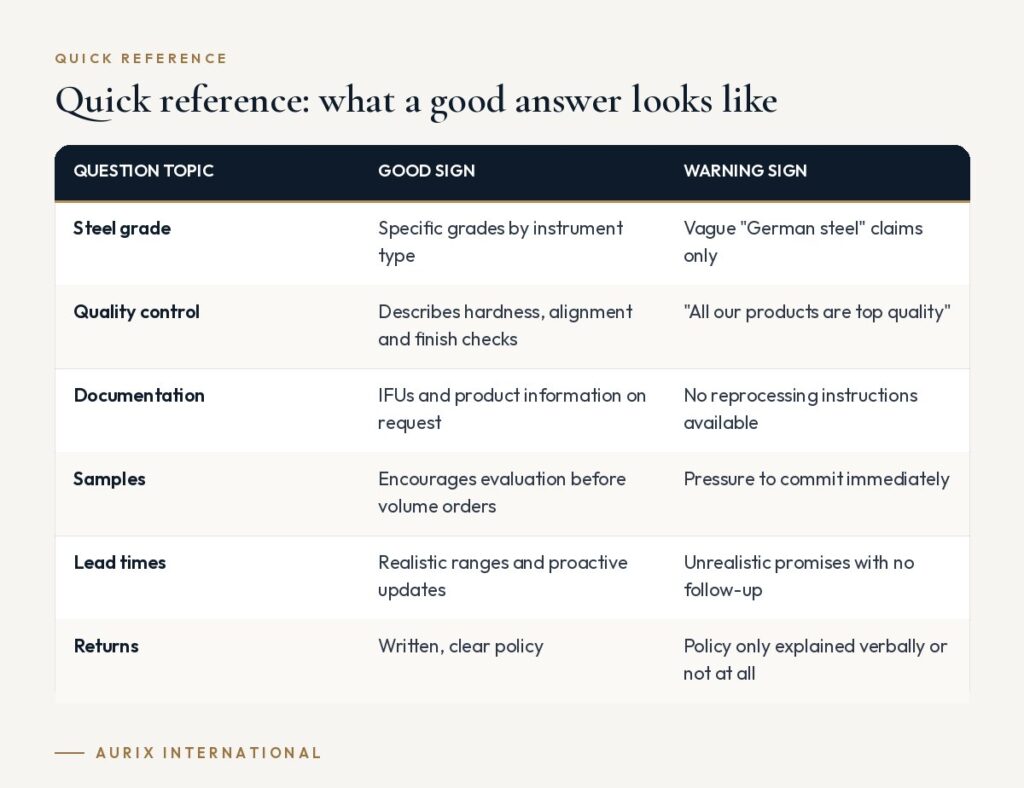
Quick reference: what a good answer looks like
| Question topic | Good sign | Warning sign |
|---|---|---|
| Steel grade | Specific grades by instrument type | Vague “German steel” claims only |
| Quality control | Describes hardness, alignment and finish checks | “All our products are top quality” |
| Documentation | IFUs and product information on request | No reprocessing instructions available |
| Samples | Encourages evaluation before volume orders | Pressure to commit immediately |
| Lead times | Realistic ranges and proactive updates | Unrealistic promises with no follow-up |
| Returns | Written, clear policy | Policy only explained verbally or not at all |
How to choose a dental instruments supplier after asking
Once you have answers, compare suppliers side by side rather than relying on memory or a single price. A few practical steps help:
- Score each supplier on quality, range, documentation, communication and price using the same criteria.
- Compare like for like. A cheaper curette made from a softer steel or with a poorly finished blade is not a real saving. Our article on comparing supplier quotes includes an RFQ template.
- Start with a trial order of high-use instruments before switching your whole inventory.
- Involve the people who use the instruments: clinicians for feel and performance, assistants for reprocessing and tray setup.
- Review after six to twelve months and note any early failures, corrosion or delivery problems.
For a broader framework, see our guide on how to vet a dental instruments supplier.
Frequently asked questions
Should I always choose the supplier with the lowest price?
Not necessarily. Instruments that dull quickly, corrode or misalign need replacing sooner, which raises the long-term cost. Compare steel quality, finish, documentation and support alongside the unit price.
How many suppliers should I compare?
Two to four is usually enough to understand the market for your needs. Comparing more can be useful for large wholesale or private-label programs, but it also takes more time to evaluate samples properly.
Is it a problem if the supplier does not manufacture everything itself?
No. Many reputable suppliers work with partner manufacturers. What matters is that they can explain their quality checks, provide documentation and stand behind the products they sell.
What should I ask for in writing?
Pricing tiers, MOQs, lead time ranges, return and defect policies, and any custom-branding terms. Written terms prevent misunderstandings once orders begin.
Have questions for your next supplier? Aurix International is happy to answer every one of them, from steel grades and kits to wholesale and private-label options. Ask our team →