Buying dental instruments online is convenient, but the same marketplaces that offer choice also make it easy for low-quality or misrepresented products to look professional. A polished photo cannot tell you whether a scaler will hold an edge or whether a forceps joint will survive repeated autoclave cycles. These ten red flags help you spot trouble before it reaches your trays.
Key takeaways
- Vague material claims and missing care instructions are the most common warning signs.
- Prices far below the market usually mean compromises in steel, heat treatment or finishing.
- A real business has clear contact details, written policies and knowledgeable staff.
- Inspect every delivery and test new suppliers with a small order first.
The top 10 red flags when buying dental instruments online
1. Vague or contradictory material claims
Listings that say only “stainless steel”, “German steel” or “medical grade” without naming a grade or explaining which steel is used for which instrument deserve caution. Some listings even mix claims, such as “German stainless steel made in multiple countries”, without explanation.
A trustworthy seller can tell you the grade and why it suits the instrument. Our article on what “German stainless steel” really means explains why the label alone proves little.
2. No instructions for use or reprocessing guidance
Reusable dental instruments must be cleaned and sterilized according to the manufacturer’s instructions for use (IFU). If a seller cannot provide cleaning, lubrication and sterilization guidance, you have no way to reprocess the instruments in line with CDC recommendations. Treat missing IFUs as a serious warning sign.
3. Prices that are far too low
Good instruments require decent steel, controlled heat treatment, careful grinding and hand finishing. When a “complete” 20-piece surgical set costs less than a single quality forceps elsewhere, something has usually been cut: softer steel, thin plating over poor base metal, or rough finishing that traps debris.
4. Stock photos and generic product names
Watch for listings that reuse the same image for many different instruments, show patterns that do not match the description, or use names like “dental tool set 1” instead of recognized pattern names and numbers. A serious supplier labels a forceps as, for example, a #150 upper universal or a #23 cowhorn, and shows the actual product.
5. No identifiable company behind the store
If you cannot find a company name, physical business address, phone number or working email, you have little recourse if something goes wrong. Check that the seller is a real business with a history, and be wary of storefronts that appeared recently with hundreds of products and no background.
6. Reviews that look manufactured
Large numbers of short, generic five-star reviews posted in a narrow time window, reviews that describe a different product, or reviews that never mention clinical use are all suspicious. Look for detailed feedback from dental professionals that mentions sharpness, balance, corrosion resistance and how the instruments hold up after sterilization.
7. Missing or unclear return and defect policies
A legitimate supplier publishes its return, exchange and defect policy. If the policy is missing, hidden, or limited to “all sales final”, you carry all the risk of instruments that arrive damaged or fail early.
8. Coatings that hide the steel
Some low-cost instruments are plated or painted to look shiny or colorful. Plating can flake or chip during cleaning and autoclaving, exposing poor base metal that rusts. Color-coded rings and resin handles are fine; what matters is that the working end and joints are solid, correctly finished stainless steel.
9. Sellers who cannot answer technical questions
Ask a simple question such as “Which Gracey numbers are in this set?” or “Is this elevator blade hardened?” If the reply is evasive, copied from the listing, or simply wrong, the seller may not understand what they are selling. Knowledgeable staff are a sign of a supplier that takes quality seriously.
10. Pressure tactics and unusual payment requests
Countdown timers, “only today” discounts on bulk orders, requests to pay by wire transfer to a personal account, or pressure to skip samples are classic red flags. Reputable suppliers are comfortable with you taking time to evaluate their products and use standard, traceable payment methods.
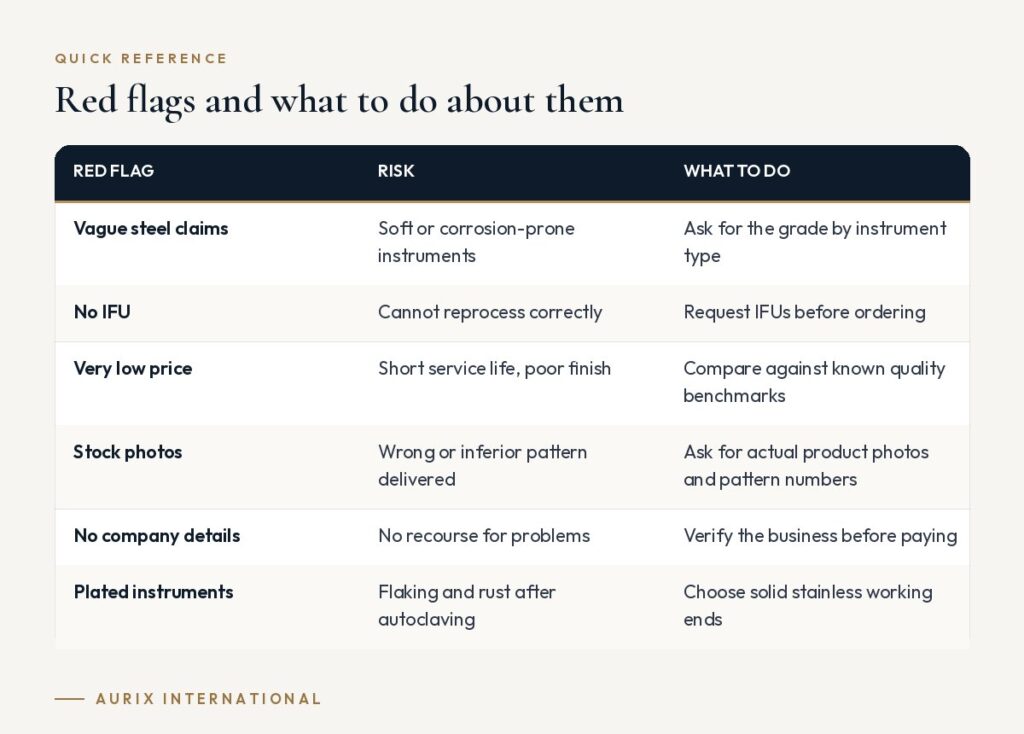
Red flags and what to do about them
| Red flag | Risk | What to do |
|---|---|---|
| Vague steel claims | Soft or corrosion-prone instruments | Ask for the grade by instrument type |
| No IFU | Cannot reprocess correctly | Request IFUs before ordering |
| Very low price | Short service life, poor finish | Compare against known quality benchmarks |
| Stock photos | Wrong or inferior pattern delivered | Ask for actual product photos and pattern numbers |
| No company details | No recourse for problems | Verify the business before paying |
| Plated instruments | Flaking and rust after autoclaving | Choose solid stainless working ends |
Buying tips for safer online purchasing
- Start small. Order a few high-use instruments first and run them through your normal cleaning and sterilization cycles.
- Inspect on arrival. Check tips, joints, serrations, finish and markings. Our checklist of quality checks for new instruments walks through the essentials.
- Keep records of where each batch came from so you can trace problems later.
- Use specialist suppliers who focus on dental and surgical instruments rather than general marketplaces that sell everything.
- Know the broader warning signs of counterfeit and substandard products; see counterfeit and low-quality instrument warning signs.
Frequently asked questions
Are all cheap dental instruments low quality?
Not always, but very low prices usually reflect compromises in materials or finishing. Judge instruments on steel grade, heat treatment, finish and documentation, then decide whether the price is fair.
How can I tell if an instrument is plated?
Plated instruments may show an unusually bright or uneven surface, color differences at edges, or flaking after a few cycles. If in doubt, ask the seller directly and inspect the instrument closely after initial reprocessing.
Is buying from large online marketplaces always risky?
Marketplaces host both reputable and poor sellers. The same checks apply: identify the actual company, ask technical questions, request IFUs and test with a small order.
Buy with confidence, not guesswork. Aurix International supplies surgical-grade stainless steel dental and surgical instruments and is happy to answer technical questions before you order. Talk to a specialist →