Atraumatic extraction instruments remove a tooth while preserving as much of the surrounding bone and gingiva as possible. That matters most when an implant or bridge is planned, because a thin buccal plate damaged during extraction can compromise later treatment. The approach relies on cutting the periodontal ligament, gentle luxation and sectioning rather than force. Here are ten instruments at the heart of an atraumatic technique.
Key takeaways
- Atraumatic extraction works by severing the periodontal ligament and expanding the socket gently, not by applying heavy force.
- Periotomes and luxating elevators are the core instruments; they have thin, sharp blades.
- Sectioning multi-rooted teeth reduces stress on the buccal and lingual plates.
- Fine root tip instruments and narrow-beak forceps help remove roots without enlarging the socket.
- Thin blades are delicate; avoid twisting or levering them like a traditional elevator.
The top 10 atraumatic extraction instruments
1. Periotomes
Periotomes have very thin, flat, sharp blades that are inserted into the periodontal ligament space and advanced apically to sever the ligament fibers. Also, they pair with gentle wedging and a “walking” motion around the tooth, not with rotation.
Straight periotomes suit anterior teeth; angled versions reach interproximal and posterior surfaces.
Tip: work around the full circumference in small steps, going a little deeper each time.
2. Luxating elevators
Luxating elevators combine features of a periotome and an elevator. They have thin, sharp, tapered blades that cut the ligament and gently expand the socket. They come in straight and curved forms and in a range of widths.
Use them with a cutting and wedging motion. Rotating or levering a luxator like a traditional elevator can bend or chip the fine tip.
3. Fine straight elevators
Small straight elevators, such as a narrow 301 or 34S pattern, are used once the ligament has been loosened to apply controlled rotational and wedging force. In an atraumatic approach they are used gently and in the mesial and distal spaces rather than levering against the buccal plate.
4. Bein elevators
Bein elevators have a narrow, slightly concave blade that tapers to a fine tip. In addition, they are useful for engaging small roots and narrow interproximal spaces where a broader elevator would cause unnecessary bone loss.
5. Root tip picks and apical elevators
Root tip picks (such as the West and Heidbrink patterns) have very fine, pointed tips for teasing out small root apices left in the socket. Using a fine pick avoids having to remove bone to reach a retained apex.
6. Narrow-beak extraction forceps
Once the tooth is mobile, forceps with narrow beaks that seat deep along the root, such as upper and lower root forceps, deliver it with minimal expansion of the socket. Seat the beaks as far apically as possible and favor slow, sustained movements over rapid rocking.
7. Beak-and-bumper style forceps
Some forceps designs use a single beak on the lingual or palatal side and a padded bumper on the buccal gingiva, so the tooth is removed with a lever action rather than squeezing. They reduce pressure on the buccal plate and are popular in atraumatic and pre-implant extractions.
8. Surgical handpiece and sectioning burs
A surgical handpiece with long, narrow burs allows multi-rooted teeth to be sectioned so that each root is removed along its own path. Generally, this reduces the force needed and protects the inter-radicular and buccal bone.
Sectioning is often the single most effective step for preserving bone in molar extractions.
9. Piezoelectric surgery inserts
Piezoelectric units with thin inserts can cut the periodontal ligament and fine bone around an ankylosed or fragile root with less risk to soft tissue. They are used by some surgeons as an alternative or adjunct to periotomes, especially where the buccal plate is thin.
10. Bone curettes for socket debridement
After extraction, a Lucas or Molt curette removes granulation tissue and remnants of the ligament so the socket is clean for grafting or immediate implant placement. Work gently against the walls, especially the thin buccal plate.
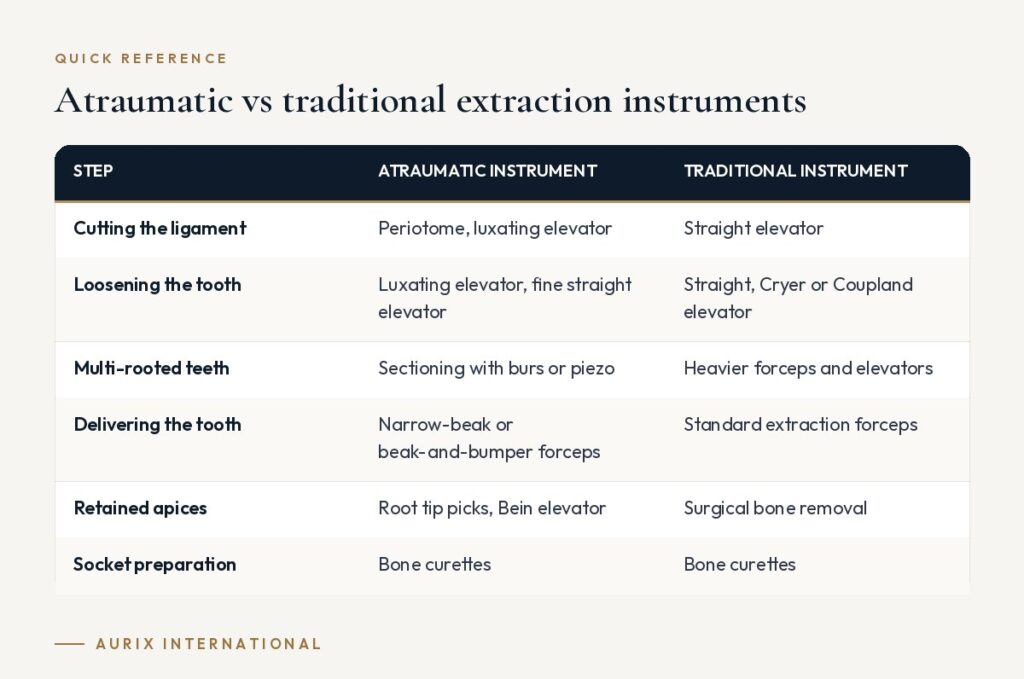
Atraumatic vs traditional extraction instruments
| Step | Atraumatic instrument | Traditional instrument |
|---|---|---|
| Cutting the ligament | Periotome, luxating elevator | Straight elevator |
| Loosening the tooth | Used when luxating elevator, fine straight elevator | Straight, Cryer or Coupland elevator |
| Multi-rooted teeth | Used when sectioning with burs or piezo | Heavier forceps and elevators |
| Delivering the tooth | Narrow-beak or beak-and-bumper forceps | Standard extraction forceps |
| Retained apices | Root tip picks, Bein elevator | Surgical bone removal |
| Socket preparation | Bone curettes | Bone curettes |
How to choose atraumatic extraction instruments
- Start with periotomes and luxators. A set of straight and angled periotomes and two or three luxating elevator widths covers most teeth.
- Check blade thinness and sharpness. The whole technique depends on thin, sharp tips. Inspect them after every cycle and sharpen or replace as needed.
- Think about handles. Larger, textured handles improve control and reduce hand fatigue during slow, controlled luxation.
- Group them in a kit. Keeping atraumatic instruments together in a cassette helps the whole team follow the same sequence.
- Plan for grafting. If you preserve sockets, add graft carriers and pluggers to the same tray.
Our article on atraumatic extraction instruments that preserve bone explains the technique in more depth, and luxating elevators vs traditional elevators compares the two approaches. For a ready-made option, see inside the Aurix Atraumatic Luxation System, or browse the wider range in the top 10 dental elevators.
Frequently asked questions
What is an atraumatic extraction?
It is an extraction technique that aims to remove the tooth with minimal damage to the surrounding bone and soft tissue, usually to preserve the site for an implant or other restoration.
What is the difference between a periotome and a luxating elevator?
Both have thin, sharp blades. A periotome mainly severs the periodontal ligament, while a luxating elevator also gently expands the socket and loosens the tooth.
Can luxating elevators be used like traditional elevators?
No. Furthermore, their thin tips are not designed for heavy rotational or levering force. Using them that way can bend or break the tip. Switch to a straight elevator for controlled rotation once the ligament is cut.
Is sectioning always needed for atraumatic molar extractions?
Not always, but sectioning multi-rooted teeth is a common way to reduce force and protect the buccal plate, especially when roots are divergent or curved.
Make bone-preserving extractions part of your routine. Aurix International can put periotomes, luxating elevators, root tip picks and curettes together in a custom atraumatic extraction kit. Build your atraumatic kit →