Implant maintenance instruments are chosen to remove biofilm and calculus from implant restorations without scratching or roughening the surfaces. Regular professional maintenance is a key part of keeping peri-implant tissues healthy, and the hygiene tray for an implant patient looks a little different from the standard scaling setup. Here are ten instruments and tools commonly used during implant maintenance visits.
Key takeaways
- The aim is to disrupt biofilm and remove deposits while preserving the implant and abutment surfaces.
- Titanium and plastic or resin instruments are widely used because they are less likely to scratch titanium than stainless steel.
- Implant-safe ultrasonic tips and low-abrasive air polishing powders extend what hand instruments can do.
- Probing is part of monitoring; use light force and follow your practice protocol.
- Home-care aids such as coated interdental brushes and implant floss are part of every visit.
The top 10 instruments for implant maintenance
1. Periodontal probe
Probing around implants helps track pocket depth and bleeding over time. Many clinicians use plastic probes around implants, while others use standard metal probes with light force. Whichever you choose, use it consistently so measurements can be compared between visits, and record them alongside radiographs.
Clear, easy-to-read markings, such as those on a UNC-15 pattern, make recordings more reliable.
2. Titanium curettes
Titanium curettes have blades made of titanium or titanium alloy, which are softer than stainless steel and less likely to scratch titanium abutments and implant surfaces. Gracey-style and universal designs are available.
Tip: titanium blades dull more quickly than steel, so check edges often and follow the manufacturer’s guidance on sharpening.
3. Titanium scalers
Titanium sickle and specialty scalers remove supragingival and lightly attached deposits on abutments and restoration margins. Their pointed tips reach embrasures and the area beneath bridge connectors.
4. Plastic and resin instruments
Plastic or resin scalers and curettes, with disposable or replaceable tips, are gentle on implant surfaces and useful for light biofilm and soft deposits. They are less effective on tenacious calculus, so many clinicians keep both plastic and titanium options on the tray.
5. Implant-safe ultrasonic tips
Ultrasonic and piezoelectric units can be used with tips designed for implants, such as tips with plastic, PEEK or carbon-fiber sleeves or coverings. Standard metal tips should not be used directly on implant surfaces unless the manufacturer states they are suitable.
6. Air polishing with low-abrasive powder
Air polishing with low-abrasive powders such as glycine or erythritol removes biofilm efficiently around implants and in areas hand instruments struggle to reach. Use the nozzles and powders recommended by the unit manufacturer for peri-implant use.
7. Rubber cup and low-abrasive paste
Polishing with a soft rubber cup and a low-abrasive or implant-safe paste removes stain and leaves surfaces smooth. Avoid coarse prophy pastes on implant abutments and restoration surfaces.
8. Interdental brushes with coated wire
Interdental brushes with nylon- or plastic-coated wire clean between implants and natural teeth without metal contact. Sizing the brush at the visit and showing the patient how to use it is one of the most valuable parts of maintenance.
9. Implant floss and threaders
Thick, spongy implant floss and floss threaders clean around abutments and under bridges and bars. They are particularly useful for full-arch restorations and overdenture attachments.
10. Mouth mirror
A front-surface mouth mirror gives clear indirect vision and retraction for assessing tissue, checking restorations and guiding instrumentation. It does not contact the implant surface but is essential for thorough, accurate work.
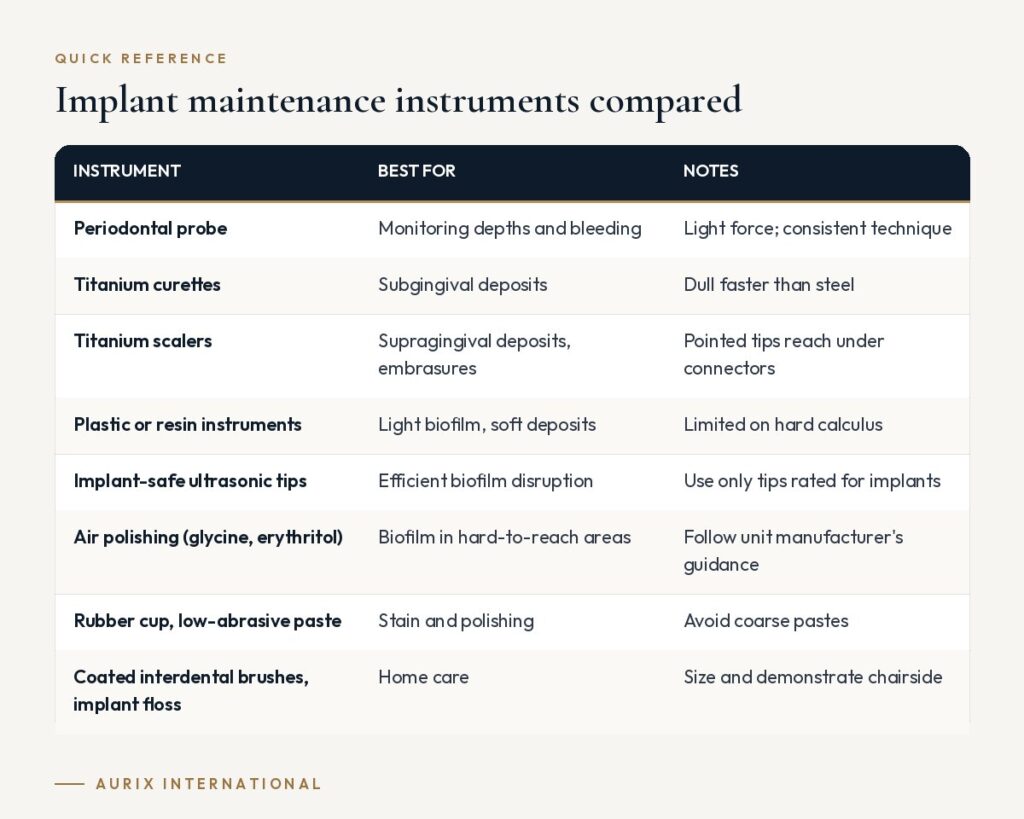
Implant maintenance instruments compared
| Instrument | Best for | Notes |
|---|---|---|
| Periodontal probe | Monitoring depths and bleeding | Light force; consistent technique |
| Titanium curettes | Subgingival deposits | Dull faster than steel |
| Titanium scalers | Supragingival deposits, embrasures | Pointed tips reach under connectors |
| Plastic or resin instruments | Light biofilm, soft deposits | Limited on hard calculus |
| Implant-safe ultrasonic tips | Efficient biofilm disruption | Use only tips rated for implants |
| Air polishing (glycine, erythritol) | Biofilm in hard-to-reach areas | Follow unit manufacturer’s guidance |
| Rubber cup, low-abrasive paste | Stain and polishing | Avoid coarse pastes |
| Coated interdental brushes, implant floss | Home care | Size and demonstrate chairside |
How to choose implant maintenance instruments
- Combine materials. A practical tray includes titanium curettes and scalers for deposits, plastic instruments for light cleaning, and an implant-safe power option.
- Keep natural-teeth instruments separate. Most implant patients still have natural teeth. Keep stainless steel Gracey curettes for those surfaces and switch to implant instruments around restorations.
- Check edge condition often. Titanium and plastic instruments wear faster than steel; replace or re-tip them when they no longer engage deposits.
- Follow the restoration and implant manufacturers. Some restorative materials and abutment surfaces have specific cleaning recommendations.
- Standardize the tray. A dedicated implant maintenance setup makes it easy for every hygienist to follow the same protocol.
Our article on Gracey curettes and implant maintenance explores the segment in more depth, and the top 10 periodontal probes covers probe markings. For the wider hygiene setup, see setting up a hygiene tray.
Frequently asked questions
Why shouldn’t stainless steel curettes be used on implants?
Stainless steel is harder than titanium and can scratch implant and abutment surfaces. Scratches can make surfaces easier for biofilm to colonize, so softer titanium or plastic instruments are commonly preferred.
Can ultrasonic scalers be used on implants?
Yes, with tips designed for implants, such as those with plastic, PEEK or carbon-fiber coverings. Do not use standard metal tips directly on implant surfaces unless the manufacturer says they are suitable.
Is it safe to probe around implants?
Probing with light force is widely used to monitor peri-implant health. Follow your practice protocol on probe type and force, and compare readings with previous visits and radiographs.
How often do implant patients need maintenance?
The interval depends on the patient’s risk, oral hygiene and periodontal history. The treating clinician sets the recall schedule for each patient.
Keep natural-tooth instrumentation sharp alongside your implant tools. Aurix International supplies surgical-grade stainless steel Gracey curettes for the natural teeth your implant patients still have. Browse Gracey curettes →