Periosteal elevators lift the mucoperiosteum off the bone to create a full-thickness flap, the first step in most surgical extractions, implant placements and periodontal surgeries. Also, a clean, controlled reflection protects the flap’s blood supply and makes closure easier. Here are the 10 periosteal elevators found most often in dental surgical kits, and how to decide which ones you need.
Key takeaways
- The Molt #9 is the most common periosteal elevator in general oral surgery.
- Finer tips (Prichard, Buser, Glickman 24G) suit periodontal and implant surgery where flaps are thin.
- Wider blades (Seldin 23, Molt 2/4) speed up reflection over larger areas.
- Keep the blade on bone and use push strokes to avoid tearing the flap.
- Sharp, undamaged edges make reflection easier and cleaner.
The top 10 periosteal elevators
1. Molt #9
The Molt #9 is double-ended, with a pointed end for lifting papillae and starting reflection and a broader, rounded end for continuing the elevation. In addition, it is the standard periosteal elevator for extractions and minor oral surgery.
Tip: Use the pointed end with a prying motion to free papillae, then switch to the broad end with push strokes along the bone.
2. Molt 2/4
The Molt 2/4 is a double-ended curette-style elevator with spoon-shaped ends of different sizes. Generally, it can be used for flap reflection as well as for curetting sockets and small bony defects.
3. Seldin 23
The Seldin 23 has a broad, slightly curved blade that reflects larger flaps efficiently. Furthermore, many surgeons use it alongside a Molt #9 in third molar and implant surgery.
4. Prichard
The Prichard periosteal elevator has a fine, sharp end and a broader end, designed for periodontal surgery. In practice, it reflects thin gingival tissue with less trauma than heavier oral surgery elevators.
Tip: The broad end can also act as a small retractor once the flap is raised.
5. Buser
The Buser periosteal elevator was developed with implant and periodontal surgery in mind. Moreover, its fine, sharp working ends help raise thin flaps cleanly around the crest and papillae.
6. Glickman 24G
The Glickman 24G is a periodontal periosteal elevator with a rounded, flat end. Also, it is common in periodontal flap surgery and as a gentle option for raising flaps in esthetic areas.
7. Freer
The Freer is a thin, double-ended elevator with flat blades, borrowed from ENT and plastic surgery. In dentistry it helps with delicate flap reflection and in sinus procedures to begin lifting the membrane.
8. Woodson
The Woodson is a double-ended instrument with a flat blade on one end and a condenser on the other. Primarily a restorative instrument, its thin blade is also used as a small, delicate elevator in minor surgery.
9. Howarth
The Howarth is a nasal-pattern periosteal elevator with a curved, spoon-like blade. In addition, some surgeons use it in sinus and maxillary procedures where its curvature follows the bone contour.
10. Obwegeser periosteal elevator
Obwegeser periosteal elevators have wide, curved blades for reflecting tissue over large areas, such as the mandibular ramus and body. Generally, they are mainly common in more extensive oral and maxillofacial surgery.
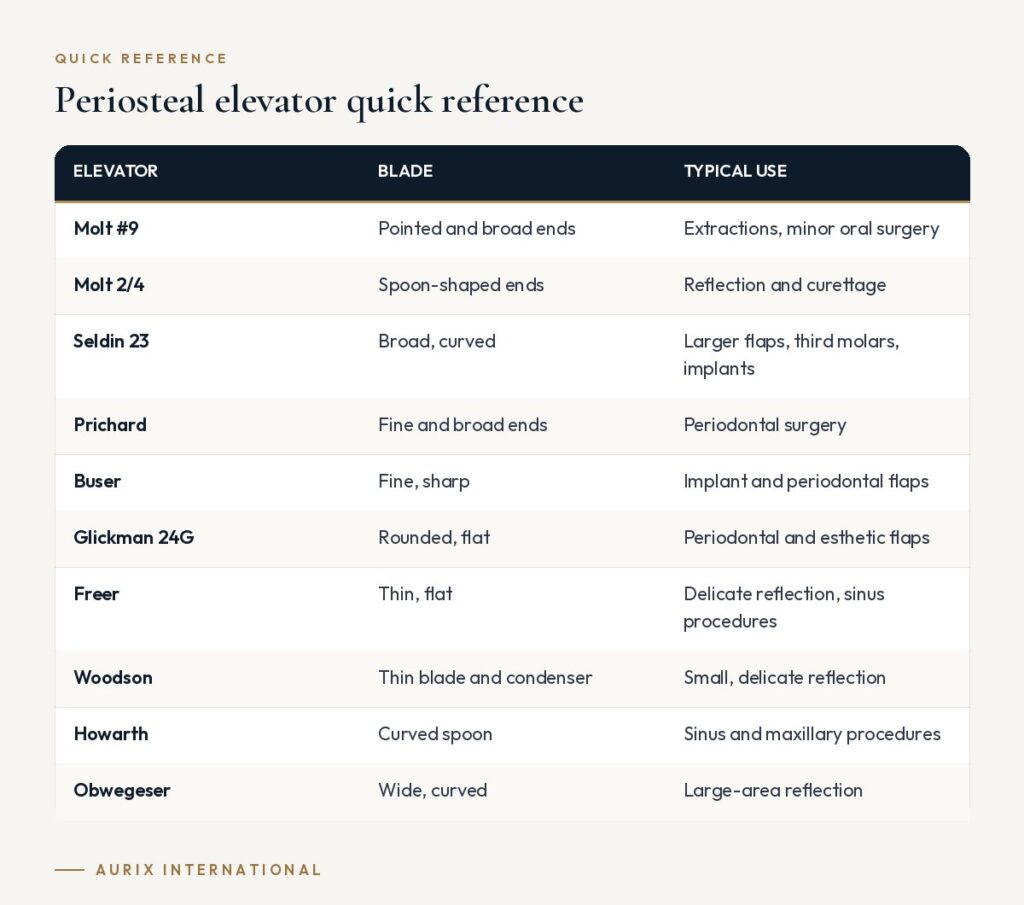
Periosteal elevator quick reference
| Elevator | Blade | Typical use |
|---|---|---|
| Molt #9 | Pointed and broad ends | Extractions, minor oral surgery |
| Molt 2/4 | Spoon-shaped ends | Reflection and curettage |
| Seldin 23 | Broad, curved | Larger flaps, third molars, implants |
| Prichard | Fine and broad ends | Periodontal surgery |
| Buser | Fine, sharp | Implant and periodontal flaps |
| Glickman 24G | Rounded, flat | Periodontal and esthetic flaps |
| Freer | Thin, flat | Delicate reflection, sinus procedures |
| Woodson | Thin blade and condenser | Small, delicate reflection |
| Howarth | Curved spoon | Sinus and maxillary procedures |
| Obwegeser | Wide, curved | Large-area reflection |
Our guide on choosing periosteal elevators by tip, width and handle goes into more detail on sizing.
How to choose periosteal elevators
- Match the blade to the tissue. Thick palatal and posterior mandibular tissue tolerates a Molt #9 or Seldin 23. Thin facial tissue and papillae in esthetic zones call for finer tips such as the Prichard or Buser.
- Check sharpness. A periosteal elevator should have a sharp, smooth edge. Dull or nicked edges tear tissue instead of lifting it.
- Consider handle diameter. Larger, textured handles reduce hand fatigue during long procedures.
- Build sets by procedure. Oral surgery trays usually need a Molt #9 and a broad elevator, while periodontal and implant trays benefit from finer instruments. Our top 15 oral surgery instruments list shows where they fit on a full tray.
- Protect the edges. Store elevators in cassettes so the tips do not knock against other instruments, and follow the IFU for cleaning and sterilization.
Technique tips for clean flap reflection
Good reflection starts with a full-thickness incision down to bone, because a periosteal elevator cannot lift a flap cleanly if the periosteum has not been cut through. Begin at a papilla or at the corner of a releasing incision, where it is easiest to get under the periosteum, and then work along the flap with short, controlled push strokes. Furthermore, keep the concave side of the blade against the bone and use a finger of the other hand to support the tissue and feel the instrument’s progress.
If the flap starts to tear, stop and check that the incision is complete rather than applying more force. In thin biotypes and around implants, finer elevators reduce the risk of perforating the flap. Periosteal elevators are often included in pre-assembled extraction and surgical kits; our overview of the 13-piece surgical extraction and luxation system shows a typical combination.
Frequently asked questions
What is a periosteal elevator used for?
It separates the periosteum and overlying gingiva from the bone to raise a full-thickness flap, giving access for extractions, bone removal, implant placement and periodontal procedures.
Which periosteal elevator is best for beginners?
The Molt #9 is the most common starting point because it combines a pointed end for papillae and a broad end for general reflection.
Are periosteal elevators sharpened?
Yes, many periosteal elevators can be sharpened carefully to restore the edge. Follow the manufacturer’s guidance and replace instruments with bent or damaged tips.
Can a periosteal elevator be used as a retractor?
Once the flap is raised, a broad periosteal elevator often holds it away from the bone, but a dedicated retractor gives more stable retraction for longer procedures.
Find the right periosteal elevators for your trays. Aurix International offers surgical-grade stainless steel periosteal elevators individually and in custom surgical kits. Build a custom kit →