
Tissue forceps, also called pickups or thumb forceps, hold and stabilize soft tissue during flap handling, suturing and debridement. The tip design decides how securely they grip and how much they crush, so the right choice protects delicate oral mucosa and helps the flap heal. These are the 10 tissue forceps most often used in oral and periodontal surgery.
Key takeaways
- Toothed tips (1×2) hold tissue securely with less pressure than serrated tips, which reduces crushing.
- The Adson is the most common tissue forceps in oral surgery.
- Fine patterns such as the Gerald and Castroviejo suit periodontal and microsurgical work.
- Atraumatic DeBakey tips are a good choice for delicate tissue.
- Hold forceps like a pen, not in the palm, for the best control.
The top 10 tissue forceps
1. Adson forceps with teeth (1×2)
The Adson has broad, flat handles that taper to narrow tips. The toothed version has a single tooth on one tip that fits between two teeth on the other, giving a secure grip on the flap with minimal pressure. It is the standard pickup for suturing in oral surgery.
Tip: Grip the edge of the flap or the underside of the tissue rather than the surface, to avoid marking the mucosa.
2. Adson forceps, serrated (non-toothed)
The serrated Adson has fine cross-serrations instead of teeth. It is useful for handling sutures, gauze and dressings, and for tissue where a toothed tip would be unnecessary.
3. Adson-Brown forceps
The Adson-Brown has rows of many fine teeth along each tip. The pressure is spread over a wider area, so it grips tissue well while causing little trauma. Many surgeons prefer it for thicker palatal and posterior tissue.
4. Gerald forceps
The Gerald is a slimmer, more delicate forceps available with fine teeth or serrations. Its fine tips make it popular in periodontal surgery and for suturing papillae.
5. DeBakey forceps
DeBakey forceps have long, atraumatic tips with fine longitudinal grooves and small cross-serrations. Originally designed for vascular surgery, they are common in dentistry when the aim is to grip delicate tissue or grafts without tearing.
6. Semken forceps
The Semken is a fine dissecting forceps with serrated tips, used for delicate tissue handling and grasping small fragments of tissue during surgery.
7. Castroviejo tissue and suture forceps
Castroviejo forceps have very fine tips, often with tiny teeth and a tying platform. They pair with fine sutures, typically 5-0 and smaller, in periodontal plastic surgery, soft tissue grafting and microsurgery.
Tip: Pair them with a Castroviejo needle holder so both hands work at the same scale.
8. Corn suture pliers
Corn suture pliers have a hole in one tip that the other tip fits into, which lets the operator hold the tissue securely while the needle is passed through. They are commonly common in periodontal flap surgery.
9. Allis tissue forceps
The Allis is a locking grasping forceps with small interlocking teeth at the tips. In oral surgery it holds tissue that will be removed, such as cyst linings or excised soft tissue lesions, rather than tissue that must heal.
Tip: The Allis can crush tissue, so avoid using it on flaps you plan to keep.
10. Microsurgical tissue forceps
Microsurgical forceps have very fine, often round handles for rotation between the fingers, and delicate tips. They pair with magnification for connective tissue grafts and fine periodontal procedures.
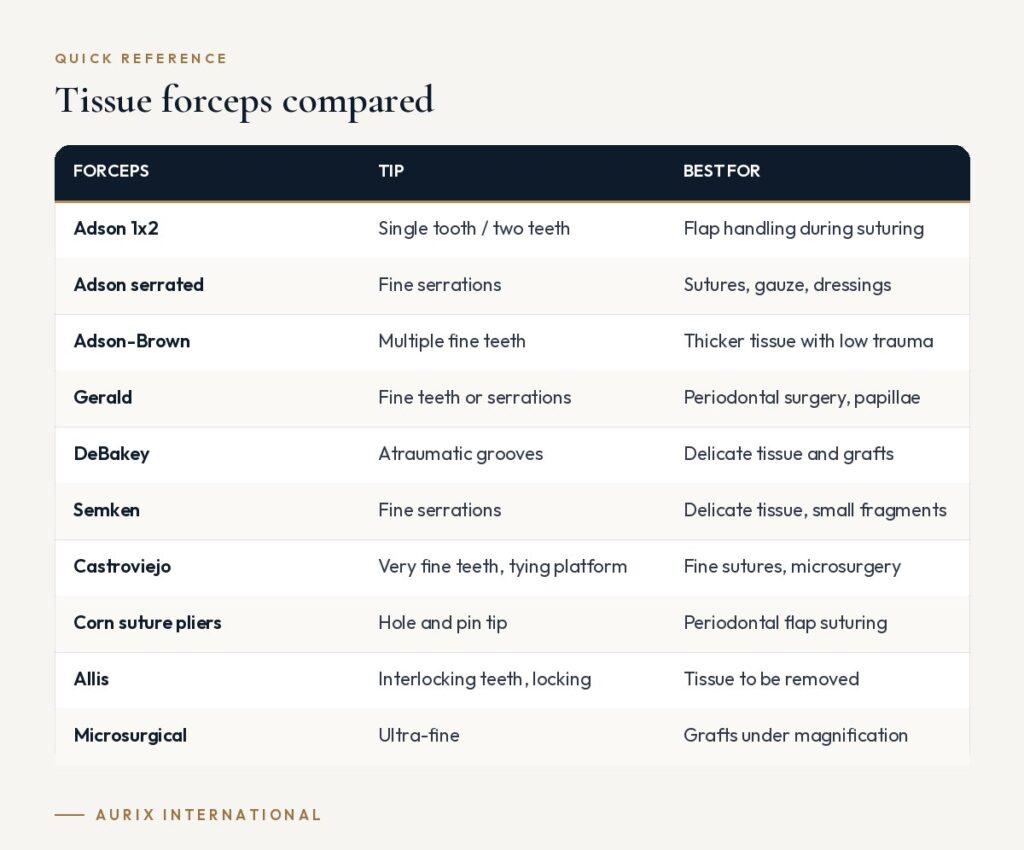
Tissue forceps compared
| Forceps | Tip | Best for |
|---|---|---|
| Adson 1×2 | Single tooth / two teeth | Flap handling during suturing |
| Adson serrated | Fine serrations | Sutures, gauze, dressings |
| Adson-Brown | Multiple fine teeth | Thicker tissue with low trauma |
| Gerald | Fine teeth or serrations | Periodontal surgery, papillae |
| DeBakey | Atraumatic grooves | Delicate tissue and grafts |
| Semken | Fine serrations | Delicate tissue, small fragments |
| Castroviejo | Very fine teeth, tying platform | Fine sutures, microsurgery |
| Corn suture pliers | Hole and pin tip | Periodontal flap suturing |
| Allis | Used when interlocking teeth, locking | Tissue to be removed |
| Microsurgical | Ultra-fine | Grafts under magnification |
For more on flap handling instruments, see our guide to tissue forceps and pickups for oral surgery.
How to choose tissue forceps
- Start with Adsons. A toothed Adson and a serrated Adson cover most extraction and implant suturing.
- Add fine forceps for periodontal work. A Gerald, Castroviejo or Corn suture plier makes handling thin flaps and grafts easier.
- Check tip alignment. Close the forceps and look at the tips against the light. Teeth should mesh precisely, with no overlap or gaps.
- Feel the spring tension. Too stiff causes hand fatigue; too soft reduces control.
- Coordinate with your suturing set. Our guide to building a dental suturing kit shows how forceps, needle holders and scissors work together.
- Inspect fine tips after reprocessing. Bent tips are a common problem; store forceps in cassettes and follow the IFU.
Handling tissue gently
Flaps heal best when they are handled as little as possible. Grasp the tissue once, pass the needle and release, rather than repeatedly regripping the same area. Hold the edge or underside of the flap, and avoid squeezing the full thickness of the tissue between serrated tips. When suturing a thin papilla, stabilizing the tissue with a fine forceps and letting the needle follow its curve reduces tearing. Our list of the top 10 needle holders for dental suturing covers the instruments that pair with these forceps.
Frequently asked questions
Are toothed forceps more traumatic than serrated forceps?
Not necessarily. Toothed forceps hold tissue securely with lighter pressure, which often causes less crushing than squeezing tissue with serrated tips. Use them on the edge or underside of the flap.
What is the difference between Adson and Adson-Brown forceps?
Standard Adson forceps have either a 1×2 tooth arrangement or serrations. Adson-Brown forceps have multiple rows of fine teeth, which spread pressure across the tissue.
Which tissue forceps are best for periodontal surgery?
Fine patterns such as the Gerald, Castroviejo and Corn suture pliers are popular because periodontal flaps and grafts are thin and delicate.
How should I hold tissue forceps?
Hold them like a pen, between the thumb and the index and middle fingers, resting on the middle finger. This gives far better control than a palm grip.
Complete your suturing and flap set. Aurix International supplies surgical-grade stainless steel tissue forceps individually or in custom suturing and surgical kits. Design your kit →