
Surgical scissors in dentistry trim soft tissue, undermine flaps, cut sutures and remove stitches. Each pattern has a blade shape, curvature and length suited to a specific task, and using tissue scissors to cut sutures or wire quickly dulls them. Here are the 10 surgical scissors most commonly used in oral surgery, periodontics and general dentistry.
Key takeaways
- Goldman-Fox, La Grange and Dean scissors target trimming gingival and oral soft tissue.
- Iris and Metzenbaum scissors help with fine dissection and undermining flaps.
- Keep dedicated suture scissors and stitch scissors so tissue scissors stay sharp.
- Castroviejo and fine dissecting scissors suit periodontal microsurgery.
- Serrated blades grip tissue and stop it slipping during the cut.
The top 10 surgical scissors
1. Goldman-Fox scissors
Goldman-Fox scissors have short, curved blades, often with one serrated edge to stop tissue slipping. They are a staple of periodontal surgery for trimming tissue tags and gingival margins, and also trim flaps in oral surgery.
2. La Grange scissors
La Grange scissors have double-curved, S-shaped blades that reach around the arch and interproximally. They trim gingival tissue and tissue tags in areas where straight blades cannot follow the contour.
Tip: The double curve takes some practice; keep the convex side toward the tissue being preserved.
3. Iris scissors
Iris scissors are small, fine scissors with sharp points, available straight or curved. In dentistry they help with precise soft tissue trimming and, in some practices, for cutting fine sutures.
4. Metzenbaum scissors
Metzenbaum scissors have long handles relative to their blades and blunt or semi-blunt tips. They target dissecting and undermining soft tissue, for example to release a flap for tension-free closure.
5. Dean scissors
Dean scissors have angled, curved blades, often with one serrated edge, set on longer handles. They are popular in oral surgery for trimming soft tissue and cutting sutures in posterior areas.
6. Mayo scissors
Mayo scissors are heavier scissors with a semi-blunt tip, available straight or curved. Straight Mayos commonly cut sutures, while curved versions cut thicker tissue.
7. Straight suture scissors
Dedicated straight operating scissors are kept for cutting suture tails during surgery. Using a separate pair protects the edges of fine tissue scissors.
Tip: Leave suture tails long enough to grasp at removal, typically a few millimeters, and avoid cutting so close that the knot unravels.
8. Spencer stitch scissors
Spencer stitch scissors have a small hook or notch on one blade that slides under a suture loop. They help with suture removal at the postoperative visit, cutting the stitch cleanly without pulling on the tissue.
9. Castroviejo scissors
Castroviejo scissors are spring-action microsurgical scissors with very fine blades. They are common in periodontal plastic surgery and grafting, usually under magnification, where precise cuts in thin tissue matter.
10. Fine dissecting scissors (tenotomy pattern)
Fine dissecting scissors, such as the Stevens tenotomy pattern, have slender blades and blunt or sharp tips. They help with delicate soft tissue dissection and for preparing connective tissue grafts.
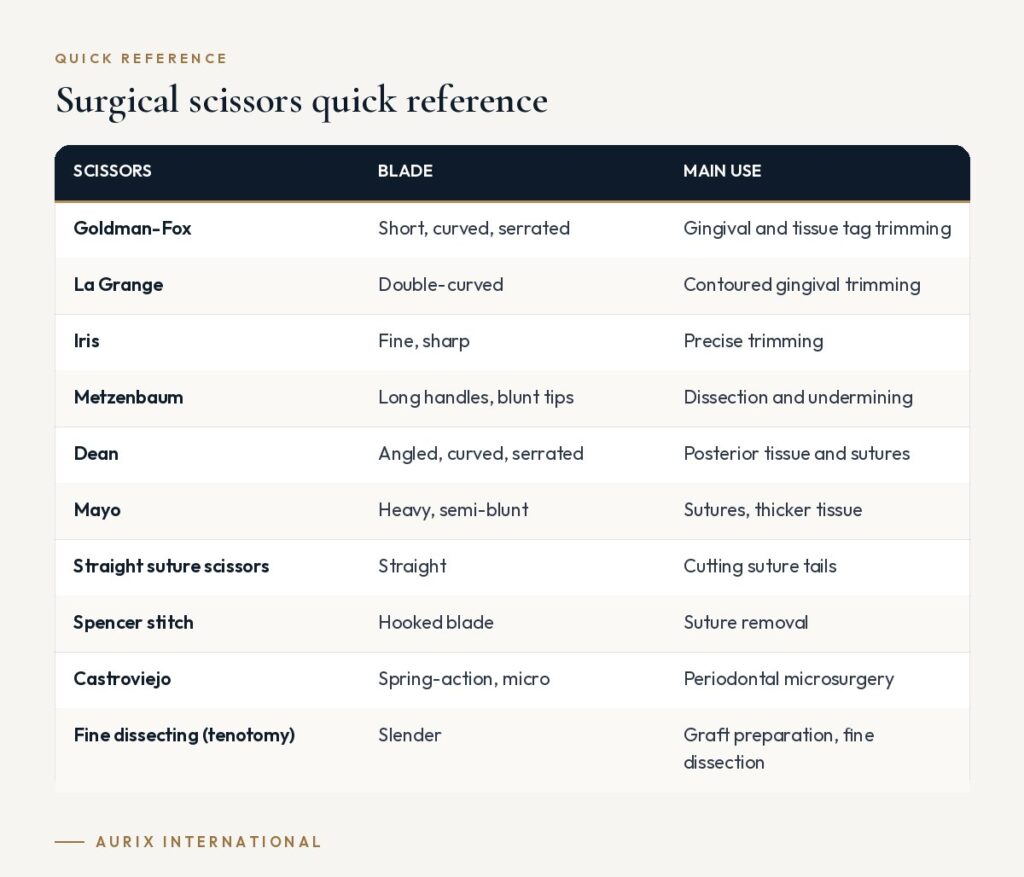
Surgical scissors quick reference
| Scissors | Blade | Main use |
|---|---|---|
| Goldman-Fox | Short, curved, serrated | Gingival and tissue tag trimming |
| La Grange | Double-curved | Contoured gingival trimming |
| Iris | Fine, sharp | Precise trimming |
| Metzenbaum | Long handles, blunt tips | Dissection and undermining |
| Dean | Angled, curved, serrated | Posterior tissue and sutures |
| Mayo | Heavy, semi-blunt | Sutures, thicker tissue |
| Straight suture scissors | Straight | Cutting suture tails |
| Spencer stitch | Hooked blade | Suture removal |
| Castroviejo | Spring-action, micro | Periodontal microsurgery |
| Fine dissecting (tenotomy) | Slender | Graft preparation, fine dissection |
For more on individual patterns, see surgical scissors for dentistry.
How to choose surgical scissors
- Separate tissue and suture scissors. Cutting sutures, especially monofilament, dulls fine tissue blades.
- Choose curvature for access. Curved and angled blades reach posterior and lingual areas; straight blades give more control anteriorly.
- Test the cut. Good scissors cut cleanly along the full blade length and to the tip without folding tissue.
- Consider tungsten carbide inserts. Carbide-edged scissors, often recognized by gold-colored handles, hold their edge longer.
- Look after the joint. Clean scissors open, lubricate the hinge with instrument lubricant as the IFU allows, and send them for sharpening when they start to chew tissue. See common dental instrument care mistakes to avoid.
Caring for surgical scissors
Scissors are precision cutting instruments, and most damage happens during use and reprocessing rather than wear. Do not use tissue scissors on wire, gauze, plastic or heavy sutures. After the procedure, wipe off blood and debris, clean the scissors in the open position and inspect the blades for nicks and the tips for misalignment before packaging. A simple test is to cut a piece of thin latex or tissue paper: good scissors cut cleanly to the tip without folding or tearing it.
Store scissors in a cassette or with tip protectors so the points do not knock against other instruments, and sterilize them according to the manufacturer’s IFU. When a pair starts to chew tissue, send it for professional sharpening or replace it. Practices that buy many scissors for several operatories often compare kit and single-instrument pricing; see our article on single instruments vs kit pricing.
Frequently asked questions
Which scissors are common in periodontal surgery?
Goldman-Fox and La Grange scissors are the classic periodontal scissors for trimming tissue. Castroviejo and fine dissecting scissors help with grafts and microsurgery.
Can I use the same scissors for tissue and sutures?
It is better not to. Sutures dull the fine edges of tissue scissors, so most clinicians keep dedicated suture scissors on the tray.
What are stitch scissors?
Stitch scissors, such as the Spencer pattern, have a hooked blade that slips under a suture loop so the stitch can be cut and removed without pulling on tissue.
Why do some scissors have serrated blades?
A serrated blade grips the tissue and stops it sliding away from the blades as they close, giving a cleaner, more predictable cut.
Keep sharp scissors on every surgical tray. Aurix International supplies surgical-grade stainless steel scissors and can include them in pre-assembled or custom surgical and periodontal kits. Ask our team →