For dental service organisations (DSOs) and multi-location groups, instruments are a scale problem. When every location uses different patterns from different vendors, training takes longer, audits are harder, purchasing is fragmented and costs creep up. A capable dental instruments supplier — combined with a clear standardisation plan — is one of the fastest ways to bring order and savings.
Key takeaways
- Standard kits per procedure make staff interchangeable between locations.
- Fewer SKUs in larger volumes unlock better pricing.
- Pilot new kits before rolling out group-wide.
- Track spend and replacements by location to spot reprocessing problems.
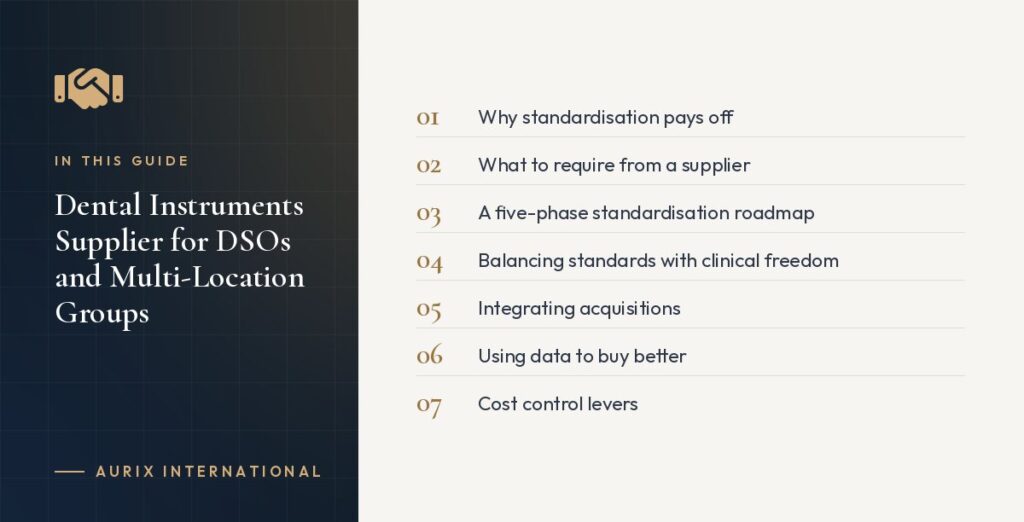
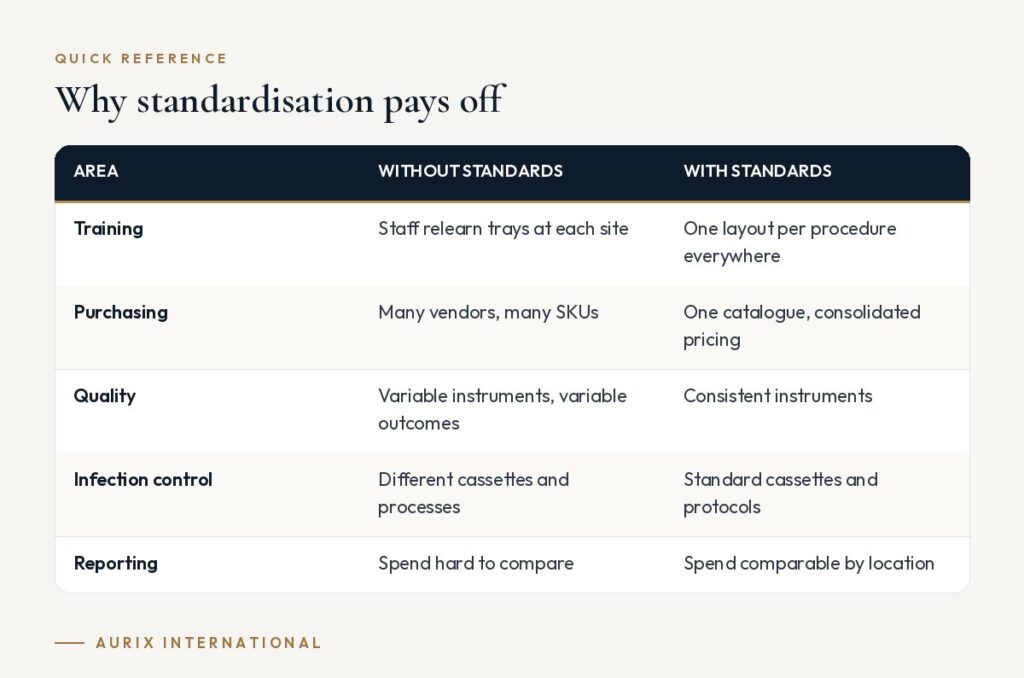
Why standardisation pays off
| Area | Without standards | With standards |
|---|---|---|
| Training | Staff relearn trays at each site | One layout per procedure everywhere |
| Purchasing | Many vendors, many SKUs | One catalogue, consolidated pricing |
| Quality | Variable instruments, variable outcomes | Consistent instruments |
| Infection control | Different cassettes and processes | Standard cassettes and protocols |
| Reporting | Spend hard to compare | Spend comparable by location |
What to require from a supplier
- Capacity to deliver identical kits to many locations on schedule.
- Pre-assembled and custom kits for each procedure.
- Clear wholesale tiers based on group volume.
- Flexible ordering: central purchasing, per-location ordering from an approved catalogue, or both.
- Consolidated or per-location invoicing.
- Order reporting by location.
- Optional branding or laser marking with the group’s name.
- A dedicated contact or responsive account team.
A five-phase standardisation roadmap
| Phase | Activity | Output |
|---|---|---|
| 1. Audit | Collect tray lists and spend from each location | Current-state picture |
| 2. Agree | Clinical leads agree one kit per procedure plus approved alternatives | Group standard |
| 3. Pilot | Trial kits in one or two locations for 4–6 weeks | Feedback and adjustments |
| 4. Roll out | Phased delivery and training across locations | Standard kits live |
| 5. Maintain | Standard reorder process, quarterly reporting, annual review | Sustained savings |
Balancing standards with clinical freedom
Clinicians care deeply about their instruments. The most successful groups agree a core standard for each procedure with a short list of approved alternatives for clinicians who genuinely need them. This preserves most of the purchasing benefit while respecting clinical judgement and improving adoption.
Integrating acquisitions
Newly acquired practices often have a patchwork of brands and patterns. A clear group standard and a supplier who can deliver quickly make integration smoother. Replace kits procedure by procedure, starting with the most-used, and train the new team on group layouts during the switch.
Using data to buy better
Track instrument spend and replacements by location. A site replacing curettes far more often than others may have a sharpening or reprocessing issue; a site using more extraction kits may need extra sets. Ask your supplier for order reports by location or keep a simple shared spreadsheet. See instrument tracking.
Cost control levers
- Fewer patterns in larger quantities.
- Kits instead of loose instruments.
- Annual volume commitments in exchange for better tiers.
- Better instrument care to extend lifespan — see total cost of ownership.
Compliance and audit readiness
Standard instruments and cassettes make infection-control audits simpler: one set of reprocessing instructions per kit, consistent packaging and labelling, and predictable sterilisation loads. Ask your supplier for reprocessing instructions for every product and keep them accessible at every site.
Example: a 12-location group
A group with 12 locations found 40 different extraction forceps patterns in use. Clinical leads agreed 14 standard patterns in two kit configurations plus four approved alternatives. Central ordering from one supplier moved the group into a higher pricing tier, and new assistants could work at any site after a single training session.
Frequently asked questions
Should every location order separately?
Many groups use central purchasing with per-location delivery; others let locations reorder from an approved catalogue. Both work if the catalogue is controlled.
Can kits carry our group branding?
Yes, through laser marking and branded cassettes.
How long does group-wide standardisation take?
Typically several months from audit to full roll-out, depending on the number of locations.
Next steps
Aurix works with groups to standardise kits and pricing. Start a conversation, read about wholesale accounts, or compare suppliers in our US supplier guide.