Dental hygienist instruments are the tools hygienists rely on to examine, measure and debride the dentition at every recall and periodontal maintenance visit. Because hygienists use them for hours each day, the right selection affects not only clinical results but also comfort and long-term hand health. Here are the ten instruments that earn a place in nearly every hygienist’s cassette, with notes on when to reach for each.
Key takeaways
- A hygienist’s kit combines assessment tools (mirror, probe, explorer) with debridement tools (sickles, curettes, ultrasonics).
- Front-surface mirrors and lightweight, wide handles make long days easier.
- Extended-shank and mini-bladed Graceys extend reach into deep pockets and narrow root surfaces.
- Sharpening equipment belongs on the list: dull blades mean more strokes and more strain.
The top 10 dental hygienist instruments
1. Mouth mirror
The mirror provides indirect vision, retraction of the cheek and tongue, and light reflection into dark areas. Front-surface mirrors give a sharper image without the “double image” of rear-surface glass.
Tip: mirror heads wear and scratch over time. Replace them as soon as the image becomes cloudy, since straining to see leads to poor posture.
2. Periodontal probe
Probing depths and bleeding points drive the treatment plan. Hygienists commonly choose a UNC-15, Williams or color-coded probe such as a Marquis-style design. Thin, round tips glide into tight sulci more comfortably.
Tip: agree on one probe design in the practice so charting from different clinicians can be compared reliably.
3. ODU 11/12 explorer
The ODU 11/12 has a long, curved lower shank that reaches the base of posterior pockets and wraps around line angles. It is the go-to explorer for detecting residual subgingival calculus after debridement.
Tip: use overlapping vertical strokes and keep the side of the tip in contact with the root.
4. Shepherd’s hook explorer (No. 23)
Although less useful for deep pockets, the Shepherd’s hook is handy for checking supragingival calculus, sealants, margins and pits and fissures. Many hygienists keep a double-ended explorer/probe combination on the tray for quick examinations.
Tip: use it with a light, relaxed grasp. The finer and more flexible the tip, the more clearly you will feel small spicules of calculus and irregular margins.
5. Anterior sickle scaler
A straight-shank sickle quickly removes supragingival calculus from the lingual of mandibular incisors, which is one of the most common deposit sites. Its two cutting edges allow work on both mesial and distal surfaces.
Tip: keep the face at roughly 70 to 80 degrees to the tooth and use short, overlapping strokes.
6. Posterior sickle scaler (204S style)
Contra-angled sickles reach under contacts on premolars and molars. Hygienists often use them for interproximal supragingival deposits before switching to curettes for subgingival work. The H6/H7 is a slimmer alternative many hygienists prefer for anteriors and premolars.
Tip: keep the sickle tip pointed toward the contact and work from the line angle into the proximal surface with short pull strokes.
7. Universal curette
A universal curette, such as a Columbia 13/14 or Barnhart 1/2, adapts to anterior and posterior surfaces with one double-ended instrument. It is a versatile choice for light to moderate subgingival deposits and is ideal when tray space is limited.
8. Gracey curettes
Area-specific Graceys are the workhorses of periodontal maintenance and scaling and root planing. A practical hygiene set usually includes 1/2 or 5/6 for anteriors, 11/12 for posterior mesials and 13/14 for posterior distals, with 7/8 for facial and lingual surfaces.
Tip: the lower edge is the cutting edge. With the terminal shank parallel to the tooth surface, the blade is automatically at the right working angle. Read our top tips for using Gracey curettes for more.
9. Extended-shank and mini-bladed curettes
Extended-shank Graceys have a terminal shank about 3 mm longer than standard, for pockets deeper than about 5 mm. Mini-bladed versions have a blade roughly half the length, which suits narrow roots, furcations and tight anterior pockets.
Tip: add these selectively for patients with deep or narrow pockets rather than replacing standard Graceys entirely.
10. Ultrasonic scaler inserts
Most hygienists combine hand instrumentation with an ultrasonic scaler. Standard-diameter inserts handle heavier calculus; slim periodontal inserts reach deep pockets and furcations with less tissue distension.
Tip: check insert wear with the manufacturer’s guide card. A worn tip loses efficiency even when it still looks intact.
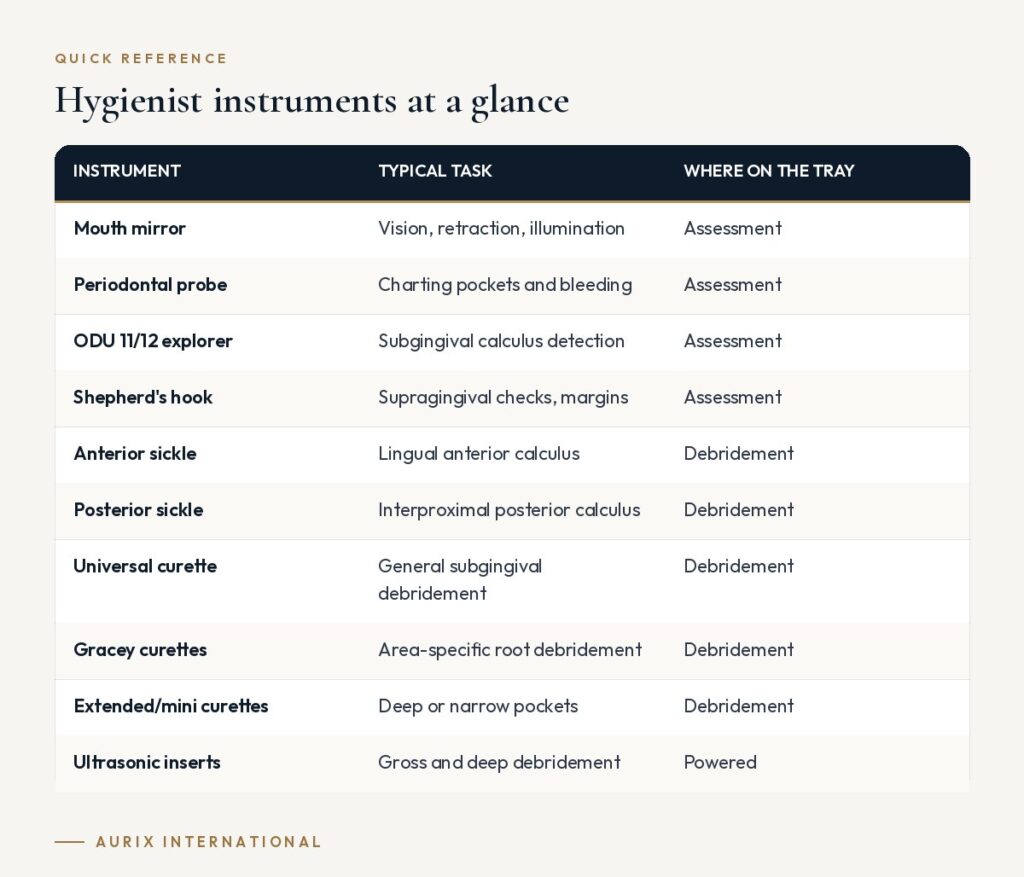
Hygienist instruments at a glance
| Instrument | Typical task | Where on the tray |
|---|---|---|
| Mouth mirror | Vision, retraction, illumination | Assessment |
| Periodontal probe | Charting pockets and bleeding | Assessment |
| ODU 11/12 explorer | Subgingival calculus detection | Assessment |
| Shepherd’s hook | Supragingival checks, margins | Assessment |
| Anterior sickle | Lingual anterior calculus | Debridement |
| Posterior sickle | Interproximal posterior calculus | Debridement |
| Universal curette | General subgingival debridement | Debridement |
| Gracey curettes | Area-specific root debridement | Debridement |
| Extended/mini curettes | Deep or narrow pockets | Debridement |
| Ultrasonic inserts | Gross and deep debridement | Powered |
Buying tips for hygienists
- Prioritize ergonomics. Wider, lighter handles with a textured grip reduce the pinch force needed to control the instrument. Consistent handle styles across the cassette help muscle memory.
- Color-code where it helps. Color rings can speed identification, though they need replacing when worn. Our guide to color coding instruments weighs the pros and cons.
- Budget for sharpening. Include a sharpening stone and test stick, and set a routine for when edges are checked.
- Buy in sets for multiple operatories. Matching cassettes reduce setup errors; see our hygiene tray checklist.
- Look at the steel. Surgical-grade stainless steel that tolerates repeated sterilization will hold its edge and finish longer.
Frequently asked questions
How many curettes does a hygienist need?
It depends on the patient base, but a typical setup includes one universal curette and three or four Gracey pairs, with extended-shank or mini-bladed options available for deeper or narrower pockets.
Are hollow handles better than solid handles?
Hollow and resin handles are lighter, which many hygienists find less tiring. Solid handles may give more tactile feedback. The best choice depends on personal preference and handle diameter.
How often should hygiene instruments be sharpened?
Check edges regularly with a test stick and sharpen at the first sign of dullness rather than waiting for the blade to fail. Frequent light sharpening preserves blade shape better than occasional heavy sharpening.
Equip your hygiene team with instruments built for long days. Aurix offers surgical-grade stainless steel scalers, curettes and probes, including a dedicated Gracey curette range. Browse Gracey curettes →