Choosing an OEM dental instrument manufacturer is one of the most important decisions a brand or distributor makes, because every instrument you sell will reflect that partner’s standards. The right questions reveal how a maker handles materials, quality and communication long before a problem reaches your customers. Use these ten questions in your first conversations and keep the answers on file for comparison.
Key takeaways
- Ask specific technical questions about steel grades, heat treatment, hardness and finishing.
- Request samples and test them clinically and on the bench before committing.
- Clarify who owns designs, tooling, artwork and regulatory responsibilities.
- Get minimum orders, lead times, defect handling and change control in writing.
The top 10 questions to ask an OEM dental instrument manufacturer
1. Which stainless steel grades do you use for each instrument type?
Different instruments need different steel properties. Cutting instruments such as curettes and scalers need a grade that can be hardened to hold an edge, while forceps, retractors and handles may use grades chosen for toughness and corrosion resistance. A good manufacturer will tell you which grade goes into which product and why, rather than giving a vague answer like “surgical steel.” Our guide to 410, 420 and 440A stainless steel explains the common options.
2. How do you control heat treatment and hardness?
Heat treatment determines whether a blade keeps its edge or a forceps beak holds its shape. Ask how hardening and tempering are performed, how hardness is measured, and how often batches are checked. Inconsistent heat treatment is a common cause of edges that dull quickly or tips that bend.
3. What does your quality control process look like?
Ask the manufacturer to walk you through inspection points from raw material to final packing: incoming material checks, in-process inspection after forging and grinding, final checks on alignment, joint action and finish. Ask what percentage of each batch is inspected and what happens to rejected items.
4. Can you provide samples, and how close will production be to them?
Samples are only useful if production matches them. Request samples of the exact patterns you plan to order, test them, and ask how the manufacturer ensures that production batches match approved samples. Some brands keep “golden samples” signed off by both parties as a reference. A structured approach to evaluating supplier samples makes this step more reliable.
5. How are passivation and surface finishing handled?
Passivation helps stainless steel form its protective oxide layer and resist corrosion, while the finish (satin or mirror) affects glare and appearance. Ask whether instruments are passivated, what finishes are available, and how the maker prevents surface contamination that can lead to staining after sterilization.
6. Who owns the designs, tooling and artwork?
If you develop a custom pattern or pay for special tooling, clarify ownership in writing. The same applies to logos, packaging artwork and any product names. Clear ownership protects you if you later move production or expand to a second manufacturer.
7. What marking and branding options do you offer?
Most OEM instruments carry laser-marked logos, pattern numbers and sometimes lot codes. Ask about marking placement, durability after repeated reprocessing, and whether marks can include traceability information. Also ask about packaging options and branded labels.
8. What documentation can you supply?
Depending on your market, you may need material certificates, reprocessing instructions for use (IFU), labeling information and regulatory details such as establishment registration. Ask what the manufacturer already provides and what you will need to prepare yourself. Clarify who is responsible for which regulatory obligations in each country you sell into.
9. What are your minimum order quantities, lead times and capacity?
Ask about MOQs per pattern and per order, typical lead times for first orders versus reorders, and how the manufacturer handles peaks in demand. A partner with clear capacity planning helps you avoid stockouts on your best-selling patterns.
10. How do you handle defects, complaints and changes?
Problems happen even with good suppliers. Ask how defective items are replaced or credited, how complaints are investigated, and how you will be notified of changes to materials, processes or subcontractors. A written change-control commitment protects the consistency your customers expect.
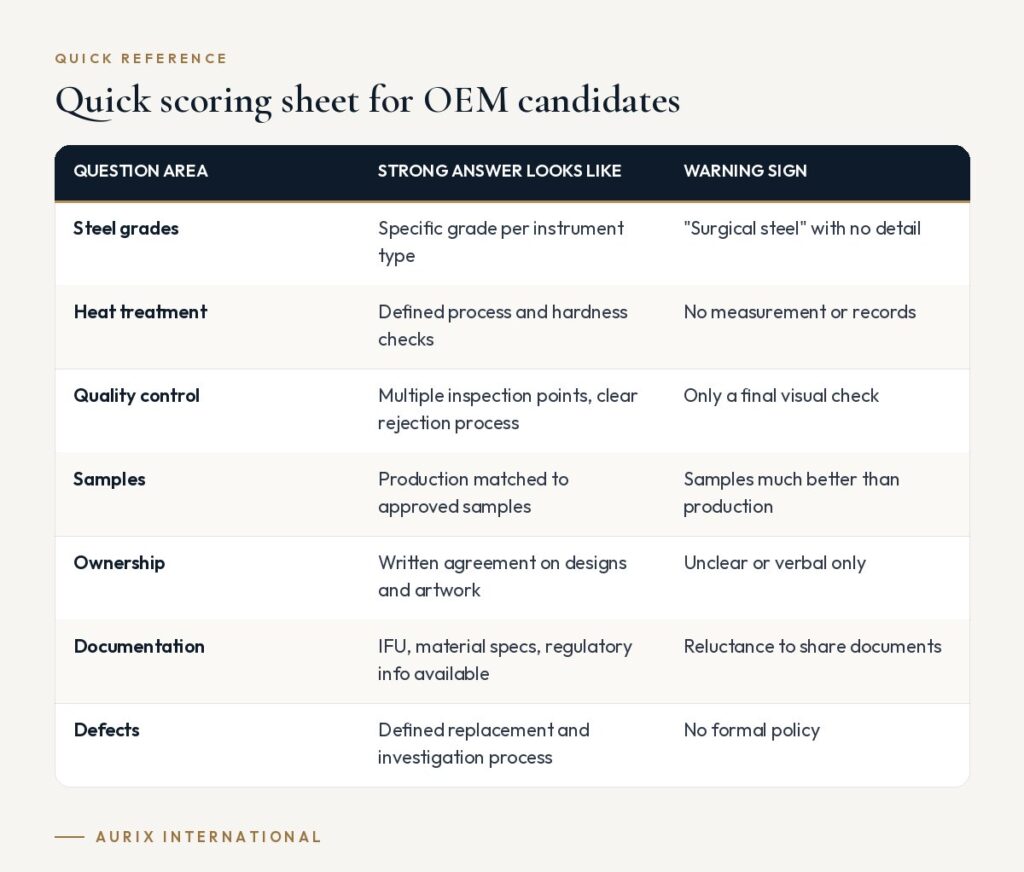
Quick scoring sheet for OEM candidates
| Question area | Strong answer looks like | Warning sign |
|---|---|---|
| Steel grades | Specific grade per instrument type | “Surgical steel” with no detail |
| Heat treatment | Defined process and hardness checks | No measurement or records |
| Quality control | Multiple inspection points, clear rejection process | Only a final visual check |
| Samples | Production matched to approved samples | Samples much better than production |
| Ownership | Written agreement on designs and artwork | Unclear or verbal only |
| Documentation | IFU, material specs, regulatory info available | Reluctance to share documents |
| Defects | Defined replacement and investigation process | No formal policy |
How to choose between OEM manufacturers
- Compare like with like. Request quotes on the same patterns, finishes and quantities so prices are comparable.
- Weigh total cost, not unit price. Include rejection rates, freight, duties, inspection and the cost of returns from customers.
- Test communication. How quickly and clearly a manufacturer answers technical questions during quoting is a good preview of how it will handle problems later.
- Start with a pilot order. A small first run of core patterns lets you verify quality before scaling.
- Plan for growth. Choose a partner whose range covers the instruments you may want to add later, from diagnostics to surgical kits.
For a broader overview of the process, read our article on OEM dental instrument manufacturing.
Frequently asked questions
Should I visit the factory before placing an OEM order?
A visit or a third-party audit can be valuable, especially for large or long-term programs. At minimum, request detailed answers about processes, review samples carefully and inspect your first production run.
Is a cheaper OEM quote always a risk?
Not always, but large price gaps often reflect differences in steel, heat treatment, finishing or inspection. Ask what is different and compare samples side by side before deciding.
How long does it take to launch an OEM range?
Timelines vary with the number of patterns, custom design work, marking and packaging approval. Ask your manufacturer for a realistic schedule that includes sample approval and first production.
Can an OEM manufacturer also assemble kits?
Many can. Ask whether they assemble procedure kits or cassettes to your specification, which can simplify your logistics and give customers ready-to-use sets.
Looking for an OEM partner with real instrument-making depth? Aurix International supplies surgical-grade stainless steel dental instruments through OEM and private label programs, drawing on four generations of craftsmanship. Discuss your OEM project →