Importing dental instruments into the USA involves more than placing an order with an overseas factory. Dental instruments are medical devices, so shipments are reviewed by U.S. Customs and Border Protection (CBP) and can be examined by the FDA at entry. The ten tips below cover the essentials in general terms; because regulations change, always confirm current requirements with the FDA and a licensed customs broker before you ship.
Key takeaways
- Foreign manufacturers generally must register with the FDA and list their devices before those devices are imported.
- Many manual dental hand instruments are Class I devices, but 510(k) exemptions have limitations, so confirm the classification of each product.
- Initial importers have their own FDA registration duties; a licensed customs broker helps with CBP entry.
- Accurate labeling, invoices and country-of-origin marking help avoid holds and delays.
This article is general information, not legal or regulatory advice.
The top 10 tips for importing dental instruments
1. Confirm that each product is regulated as a medical device
Most items used in dental care, including hand instruments such as scalers, curettes, forceps, elevators and mirrors, fall under FDA medical device regulations. Start by making a list of every product you plan to import and identify how each one is regulated. Do not assume that because one item is straightforward, the rest of the catalog is too.
2. Look up the device classification and exemption status
The FDA classifies devices into Class I, II or III based on risk. Many manual dental hand instruments fall under the dental hand instrument classification (21 CFR 872.4565) as Class I devices subject to general controls. Many Class I devices are exempt from premarket notification (510(k)), but exemptions come with limitations, for example around materials and intended use. Check the FDA’s product classification database and the relevant regulation for each product code rather than assuming an exemption applies.
Practical tip: record the product code and regulation number for every SKU in a simple spreadsheet. It makes registration, listing and customs entries far easier.
3. Make sure the foreign manufacturer is registered and listed
According to the FDA, foreign establishments that make devices for the U.S. market must register their establishment and list their devices before those devices are imported for the first time. Registration must also be renewed annually. Ask your manufacturer for its FDA registration details and confirm the listings cover the products you are buying. You can read the FDA’s overview of who must register, list and pay the fee.
4. Check that a U.S. agent has been designated
Foreign manufacturers must designate a U.S. agent as part of their FDA registration. The U.S. agent is located in the United States and acts as a point of contact between the FDA and the foreign establishment. Confirm with your supplier who their U.S. agent is and that the details are current.
5. Understand your own role as an importer
Under FDA rules, an “initial importer” is the company that furthers the marketing of a foreign device to the final user without repackaging it or changing its labeling. Initial importers have their own registration obligations and must identify the manufacturers of the devices they import, although they generally do not list devices themselves. If you relabel, repackage or sell under your own brand, your obligations can be greater. Work out which role you play before your first shipment.
6. Get labeling right before goods ship
Device labeling must meet FDA requirements (21 CFR Part 801 covers general device labeling), and FDA reviewers can detain products with inadequate labeling. Typical considerations include the name and place of business of the manufacturer, packer or distributor and adequate directions or instructions for use. Unique Device Identification (UDI) rules may also apply depending on the device. Sort out label content with your supplier before production rather than relabeling after arrival.
7. Mark the country of origin
U.S. customs law generally requires imported goods, or their containers, to be marked with the English name of the country of origin. Agree with your manufacturer how marking will be applied to instruments and packaging so that shipments are not held for marking issues.
8. Work with a licensed customs broker
A licensed customs broker can file entries with CBP, advise on tariff classification under the Harmonized Tariff Schedule, explain current duty rates and arrange a customs bond if one is needed. Device entries also carry FDA data, such as product codes and registration numbers, that must match what the FDA has on file. A broker familiar with medical devices can prevent many avoidable delays. Tariff rates and trade rules change, so ask your broker for current information on every shipment.
9. Keep your paperwork complete and consistent
Inconsistent paperwork is one of the most common causes of holds. Make sure the commercial invoice, packing list and FDA entry data agree on product descriptions, quantities, values, manufacturer details and country of origin. Keep copies of registration confirmations, classification research and correspondence with your supplier in one place.
10. Inspect goods on arrival and keep records
Once goods clear customs, inspect them against your purchase order and specifications: check markings, finish, tip alignment, joint action and packaging. Keep records of lots received, complaints and any issues reported by customers. Good records support your obligations as an importer and help you manage supplier quality over time. Our checklist of quality checks when instruments arrive can help.
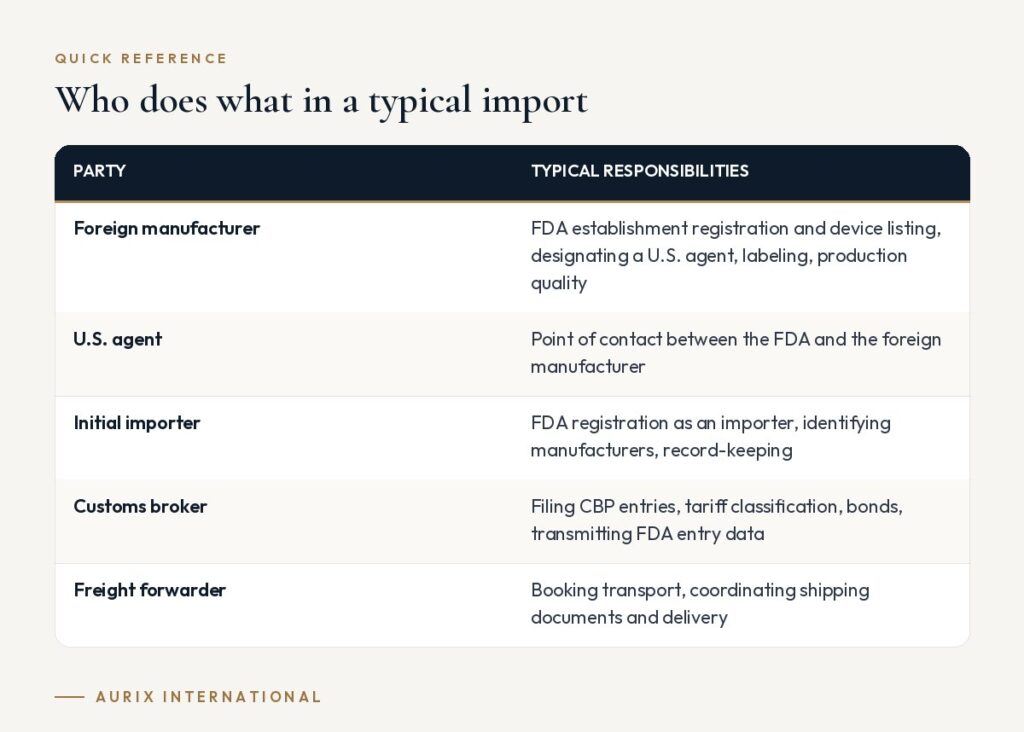
Who does what in a typical import
| Party | Typical responsibilities |
|---|---|
| Foreign manufacturer | FDA establishment registration and device listing, designating a U.S. agent, labeling, production quality |
| U.S. agent | Point of contact between the FDA and the foreign manufacturer |
| Initial importer | FDA registration as an importer, identifying manufacturers, record-keeping |
| Customs broker | Filing CBP entries, tariff classification, bonds, transmitting FDA entry data |
| Freight forwarder | Booking transport, coordinating shipping documents and delivery |
Buying tips: choosing an overseas supplier to import from
- Ask for registration evidence up front. A supplier experienced with the U.S. market should readily share its FDA registration and listing information.
- Request product documentation. Material specifications, reprocessing instructions and labeling proofs should be available before you place a large order.
- Order samples first. Test samples for quality and confirm that markings and labels are correct.
- Plan for lead times. Production, international freight and customs clearance all add time. Build buffer stock for fast-moving items.
- Consider a domestic supplier. If you would rather not manage imports yourself, buying from a U.S.-based supplier shifts much of this work away from you. See why some buyers choose a USA-based supplier.
Frequently asked questions
Do dental hand instruments need FDA 510(k) clearance?
Many manual dental hand instruments are Class I devices exempt from 510(k), but exemptions have limitations and not every product qualifies. Check the classification and exemption status of each product code in the FDA database or ask a regulatory consultant.
Can I import dental instruments for my own clinic?
Even small shipments are subject to customs and FDA review, and the manufacturer generally still needs to be registered and listed. Many clinics find it simpler to buy from an established domestic supplier or distributor.
What happens if a shipment is detained?
The FDA or CBP will issue a notice explaining the issue. Depending on the problem, you may be able to provide documentation, correct labeling under supervision, export the goods or have them destroyed. A customs broker can guide you through the process.
Where can I find official guidance?
The FDA’s medical device import pages and the device registration and listing pages are the primary sources. CBP publishes guidance on entry procedures, bonds and country-of-origin marking.
Prefer to skip the import paperwork? Aurix International is a USA-based supplier of surgical-grade stainless steel dental instruments, kits and wholesale programs for clinics and distributors. Explore wholesale ordering →