Private label dental instruments give distributors, dental service organizations and specialist brands a way to sell instruments under their own name without building a factory. Instead of reselling the same branded lines as every competitor, you work with an established manufacturer that produces, marks and packages instruments to your specification. This article walks through the ten most practical benefits, plus what to check before you commit.
Key takeaways
- Private label lets you own the brand and the customer relationship while a specialist manufacturer handles production.
- The biggest gains are pricing control, differentiation and repeat business tied to your name.
- Quality control, documentation and clear specifications decide whether a private label line succeeds.
- Start with a focused range of high-turnover instruments, then expand once demand is proven.
The top 10 benefits of private label dental instruments
1. Control over pricing and margin
When you resell a national brand, the manufacturer’s list price and the prices your competitors charge largely set your ceiling. With a private label line, you negotiate cost directly with the producer and decide your own price positioning. That flexibility lets you build tiered offers, such as an economy student line and a premium specialist line, without being locked into someone else’s price structure.
Practical tip: model your landed cost (unit price, marking, packaging, freight, duties and inspection) before setting list prices, so the margin you expect survives real-world costs.
2. A brand that belongs to you
Every instrument that carries your logo builds recognition for your business rather than for a third party. Over time, clinicians start asking for “your” curettes or “your” forceps by name. That brand equity stays with you even if you later change manufacturing partners, provided you own the trademark and the artwork.
3. Differentiation in a crowded market
Many distributors carry identical catalogs, which pushes competition toward price alone. A private label range gives you products that buyers cannot compare line by line on a competitor’s website. You can differentiate with handle styles, color-coded rings, kit configurations or packaging that suits your customer base.
4. Customer loyalty and repeat orders
Dental teams like consistency. Once a hygienist is comfortable with a particular handle weight and blade feel, they tend to reorder the same pattern. If that pattern is only available from you, replacement orders come back to you as well. Pairing private label hand instruments with consumable reorders, such as sharpening services or cassette refills, strengthens that loop.
5. Catalog consistency across product lines
Private label allows you to standardize markings, handle designs and packaging across a whole range, from scalers and curettes to extraction forceps. A unified look makes your catalog easier to navigate and helps clinics build matching trays. It also simplifies training for your sales team, who learn one product family instead of several brands.
6. Faster response to customer feedback
Because you own the specification, you can act on what customers tell you. If clinicians want a slimmer handle or a different tip pattern, you can raise it with your manufacturer and add it to the range. With a third-party brand, you can only pass feedback along and hope it is heard.
7. Custom kits under your name
Private label works especially well for procedure kits. You can assemble hygiene, restorative or surgical sets that match how your customers actually work, then sell them as a single branded SKU. Kits raise average order value and make reordering simpler. For more on how tray design affects workflow, see this guide to designing custom instrument kits.
8. Access to established manufacturing expertise
Building your own forging, heat treatment and finishing capability is expensive and slow. A private label arrangement lets you rely on a maker that already has skilled craftspeople, proven processes and quality checks. You focus on sales, marketing and service, which is where most distributors add the most value.
9. Scalable entry with lower risk
Most private label programs let you start with a limited set of high-demand patterns rather than a full catalog. You can test the market with core items such as mirrors, explorers, probes and Gracey curettes, then add specialist instruments once sales data supports it. This staged approach keeps inventory risk manageable.
10. Stronger position with institutional buyers
DSOs, dental schools and group practices often prefer a single source that can supply standardized instruments across many locations. A private label line with consistent specifications and documentation positions you as that source, and the branded product reinforces the relationship each time a box is opened.
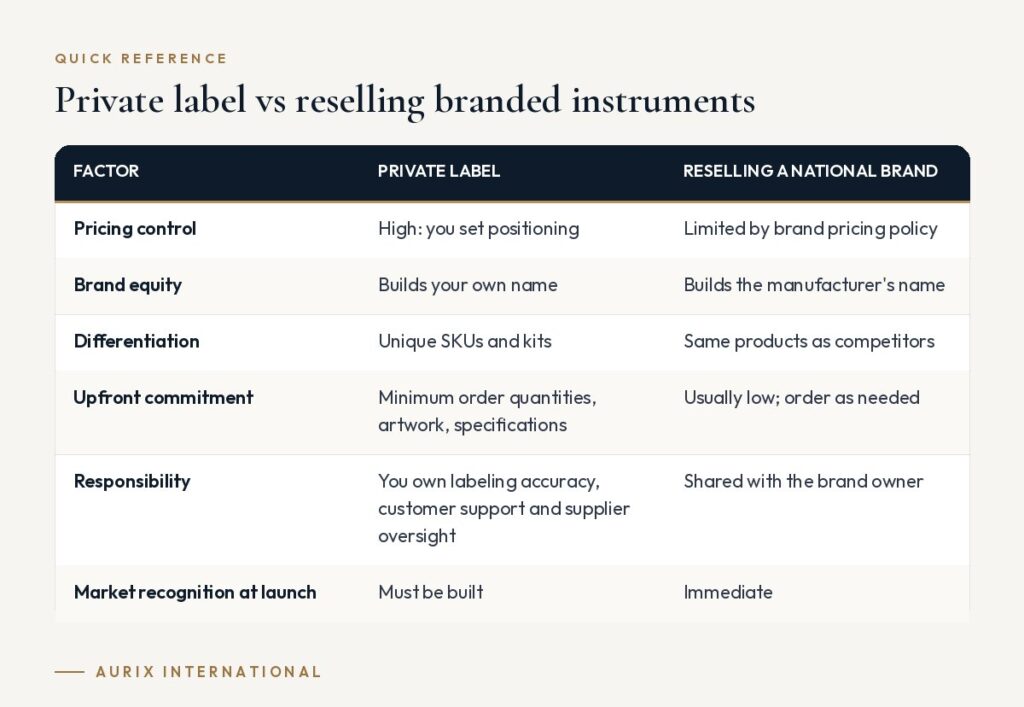
Private label vs reselling branded instruments
| Factor | Private label | Reselling a national brand |
|---|---|---|
| Pricing control | High: you set positioning | Limited by brand pricing policy |
| Brand equity | Builds your own name | Builds the manufacturer’s name |
| Differentiation | Unique SKUs and kits | Same products as competitors |
| Upfront commitment | Minimum order quantities, artwork, specifications | Usually low; order as needed |
| Responsibility | You own labeling accuracy, customer support and supplier oversight | Shared with the brand owner |
| Market recognition at launch | Must be built | Immediate |
How to choose a private label partner
The benefits above only materialize if the instruments are good. Before signing, work through these checks:
- Material and heat treatment. Ask which stainless steel grades are used for each instrument type and how hardness is controlled. Cutting instruments need different properties than forceps or retractors. Our guide to surgical-grade stainless steel explains the common grades.
- Samples and testing. Evaluate samples clinically and on the bench: edge retention, tip alignment, joint smoothness and resistance to staining after repeated sterilization cycles.
- Marking options. Confirm how your logo and pattern numbers will be applied (typically laser marking) and that marks remain legible after reprocessing.
- Documentation. Ask for material specifications, reprocessing instructions for use (IFU) and any regulatory information you will need for the markets you sell into.
- Minimums and lead times. Understand minimum order quantities per pattern, reorder lead times and how artwork changes are handled.
- Packaging and labeling. Clarify who is responsible for label content and compliance in your market. As the brand owner, you may carry obligations that a simple reseller does not.
Start with a short list of patterns that already sell well for you, agree on clear written specifications, and inspect the first production run carefully before scaling up.
Frequently asked questions
What is the difference between private label and OEM?
The terms overlap. OEM often refers to a manufacturer producing to a customer’s own design or specification, while private label usually means applying your brand to the manufacturer’s existing, proven designs. Many programs combine both: standard patterns with some custom elements.
Do I need my own regulatory registrations to sell private label instruments?
It depends on your market and your role. In the United States, for example, companies that label devices under their own name can have FDA registration and listing obligations. Requirements vary, so confirm your responsibilities with a regulatory advisor before launch.
Which instruments are best to start a private label range with?
High-turnover items with stable designs are usually the safest start: mouth mirrors, explorers, periodontal probes, Gracey curettes, sickle scalers and common extraction forceps. They sell steadily and are easy for customers to compare on quality.
Can private label instruments match branded quality?
Yes, when the manufacturer uses appropriate steel, controlled heat treatment and careful finishing. Quality depends on the maker and your specifications, not on whose name is on the handle, which is why sample testing matters.
Ready to put your name on a quality instrument line? Aurix International offers OEM and private label programs for surgical-grade stainless steel dental instruments, backed by four generations of instrument-making heritage. Explore private label options →