Dental instrument trends rarely make headlines, but they shape daily work in every operatory and sterilization room. In 2026 the biggest shifts are less about radical new instruments and more about how instruments are designed, organized, tracked and bought. These ten trends reflect what clinicians, practice managers, schools and distributors are paying attention to this year.
Key takeaways
- Kits, cassettes and custom tray design continue to replace loose instruments.
- Ergonomics and minimally invasive techniques are driving handle and working-end design.
- Traceability, marking and inventory tools are becoming routine, not optional.
- Buyers are weighing supply chain resilience and sustainability alongside price.
The top 10 dental instrument trends for 2026
1. Pre-assembled and custom procedure kits
Practices increasingly buy instruments as complete procedure kits rather than individual items. Custom kits, often designed with online kit builders, let teams combine their preferred patterns into standardized sets. The appeal is consistency, faster setup and simpler ordering. Our article on why pre-assembled kits are growing explores the reasons.
2. Cassette-based reprocessing
Instrument cassettes that hold a complete set through cleaning, sterilization, storage and use continue to spread. They reduce handling of sharp instruments, protect tips and edges, and make missing items obvious. More practices are designing their kits around specific cassette layouts.
3. Ergonomic handle design
Awareness of hand and wrist strain among clinicians and hygienists keeps pushing demand for larger-diameter, lightweight handles with textured grips. Hollow stainless, resin and silicone-covered handles are common options, and buyers are paying more attention to balance and weight distribution.
4. Instruments for atraumatic extraction
Preserving bone and soft tissue during extraction, particularly ahead of implant placement, remains a priority. That supports continued interest in periotomes, luxating elevators, fine root-tip instruments and slimmer forceps beaks. Our guide to atraumatic extraction instruments covers the key options.
5. Implant maintenance instruments
As more patients have implants, hygiene teams need instruments that can clean implant surfaces without scratching them. Titanium, plastic and other implant-safe scalers and curettes are becoming standard on hygiene trays alongside conventional stainless steel instruments.
6. Traceability and marking
Practices, hospitals and schools are paying more attention to which instruments they own and where they are. Laser marking, color coding, unique device identification and instrument tracking systems all help with inventory, accountability and loss prevention. Even smaller clinics are adopting simple tracking spreadsheets or apps.
7. Higher expectations for documentation
Buyers increasingly expect clear instructions for use, product information and material details from their suppliers. Distributors and private-label brands in particular need complete documentation for their own customers and regulatory obligations. Suppliers who provide this readily stand out.
8. Supply chain resilience
After several years of shipping disruption and shifting trade policy, many buyers now value dependable supply as much as unit price. Groups and distributors are planning orders further ahead, diversifying sources and favoring suppliers that communicate clearly about lead times. See our article on global dental supply chains in 2026.
9. Sustainability and reusable instruments
Interest in reducing waste is encouraging practices to look again at single-use items and choose durable reusable instruments where clinically appropriate. Longer-lasting instruments, repair and re-tipping, and efficient reprocessing all contribute. Our guide to sustainability in dental instruments discusses practical steps.
10. Growth of private label and online buying
Distributors, DSOs and schools are increasingly offering instruments under their own brands, supported by OEM and private-label manufacturing. At the same time, more professional purchasing is moving online, with detailed product pages, kit builders and direct wholesale ordering replacing catalog-only buying.
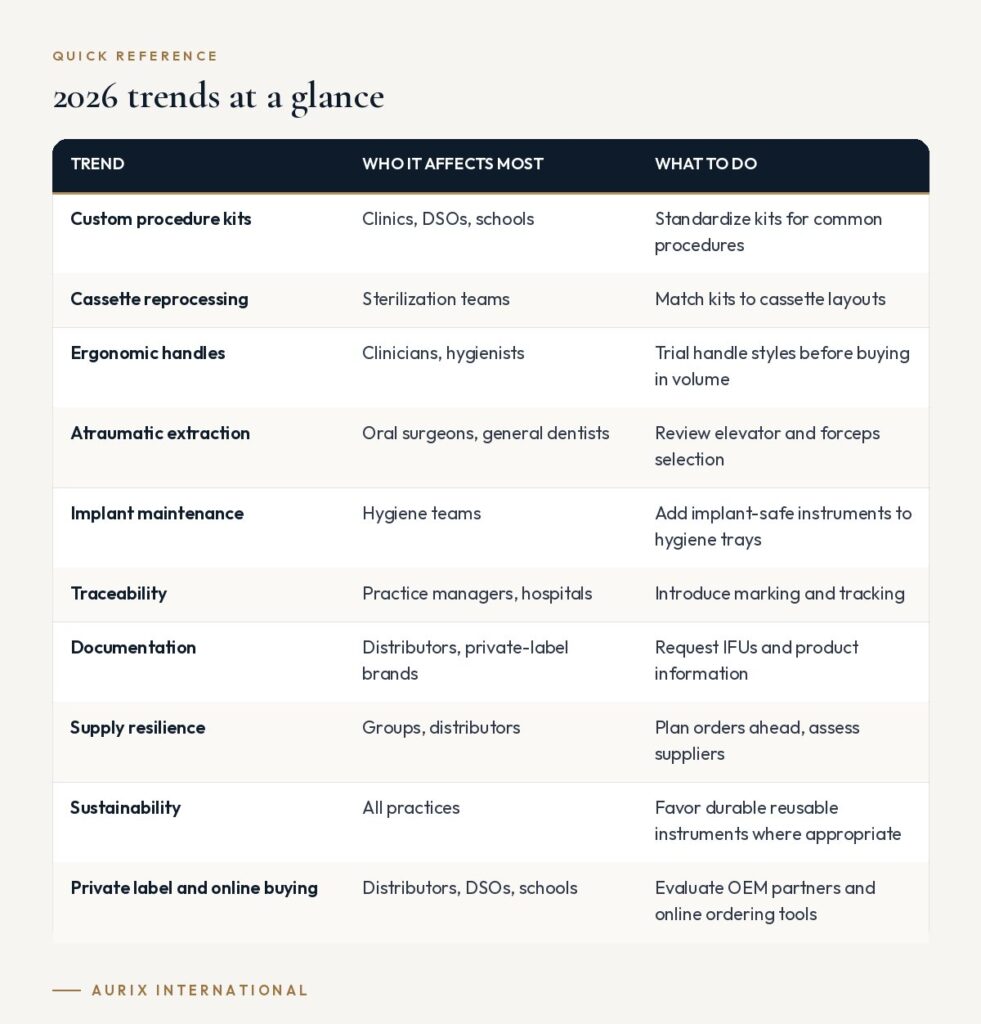
2026 trends at a glance
| Trend | Who it affects most | What to do |
|---|---|---|
| Custom procedure kits | Clinics, DSOs, schools | Standardize kits for common procedures |
| Cassette reprocessing | Sterilization teams | Match kits to cassette layouts |
| Ergonomic handles | Clinicians, hygienists | Trial handle styles before buying in volume |
| Atraumatic extraction | Oral surgeons, general dentists | Review elevator and forceps selection |
| Implant maintenance | Hygiene teams | Add implant-safe instruments to hygiene trays |
| Traceability | Practice managers, hospitals | Introduce marking and tracking |
| Documentation | Distributors, private-label brands | Request IFUs and product information |
| Supply resilience | Groups, distributors | Plan orders ahead, assess suppliers |
| Sustainability | All practices | Favor durable reusable instruments where appropriate |
| Private label and online buying | Distributors, DSOs, schools | Evaluate OEM partners and online ordering tools |
How to choose which trends to act on
- Start with pain points. If setup is slow, look at kits and cassettes; if staff report hand fatigue, look at ergonomic handles.
- Pilot before rolling out. Test new instruments or kit layouts in one operatory or location first.
- Involve the whole team, from clinicians to sterilization staff, since many trends affect workflow more than individual instruments.
- Check supplier capabilities for kits, custom marking, documentation and private label before you commit.
- Keep quality central. New formats only help if the instruments themselves are well made. For more on design direction, see trends in dental instrument design.
Frequently asked questions
Are hand instruments being replaced by powered devices?
Powered scalers and other devices are widely used, but hand instruments remain essential for diagnosis, fine scaling, root planing, surgery and restorative work. Most practices use both.
Is it worth switching to cassettes?
For many practices, yes. Cassettes can streamline reprocessing and protect instruments, but they require planning around kit contents, washer and sterilizer capacity, and storage space.
What is the easiest trend for a small clinic to adopt?
Standardizing a few procedure kits and introducing basic inventory tracking are low-cost steps that bring quick benefits in setup time and fewer lost instruments.
Stay ahead of what is changing. Aurix International supports clinics, schools and distributors with pre-assembled kits, custom kits and OEM and private-label instrument programs. Explore OEM and private label →