A quality dental instrument does its job precisely, feels comfortable in the hand and survives years of cleaning and sterilization without losing performance. Two instruments that look identical in a catalog can behave very differently in practice. These ten features are what experienced clinicians, assistants and buyers look for when they separate good instruments from merely adequate ones.
Key takeaways
- Quality starts with the right steel for the job and correct heat treatment.
- Precision at the working end matters most: sharp, true, well-aligned tips and blades.
- Ergonomics, balance and finish affect both clinical results and hand fatigue.
- Clear markings and IFUs are part of a quality product, not an extra.
The top 10 features of a quality dental instrument
1. The right steel for the instrument
A quality instrument is made from a stainless steel suited to its function. Cutting instruments such as curettes and scalers need hardenable martensitic grades that hold an edge, while other items prioritize toughness or corrosion resistance. Our comparison of 410, 420 and 440A stainless steel explains these choices.
2. Correct heat treatment
Heat treatment turns good steel into a good instrument. Properly hardened and tempered steel resists bending, holds an edge and is not so brittle that tips chip. You cannot see heat treatment, but you notice it quickly in how an instrument performs and wears.
3. Edge retention on cutting instruments
Scalers, curettes, chisels and hoes should arrive sharp and stay sharp through a reasonable number of uses. A quality blade can be resharpened many times while keeping its shape. Instruments that dull after a few appointments cost more in chair time and replacements than they save on purchase.
4. Precise working-end geometry
Every pattern has a design purpose. A Gracey curette’s blade is offset to the terminal shank so the lower cutting edge adapts to the root surface; a #151 forceps has beaks shaped for mandibular teeth; a periodontal probe needs accurate, legible markings. Quality instruments reproduce these designs accurately from piece to piece.
5. Accurate alignment of tips and jaws
For forceps, pliers, needle holders and tissue forceps, the jaws must meet evenly along their length without gaps or twisting. Misaligned tips slip, damage tissue or fail to grip. Double-ended instruments should have working ends true to the handle and correctly mirrored.
6. Smooth, durable joints
Hinged instruments should open and close smoothly, with even tension and no lateral play. Box joints should be precisely fitted, and ratchets should engage and release reliably. Good joints remain smooth over time, provided they are cleaned and lubricated as directed in the IFU.
7. Ergonomic handle design and balance
Handle diameter, weight, texture and balance affect control and fatigue. Many clinicians prefer larger-diameter, lightweight handles with a textured grip for periodontal work, while surgical instruments need a secure, stable hold. Our guide to hollow, solid and resin handles compares the options.
8. High-quality surface finish
A smooth, uniform finish, whether satin or mirror, is easier to clean and better at resisting corrosion. Look for surfaces free of pits, grinding marks, burrs and scale, particularly in serrations and around joints where debris can hide. Good finishing and passivation are signs of careful manufacturing; see our article on passivation and finishing.
9. Clear, permanent markings
Pattern names and numbers, along with manufacturer or supplier identification, should be easy to read and should not fade with repeated reprocessing. Clear markings help staff identify instruments quickly, reduce setup errors and support inventory tracking.
10. Reprocessing compatibility and documentation
A quality instrument is designed to withstand repeated cleaning and steam sterilization without spotting, cracking or losing function, when processed according to the manufacturer’s instructions for use. It should come with an IFU that tells your team how to clean, lubricate and sterilize it correctly.
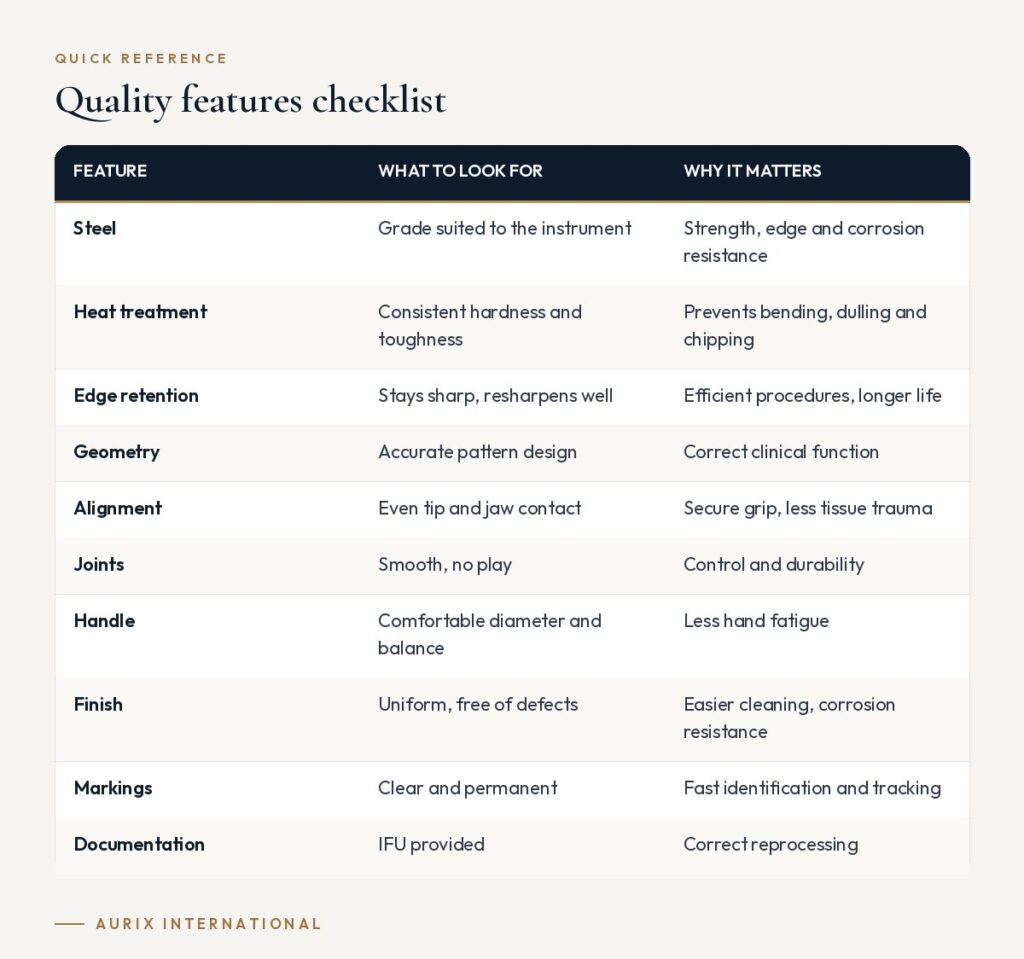
Quality features checklist
| Feature | What to look for | Why it matters |
|---|---|---|
| Steel | Grade suited to the instrument | Strength, edge and corrosion resistance |
| Heat treatment | Consistent hardness and toughness | Prevents bending, dulling and chipping |
| Edge retention | Stays sharp, resharpens well | Efficient procedures, longer life |
| Geometry | Accurate pattern design | Correct clinical function |
| Alignment | Even tip and jaw contact | Secure grip, less tissue trauma |
| Joints | Smooth, no play | Control and durability |
| Handle | Comfortable diameter and balance | Less hand fatigue |
| Finish | Uniform, free of defects | Easier cleaning, corrosion resistance |
| Markings | Clear and permanent | Fast identification and tracking |
| Documentation | IFU provided | Correct reprocessing |
How to choose quality instruments
- Inspect samples under magnification. Many defects in finish, alignment and blade edges are invisible at arm’s length.
- Put samples through your own reprocessing several times following the IFU, then re-inspect.
- Ask the supplier specific questions about grades, heat treatment and quality checks.
- Involve the users. Clinicians judge feel and performance; sterilization staff notice finish and joint issues.
- Learn the warning signs of poor instruments, outlined in our guide to counterfeit and low-quality instruments.
Frequently asked questions
Does a heavier instrument mean better quality?
No. Weight is a design choice. Many clinicians prefer lighter instruments for periodontal and diagnostic work to reduce fatigue, while some surgical instruments benefit from more mass. Balance and fit for purpose matter more than weight alone.
Is a mirror finish better than a satin finish?
Neither is automatically better. Satin finishes reduce glare under operatory lights, while mirror finishes are very smooth. What matters most is that the finish is uniform and free of defects.
How long should a quality dental instrument last?
It depends on the instrument type, how often it is used, and how it is cared for. Cutting instruments wear with sharpening, while well-maintained non-cutting instruments can remain in service for many years.
Quality you can feel in every instrument. Aurix International supplies surgical-grade stainless steel instruments individually, in pre-assembled kits and in custom sets. Explore our instruments →