
Rubber dam instruments and clamps are the foundation of good isolation in endodontics and in many restorative procedures. A dam keeps the field dry and visible, protects the patient’s airway from small instruments and materials, and improves infection control. Also, this list covers the 10 instruments and clamp types that make up a practical rubber dam kit, with tips on choosing and using each one.
Key takeaways
- A complete kit includes a punch, clamp forceps, frame, dam sheets, template and a range of clamps.
- Clamps are chosen by tooth type and situation: winged or wingless, molar, premolar, anterior or cervical.
- Always tie floss to the clamp bow as a safety ligature before placing it.
- Clamp jaws should grip at four points on the tooth below the height of contour.
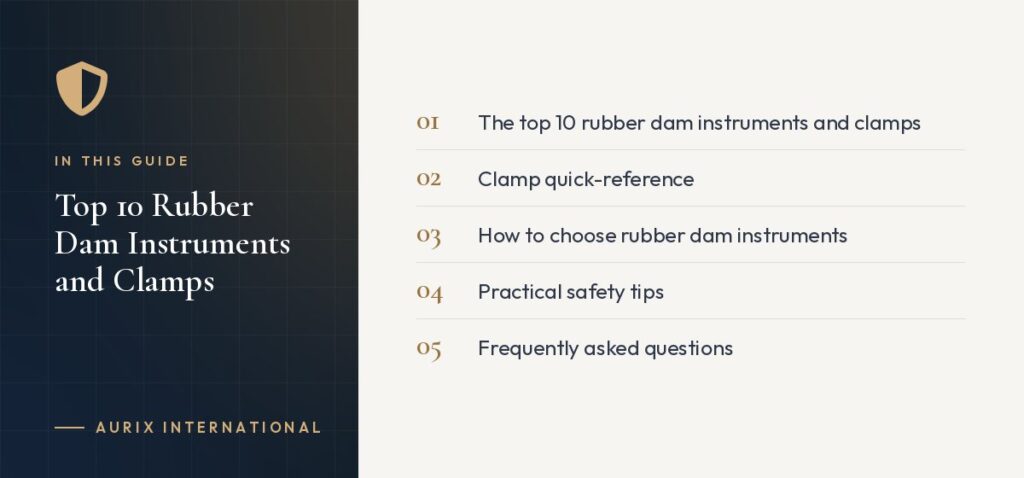
The top 10 rubber dam instruments and clamps
1. Rubber dam punch
The punch cuts clean holes in the dam sheet. Most punches have a rotating table with several hole sizes, from small holes for lower incisors to the largest hole for the clamped tooth, usually a molar.
Tip: A clean, sharp punch is essential. Ragged holes tear easily and leak. In addition, check the cutting point and table holes regularly.
2. Rubber dam clamp forceps
Clamp forceps engage the holes in the clamp jaws, spread the clamp and carry it to the tooth. Common patterns include Brewer-style and Ivory-style forceps; look for a secure engagement and a smooth spreading action.
Avoid over-spreading clamps, which can weaken the bow and cause them to lose grip or break.
3. Rubber dam frame
The frame holds the dam taut away from the face. The U-shaped Young’s frame is a classic metal design; radiolucent plastic frames are popular in endodontics because they do not obscure radiographs and can stay in place during imaging.
4. Rubber dam sheets
Dam sheets come in different thicknesses (often thin, medium, heavy and extra heavy), sizes and colors, and in latex and non-latex versions. Heavier dams retract tissue better and resist tearing; thinner dams are easier to pass through tight contacts.
Tip: Keep non-latex sheets in stock for patients with latex allergy, and record latex sensitivity in the patient’s chart.
5. Rubber dam template or stamp
A template or ink stamp marks the hole positions on the dam so that the punched holes match the arch form. Generally, this helps the dam lie flat and keeps the frame centered.
6. Winged molar clamps
Winged clamps have extensions (wings) that hold the dam sheet, so the clamp, dam and frame can be placed together in one step. Common molar patterns include the Ivory 8A and 14.
Winged clamps are efficient for routine endodontics, but the wings can make access slightly more crowded.
7. Wingless molar clamps
Wingless clamps, such as the W8A, are usually placed first and the dam is then stretched over them. They give good visibility and suit partially erupted or conical molars. Clamps with inclined jaws, such as the 14A, help on partially erupted molars.
8. Premolar clamps
Premolar clamps have smaller jaws shaped for the narrower crowns of premolars. Furthermore, the Ivory 2 and 2A are widely used patterns, in winged and wingless versions.
Tip: Try the clamp on the tooth before placing the dam. It should be stable and not rock when gently pushed.
9. Butterfly clamp for anterior teeth
Butterfly clamps, such as the Ivory 9, have two bows and target incisors, canines and some premolars. In practice, they retract the dam and gingiva for anterior restorations and endodontic access.
10. Cervical retainer clamp
Cervical retainers, such as the 212, retract the gingiva to expose Class V lesions on facial surfaces. They are often stabilized with compound or a light-cured material to prevent movement during treatment.
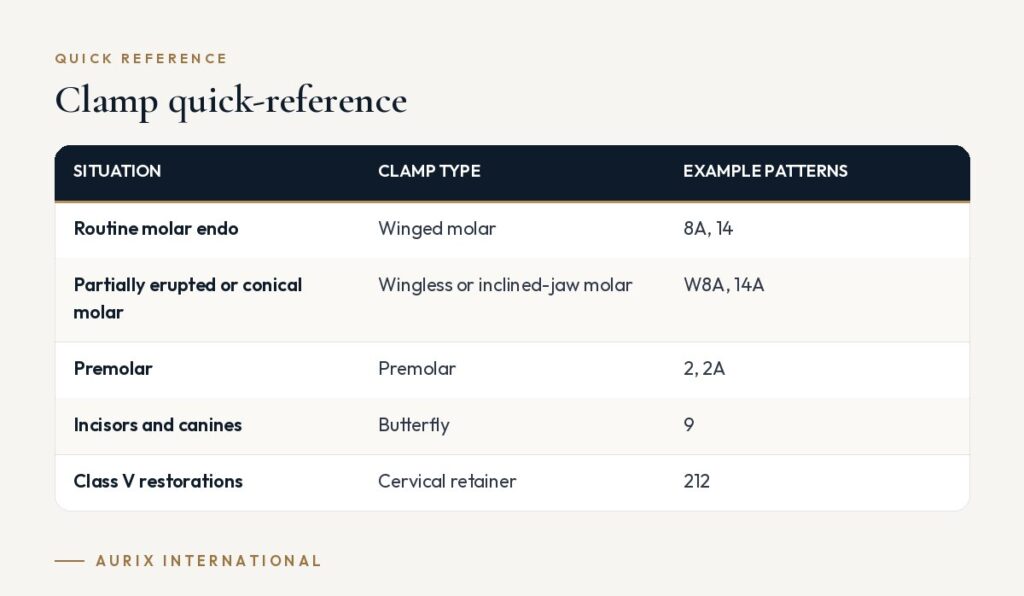
Clamp quick-reference
| Situation | Clamp type | Example patterns |
|---|---|---|
| Routine molar endo | Winged molar | 8A, 14 |
| Partially erupted or conical molar | Wingless or inclined-jaw molar | W8A, 14A |
| Premolar | Premolar | 2, 2A |
| Incisors and canines | Butterfly | 9 |
| Class V restorations | Cervical retainer | 212 |
Clamp numbering varies between manufacturers, so check the catalog descriptions before ordering. Our guide to choosing rubber dam clamps by tooth goes into more detail.
How to choose rubber dam instruments
- Start with a small core set of clamps. A few molar, premolar and anterior patterns cover most cases; add specialty clamps as needed.
- Check clamp steel and spring. Clamps should return to shape after spreading. Replace clamps that have lost tension or show cracks at the bow.
- Choose a radiolucent frame for endodontics. It allows radiographs without removing the frame.
- Keep the kit together. A dedicated cassette with punch, forceps, frame, template and clamps makes setup quick. Our overview of rubber dam kits shows what to include.
- Reprocess correctly. Clean and sterilize reusable instruments according to the manufacturer’s instructions for use (IFU) and CDC guidance. Dam sheets are single-use.
Practical safety tips
- Tie a length of floss to the clamp bow before trying it in, so a dislodged clamp can be retrieved.
- Use a blunt instrument, such as a plastic instrument, to invert the dam edge into the sulcus for a better seal.
- Floss through contacts to pass the dam, and use wedges or stabilizing cord when needed.
Rubber dam is essential for endodontics, so see the top 10 root canal instruments for the rest of the procedure. Aurix International supplies rubber dam instruments as part of its range, individually and in kits.
Frequently asked questions
What is the difference between winged and wingless clamps?
Winged clamps have extensions that hold the dam, allowing clamp, dam and frame to be placed together. Wingless clamps are placed first and the dam is stretched over them, often giving better visibility.
Which clamp is used most for molars?
Patterns such as the 8A and 14 commonly help with molars, with wingless versions such as the W8A and inclined-jaw clamps such as the 14A for partially erupted teeth. Numbering can vary by manufacturer.
Why tie floss to a rubber dam clamp?
The floss acts as a safety ligature, allowing a clamp to be retrieved quickly if it slips or breaks, which reduces the risk of it being swallowed or inhaled.
Can rubber dam clamps be sterilized?
Stainless steel clamps are reusable and can be sterilized according to the manufacturer’s IFU. Inspect them for cracks and loss of spring at each cycle.
Put a complete rubber dam kit in every operatory. Aurix can supply punches, forceps, frames and clamps individually or as a ready-to-use isolation kit. Build your rubber dam kit →